The
name Akira Kurosawa immediately invokes cinema. If the name is not familiar,
his work often is. Chances are everyone has at least heard of one of his film
titles, including: Seven Samurai, Yojimbo, Ikiru, The Bad Sleep Well,
Rashomon and High and Low, not only because these films are all
masterpieces, but many of them have been remade
into a variety of properties. Additionally, he was the first to use certain
filmmaking techniques and storytelling choices that have all become standard.
There is no modern or post-modern film without the work of Akira Kurosawa. For
that reason, Kurosawa, and his work, will be the next subject for this blog’s
sociological analysis and review. However, given that Kurosawa made 30 films
over his near 60-year career (which would take me two and a half years to
complete at my current pace) it would take too long to complete. Instead, over
the coming months I will be doing a deep dive into Kurosawa’s Jidaigeki
Chambara films.
Jidaigeki and Chambara films
Jidaigeki loosely translates into
English as “period piece”, what we might think of in western cinema as a
“costume drama”. The Japanese conceive of a period in their history far earlier
than the Victorian era often depicted in western “costume dramas”. In Japan, Jidaigekis
usually take place during the Edo period of Japan that spans 1603-1868, as well
as the Meiji period between 1868-1912. Chambara translated to mean “Sword
Fight” is a sub-genre of the Jidaigeki films that focuses on the Samurai class
and usually takes place in the Tokugawa period of 1600-1868; when the Samurai
class was fading due to western influences. A lot of Samurai films center on
the “Ronin” or masterless Samurai, who have been jobless and homeless since
their retainer and lord (called a Daimyo) lost his land and status due to the
socio-political changes in Japan. These “Roaming Ronins”, who still retained
the status of Samurai, would farm out their martial skills to survive.
Chambara
films gained prominence in a post-World War II era. Allowing Japanese directors
to reinforce the “spirit” of the Samurai into the culture, and as if modeling after
reality, would often feature psychologically and physically scarred warriors
(usually from previous battles or wars) as
their protagonists. Many of the post war Chambara films were darker in tone and
significantly more violent. Given this particular effect/purpose, most of the
Chambara films produced were between 1950-1980. While there are some outliers, few
Chambara films are made today. Instead, “The
Samurai Spirit” is imbued in modern genre pictures
(Sci-fi, Fantasy, Crime Noir) and motivates the actors that have a lineage in
the Samurai class.
BRIEF HISTORICAL CONTEXT
Kurosawa got his
directing career off the ground with a job as an assistant director for PCL (Photo
Chemical Laboratories) a company that would later become Toho Pictures in 1936.
To get the job, he had submitted an essay in which applicants were asked to
identify the fundamental deficiencies in Japanese film. To which Kurosawa
answered that the flaws were fundamental, and that there was no way to fix
them. This intrigued examiner and director Kajiro Yamamoto who became a mentor
to the young Kurosawa. Yamamoto pushed Kurosawa to write for the screen. It was
his belief that a good director was also a screenwriter; something that
Kurosawa would do for the rest of his life.
Kurosawa’s directing
career and trajectory was greatly hindered by Japan’s involvement in World War
II. The censorship board rejected his first major studio film, Sanshiro
Sugata. They considered the work to be too “western” (A criticism that
would be consistent throughout Kurosawa’s career). The film was permanently
stalled until famed director Yasujiro Ozu, threw his artistic reputation and clout
behind the film.The meteoric success of
Sugata, and the structure of the studio system contract, forced Kurosawa
to make an unintended sequel which is regarded as the worst film in his
career.While several of his films
became successful during this period, Kurosawa did not “become Kurosawa” until
well into the post war period of Japan, when he first began his collaboration
with the Cinematic force of nature Tashiro Mifune and the steady and consistent
power of Takashi Shimura.
The collaboration between
Takashi Shimura, Akira Kurosawa and Tashiro Mifune is a cinematic Triumvirate
that is unparalleled. All three working together a total of 13 times over their
respective careers (and additionally with Kurosawa separately), Kurosawa’s work
and Chambara films in general, would not be what they are, without the work of these
two men. Shimura and Mifune star (or are featured) in 7 out of the 8 Kurosawa
Samurai films I will be covering in this series. One
essay, in discussing the two actor’s collaboration,
compared Shimura and Mifune, to DeNiro and Pacino in their approach, screen
presence and captivation. Additionally, both lent their talents to other films
in the genre. The image of Tashiro Mifune in Samurai garb, became the basis for how
a traditional Samurai should look in the medium.[1]There
is no modern Chambara films without these three men. Their commitment to the
craft of the genre can never be understated.
One of the many reasons
Akira Kurosawa became such a famed director, was for his western influences. It
was his thinking that Japanese cinema at the time was fundamentally flawed that
got him his first job. But over the course of his career, Kurosawa began to show
these western foundations. Directors like Fritz Lang and John Ford, to Writers
like Shakespeare and Dostoevsky, all became apparent influences in Kurosawa’s
work. Yet, because Kurosawa was coming into film when Japanese cinema was
waning, His style became the
foundation of a lot of Japanese Cinema moving forward.[2]
Kurosawa not only
revolutionized Japanese Cinema, but his name became synonymous with Japanese
Cinema in the west. Starting with Rashomon, most of his films had a wide
release and therefore a wide influence, especially in the United states during
the 1970’s.The directors coming out of
US film schools in the late 1960’s- 1970’s, “borrowed” heavily from Kurosawa,
Scorsese, Milius, Spielberg, Coppola and especially George Lucas, cite Kurosawa
as a major influence on their work[3]. This influence was so
strong that these directors worked together to not only get Kurosawa a lifetime
achievement Oscar, but they also helped to both produce and distribute some of
his later films including: Kagemusha, Dreams and Ran.
SEEDS OF SOCIAL ANALYSIS
Because Kurosawa’s Chambara films are
usually taking place at the tail end of the Edo Period, he is consistently
dealing with issues of class dynamics; often juxtaposing the status of the
Samurai class, with many of his characters being both penniless and homeless.
He may localize this by telling the story through the two lowest status
characters, as he does in The Hidden Fortress, or challenge the status
stereotypes between peasants and samurai in Seven Samurai, or the retention
of honor in the face of poverty in the Sanjiro duology. Kurosawa has a lot to say when it comes to
poverty, social class and how those things play out in a feudal society but
reflect the social issues of the time.
A lot of the other
thematic elements Kurosawa plays with are those found in western literature.
Specifically for this series, Kurosawa’s Shakespearian Chambara adaptations are
important. Thus, the thematic elements in Shakespeare’s Macbeth, and King Lear,
are shown through a Japanese cultural prism with Kurosawa’s Throne of Blood
and Ran respectively.
Unlike Miyazaki,
the focus of the previous series, Kurosawa does not have a strong track
record when it comes to inclusive cinema. Many of his roles for women are under
written and stereotypically one dimensional. He does not discuss social issues
involving race, gender, or disability. As I will discuss, part of this is the
historical context in which he was living and the socio-political environment
in which he was working, and part of it was his own enculturated ideas about
gender.
CONCLUSION
Kurosawa
is a master filmmaker and one of the 5 greatest directors in history, that
without him, cinema would not be the same. His process, themes and
understanding of the power and importance of cinema, have allowed film to
continue after his death. All of Kurosawa’s work is spectacular, and everyone
should watch all 30 of his films at some point. But I am of the opinion that,
excluding Ikiru, which is devastatingly powerful on its own, his Samurai
films are my favorite, and the films that are most digestible to a western
audience, as
many of them mirror the actual genre of the Western itself.
Personally, I have always
been fascinated with Japanese culture, especially the Samurai class. Kurosawa’s
Chambara films are a big part of why and how that interest became so important
to my identity.To be able to break
Kurosawa’s work down including my favorite film of all time sociologically,
using sociological theories and ideas, is the quintessential reason I continue
to write these reviews. It is my hope, that through this series, I will add a
sociological dimension to the criticism of Kurosawa, and I get some readers
interested in going back and (Re) discovering the greatness that is, Akira
Kurosawa.
[1] I
still think it looks weird to see Mifune in modern garb. When I watch him in
The Bad Sleep well or even Stray Dog I am like, “This is odd.”
[2] Jump
cuts, tracking shots, the dissolve, the wipe, wide shots with long lenses, The
shooting of action, slow motion to depict speed, gathering of the team montage,
cutting on motion, The lone wolf protagonist
[3]Star
Wars: a New Hope is basically Hidden Fortress
The
eleventh film in my continuing analysis of The Films of Hayao Miyazaki is the
World War II animated Biopic The Wind Rises. Critically understood as
Miyazaki’s Magnum Opus, Miyazaki’s latest film to date, was laborious in its
production, stirred up controversy, and is the most metatextual of any of
Miyazaki’s previous work. Central to this introspection is the thematic question
of struggle between creativity and practicality, and where the value of process
and product lie; in its expression, or its ability to be used?More somber and bleak than any of his other
work, The Wind Rises in its production, context and themes is the most
emotionally resonating film Miyazaki, and Ghibli in general, have ever
produced.
PLOT
After
a shared dream with legendary Italian plane designer Giovanni Caproni when he
was a boy, Jiro Horikoshi, vows to become an aeronautic engineer, striving to “make
something beautiful.” Reaching adulthood during World War II, Jiro becomes one
of Japan’s greatest engineers; eventually developing the famous Zero model
aircraft. Through his “ten years in the Sun”, Jiro struggles with the practical
applications of his creative outlet in a time of war: only finding solace in
the environmentally kismet relationship that develops between himself and Nahoko,
a Young painter with Tuberculosis.After
a number of tragic losses, Jiro, reflecting on his life, questions whether any
of it: successes, happiness, failures, and a complicated legacy, was ever worth
it.
HISTORICAL CONTEXT
The
historical context needed to understand The Wind Rises is twofold. Because
this is a biographical picture (loose though it is) there needs to be an
understanding of the context of production (in 2013) juxtaposed with the context
of that which it is depicting (1927-1944). Understanding the film on these
levels, clarifies the unjust criticism of those that think this film is Pro-war;
and elucidates on the complicated history Miyazaki has with World War II in
general.
Production
The beginning of
production on The Wind Rises marks the 6th “unretirement” of
Hayao Miyazaki.Originally deciding to
come back to create a sequel toPonyo,
Miyazaki
was encouraged by Producer Suzuki to adapt his Manga about Jiro Horikoshi, as a
way to challenge children with ideas and concepts they have yet to understand,
or be familiar with.
Miyazaki’s Manga was a “self-confessed” hobby
as an aerophile. He was uncertain as to the films feature length potential as
most of the Manga was focused on the historical development of Japanese
aerospace in the early 20th century. However, once Miyazaki decided
to use the book The Wind has Risen by Tatsuo Hori to help fill in the
interpersonal relationships of his depiction of Jiro, (this is where the
character Nahoko and her suffering from Tuberculosis are added), Miyazaki felt
that he had a story worthy of a feature.
The production began in
2010, and much of it is captured in the fantastic documentary The
Kingdom of Dreams and Madness by Mami Sunada.The film is an inside look at the daily
activities/practices of Miyazaki, and his staff while working on the production
of The Wind Rises and Takahata’s The Tale of the Princess Kaguya.The emotional crux of the film, that influences
the animation Miyazaki uses in depicting Japan during World War II, comes in
the form of a letter a stranger writes to Miyazaki, recounting meeting Miyazaki’s
father during the evacuation of civilians after the US Nuclear bombing of Japan.
The stranger had been evacuated to Miyazaki’s house when Miyazaki’s family were
evacuated elsewhere. There, the stranger met Miyazaki’s father and was given
candy by the patriarch; along with some kind words.This letter resonates with Hayao Miyazaki so
much that he can barely respond, as it recontextualizes his own relationship
with his father and his ongoing relationship with his son.It is this amount of significance that
Miyazaki channels when he both talks about the importance of planes,[1] and the value of Jiro and
Nahoko’s relationship.
The Kingdom of Dreams and
Madness and its companion documentary completed in 2016, Hayao Miyazaki: The Never
Ending Man,chronicles Miyazaki’s journey in completing The
Wind Rises and beyond. Most of what captures the audience is the process of
such a genius like Miyazaki. Because he is such a perfectionist, making a film
can be at times exhilarating or agonizing. There is an image, an idea that
Miyazaki has in his own head, and by his own admission, has never seen these
images fully realized. After the Production of ‘Wind’ he even turned to
CGI to see if it had the ability to bring his ideas to full realization…they
did not. While it did not lead to an embrace of CGI, it did revitalize Miyazaki
enough to decide to come out of retirement, again, to give us the film that is
now in production: How
do you Live?
Documentaries’ Aside
For the good of humanity there needs
to be a documentary film crew, commissioned by the Japanese Government, to
follow Miyazaki around to record the pearls of wisdom that he randomly gives
out, and as an example about how one should comport their life.[2] Miyazaki lives in a modest
home, with the ability to walk to work every day. He has a ritualized routine
and begins his workday at 11am and works till 9pm. He has scheduled breaks for
walks and meals and only takes one day off a week; Sundays, when he cleans up
the local river. Through these documentaries we learn that Miyazaki lives the
themes that he spouts in all of his work. He keeps up on current events; scrap
booking the changes to his city during the Financial crisis of 2008 and the
Fukoshima Nuclear plant disaster. Yet, he remains introspective, pondering if
what he does as a filmmaker is worthwhile and can make a difference in the face
of such social issues. Still, he persists in his determination to transform
whatever is in his head, into a clear and unobstructed reality.
It is
amazing that Miyazaki has not had to sacrifice his control and creativity for
his level of success. His rejection of the typical corporate structure and
cultural mindset should be the model by which others should be judged. Early on,
when Ghibli as a studio was just getting started, he sat down with his
animators and basically stated that we are a studio that strives to break even;
to not necessarily make a profit. Miyazaki made it clear that the typical
Japanese “Salary Man” corporate ladder structure, would not be in place at
Ghibli. He ended the conversation by saying that “If you are seeking lifetime
salaried employment this is not the place for you. Corporations are nothing but
conduits for money.” Instead, the ‘Miyazakian’ Approach can be clearly summed
up in a sign that Miyazaki has around the Studio. It reads:
Quit if:
1.You
have No ideas
2.You
always Rely on Others
3.Shirk
Responsibility
4.Lack
Enthusiasm
This is what it means to be Miyazaki
Release and Controversies’
Upon the film’s release in
the United States on February 21st 2004, there were several
reviews that saw the film as “pro-war”.
These reviews display an unnuanced and limited understanding of the film. To
the authors of these reviews, the simple focus of the film on the life of Jiro Horikoshi,
the designer and creator of a plane that was used in the war, is in their
minds, tantamount to being supportive of the Japanese Government’s decisions to
use those planes for war. In a very oblique way, they may have a point. If the
plane didn’t exist, it could obviously not be used. But that does not mean that
it would have prevented the war, or the atrocities that were committed during
it. Secondly, this idea is directly addressed in the film in the dream
conversations that Jiro has with Caproni. The choice Jiro, and by extension, Miyazaki,
make is to not stifle creativity, art, and technological progress out of fear
of problematic practical applications (more on this in Social Analysis).Finally, this criticism of the film negates
the letter that Miyazaki and a number of animators wrote and signed to then PM
Shinzo Abe; who at the time was attempting to repatriate Japan through a change
to article 9 of the Japanese Constitution that vies for international peace. A
change to this article of the constitution, would allow them to grant more
powers to Japan’s Defense Forces[3] to protect themselves and
provide aid to allies.[4] Yet, regardless of this
letter (which branded Miyazaki a traitor by the Liberal Democratic Party of
Japan) Miyazaki admits to having a complicated relationship with Japan during
World War II; cherishing the advancements and creative technologies that came out
of that period, while as a pacifist, abhorring what those things were used for.[5]
The Wind Rises was
nominated for several awards including: Writingat the Animation awards, and a nomination for "Best Animated
Feature" at the Academy Awards.[6] Joe Hisashi, the
film’s composer, was also honored with the Japan Academy Prize in
the category of Best Music Score. The criminally low amount of awards this
film received is due to the combination of US awards being a group masturbatory
process, within a culture of only recognizing international talent (outside the
US) once, as a legacy gift.
SOCIAL ANAYLSIS
The
Wind Rises is unique in its social analysis in that the majority of
Miyazaki films, being predominantly populated with magic and fantasy creatures,
is mostly metaphorical. With the fantastical elements regulated to dream
sequences, this is the Miyazaki film that is grounded in reality. Therefore,
the symbolism of what the characters mean in this Miyazaki film, intersects
with a real-life social analysis of Japan during World War II.Thus, we could easily talk about issues of
imperialism, economic collapse, Government control and oppression and the way
Bureaucracies can perpetuate all of it. These corruptible interlocking systems,
lead to atrocities for both wartime coalitions (Axis and Allies) beyond the
“usual violence of war”; such as the sexual slavery in Japan during world war
II (labeled ‘comfort
women ‘) as well as the US Japanese
internment.
However, since I am not a
Military analyst or a war historian, and in part that these ideas have already
been mulled over and written about incessantly, I have decided instead, to
focus on the central question that Miyazaki poses in this film: What is the
relationship between the creation of something, and how that thing is used.These are ideas that many scholars of popular
culture wrestle with. Usually, it is asking the question: “Should
we be able to separate the actions and behaviors of the Artist, from the art
that they produce.”. From Michael Jackson, the productions of
Harvey Weinstein, Woody Allen, Charlie Rose, Don Imus, Louis C.K. and Joss
Whedon,[7]
many of the creators of pop culture that we cherish have turned out to be trash
human beings. So, what is our next course of action? Do we boycott? This may be
easier if you do not have an emotional attachment to the product (especially
through Nostalgia). Yet, we rarely ask the question in reverse, as Miyazaki
does; what happens when the product is used and embraced in socio political
ways that its creator did not intend[8].
Miyazaki directly
addresses the above question in Jiro’s dream conversations with Caproni.As they wax poetic about the existence of the
pyramids, lack of transference in their work and letting
their creation speak for itself. In the end however, even
though Miyazaki has Caproni clearly state that planes should not be used for
war or to make money, he settles on planes being beautiful, cursed dreams;
that even though they were a major industrial feat of engineering, they
inevitably, given the systems that we live within, will be pragmatically folded
into society. At the time, this meant that anything that was worth putting
money into, would be those things that would help the war effort. Thus, Jiro’s
plane became a machine of death. Jiro illudes to this as a failure at the end
of the film, saying: “It all fell apart in the end, none of them came home.”
Caproni ominously responds: “They had nothing to come home to.” Given Japan’s
utter defeat and occupation after the war. One of the final shots of the film
is of Jiro walking among the wreckage of his creation, obliterated by their use
in war.
The imagery described
above, clearly places Miyazaki’s pacifist belief in the context of the futility
of war; that it warps and mutates something beautiful and brilliant into a
diseased shadow self of the original.While, as I stated earlier, even this obvious declaration was lost on a
few reviewers at the time, Miyazaki addressed and was clear about his messaging
and intentions. Whereas
other creators of pop culture with heavy
socio-political subject matter, deflect having a definitive answer.
The problem with creators
fueling the ambiguity of their work, especially when it is being used for a
socio-political purpose (intentionally or not), is that it comes off as a
shield against criticism.By maintaining
the ambiguity of the messaging, it allows the content to have broader appeal,
and therefore be more profitable. Thereby, any clarity provided by the creators
may hurt the content’s appeal, interest and ultimately its bottom line. Additionally,
the more precise a creator is in their messaging, the more they are going to
have to defend their position and be questioned about the political nature of
their work[9].
It should be mentioned
that the reaction to Pop Culture is often politicized. Because Pop Culture is
soft power, the consumption of pop culture can inform our understanding of the
world. However, “The door swings both ways.”[10] and we also interpret
popular culture based upon our political social beliefs. This is confirmation
bias within content. We see messaging that reaffirms our own ideas, desires,
and beliefs. Because of this, if someone is being too vague or loose with their
messaging (see the above link) they may be criticized as being too glib or
flippant with the subject matter; because those who understand the soft power
of pop culture, and more acutely, understand the complexities of the subject a
piece of pop culture may be touching upon (however heavy) is careless, without
context. Again, this is an attempted deflection through an appeal to pop
culture as being mindless entertainment, or “turn your brain off fun.”; ignoring
that these pedagogies of pop culture consumption are shallow, and not universal
across populations.
Rather than run from the
political and potentially polarizing embrace of meaning and messaging for the
purpose of profit or protection; more creators need to stand behind their work
and their message like Miyazaki. Once we have a general acceptance of this
practice there is a clarity that comes with it. Creators will feel more
inclined to speak out against the unexpected, or undesired use, or inaccurate
interpretation of their work; while clearly presenting the material to the
public for what it is. That way, people can make an informed decision about
which pieces of pop culture they want to consume.This isn’t the most capitalist friendly
solution; and perhaps it shouldn’t be, given that capitalism is a part of the
problem.
CONCLUSION
During the time of
release of The Wind Rises, Disney still held the distribution rights for
all of the Ghibli catalog. Therefore, they were the ones to first release the blu-ray
in 2014. On this single disc there were poultry special features, scanned 2 k
resolution and mono audio tracks. It seemed that the “bells and whistles” that
Disney brought out in their Distribution and push for Spirited
Away, were nowhere to be seen for this release.[11] Whereas, the 2020 release
of The Wind Rises by Gkids (a Japanese animation studio, comprised of Ghibli
Alum) has a greater number of special features (including an episode of the
documentary Hayao Miyazaki: Ten Years with the Master), more
storyboards, Behind the scenes content, crisper image transfer and cleaner
audio track than the Disney release.
Miyazaki
is an animation genius, and The Wind Rises is his greatest and most
personal work.In the majority of
Miyazaki’s films, he has reinforced social thematic elements that are important
to him: environmentalism, humanism, equality and pacifism. Yet, it is only in
his latest work to date,[12] has Miyazaki tackled the
question that plagues all creators: Does their work have value, and was it
worth it to create? Given that I have spent time and energy over the course of two
and ½ years to explain the greatness and sociological relevance of Miyazaki and
his work; I as a scholar and fan, believe his work to be worth it. So should you.
It is a better alternative to anything
Disney has ever produced.
[2]
This was not my own idea. This was first brought to my attention during the
filmography retrospective of Miyazaki’s work on the Blank Check podcast episode
on these documentaries by host David Sims, critic for the Atlantic
[3] A
similar article (Article 96) was passed in 2014 to Amend the constitution
[4] As
of this writing, ballistic missiles and nuclear weapons are prohibited
[8]
Red Pill Movement, Journey’s song used at Trump rallies, The origin of “Proud
Boys”, Roadhouse as a police teaching tool, Princess Leia’s image, Various
court cases where pop culture is used during argumentation
[9] To
be fair, this is a damned if you do, damned if you don’t, situation. If you are
vague in its messaging, creator’s will be tried to be pinned down. Once they
are pinned down, they will be criticized for their position
[11]
Disney may also have been annoyed that Miyazaki snubbed the Oscars for Spirited
away as an act of protest the Iraq war; when they have produced a lot of
content that was in support of the war.
[12]
How do you Live? is scheduled for release in 2023
The
tenth film in my continuing analysis of The Films of Hayao Miyazaki is the
sweet and enchanting aquatic fantasy Ponyo.An adaptation of the classic tale “The
Little Mermaid” by Hans Christian Anderson, and a critique of the 1989 Disney
film of the same name, Ponyo is a tasting menu for everything Miyazaki
is known for. All the elements of a Miyazaki film are represented in Ponyo:
from a precocious young female heroine, hand drawn cell animation, sequences of
high drama, brilliant Joe Hisaishi score, and a splash of wonder that makes a
film quintessentially “Miyazakian. Yet, this is also a film that, in the face
of mounting criticism during production, re-establishes the overall technical
mastery of Miyazaki himself.
PLOT
Brunhilda,
plucky eldest daughter of the sea King Fujimoto, travels to the surface and
accidently gets caught in a jar while escaping a commercial fishing net.
Released from her glass prison by a young 5-year-old named Sosuke, who renames
her “Ponyo”, the two unlikely strangers develop an inseparable bond. After
“Ponyo” is taken back to the sea by her father, Ponyo realizes she is in love, and
decides to become human to reunite with Sosuke. Her determination to that end,
may spell doom for her and everyone on earth, if Sosuke does not reciprocate
her affection.
HISTORICAL CONTEXT
After the financially successful, but
critically tepid response to his previous film Howl’s Moving Castle,
speculation began to rise, as to if Miyazaki’s best work was behind him.
Miyazaki, unsure what to do next began to contemplate retirement.Around the same time, Hayao Miyazaki’s son,
Goro, had just released his film, The Tales of EarthSea to wide acclaim.
Suddenly, there was buzz around the question if the son had surpassed the
father.These rumors, speculations and
questions pulled Miyazaki back to his literal drawing board. Taking the
comments to heart, Miyazaki set out to create a story that would dazzle
audiences using techniques that had not been seen in years, and a consolidation
of mythologies and folklore from many different countries.
Production
Once
it was decided that Miyazaki would write and direct his tenth feature, Producer
Toshiro Suzuki suggested that Miyazaki develop another story for children.Looking for inspiration, a neighbor allowed
him to borrow Han Christian Andersen’s “ The Little Mermaid”. Miyazaki was horrified
that the titular mermaid in the original tale was soulless, and at the end, was
transformed into sea foam. This discomfort was exacerbated when Miyazaki finally
watched the Disney version of Andersen’s story; after which he decided to make Ponyo.[1]
Even
during the pre-production process, many could tell that Miyazaki was setting
everything up to flex his animation muscles; to show the industry the beauty
and majesty that hand drawn animation, when done with care and attention, could
not be surpassed.Therefore, Miyazaki
decided to go back to drawing on traditional animated cells. In the opening
sequence of the film, featuring the school of fish, over 1613 storyboard
sketches were created, and a total of 170,000 hand drawn images make up the
completed film. He wanted Ponyo to have solid simple lines that could convey motion
like no other medium. To ensure this, Miyazaki decided that he alone would draw
all the waves in the film, a laborious process. Additionally, to draw the movement of the city
and the ships moving in and out of port, animation at the time would move a
single frame of the boat across the screen. Instead, Miyazaki decided to draw each
of these ships frame by frame, another arduous procedure.
Along
with resurrecting fruitful, but grueling animation techniques, Miyazaki was
inspired by geography, art, and music creating the world of Ponyo. The setting of the cliff side sea town was
inspired by Tomonoura, a seaside port city in Fukashima in the Hiroshima
Prefecture. Miyazaki stayed in the city in 2005 and drew production stills and
reference points for Lisa and Sosuke’s town. Miyazaki was also inspired by a
painting of Shakespeare’s Ophelia (for the depiction of Ponyo’s mother) and
Wagner’s Opera Die Walkure, from which Miyazaki took Ponyo’s original
name, and had composer Joe Hisaishi write a musical homage for the film.
The animation techniques, references and music
all culminate in one of the most amazing and breath-taking animation sequences
ever put to film. When Ponyo escapes from her father, with the help of her baby
sisters, she uses some of her father’s elixirs to transform both her sisters
and the waves, into a school of fish shaped Tsunami. Once they breach the
surface, Ponyo runs and skips across the giant waves as she chases down Lisa
and Sosuke in their car.It is in this
sequence, that the care and detail of the hand drawn animation, along with the framing,
adds to the crispness of the image, and the fluidity of the overall scene (no
pun intended).
At the time of
production, Disney still had exclusive distribution rights to all Ghibli films in
the US. Together with the Kennedy/Marshall Company[2], they brought Ponyo to
a record breaking 925 screens in its first initial release in the US in August
of 2009. Grossing 209 million dollars worldwide, it became the fifth highest
grossing film of all time, behind Miyazaki’s other work such as Spirited
Away, and Princess Mononoke. The film was also adored by critics,
putting to rest the critical rumblings of his Progenical usurpation.
Like the rest of his most
recent work up to this point, the Miyazaki mythology is an amalgamation of
different ideas from Japanese mythology with a flair that is all his own. Ponyo
is first referred to by Sosuke as being a “goldfish”. This is both a reference to a type of Japanese
goldfish, and the mythical “Ningyo”, a Japanese Mermaid often depicted as a creature
with a fish body but a human face. Additionally, Ponyo’s mother, Granmamare,
the goddess of the sea, is a reference in likeness and size to Kana, the Patron
saint of sailors. This makes sense because it is the sailors out at sea, that
first encounter Granmamare after Ponyo creates the Tsunami to go after Sosuke.
What seems to set Ponyo apart from the
other films is its source material; because the film is based on the Hans
Christian Andersen’s characters, and other western mythological influences.
Firstly, Ponyo references their counterparts in the original story; specifically,
the characters of Brunhilda and her father Photon. Like Photon, Fujimoto “disguises”[4] himself as a gardener to
retrieve his daughter, and has an open distain for the human race. Whereas Brunhilda
is just as rebellious as Ponyo, but where Ponyo has the ability to choose to
become human, Brunhilda is cursed with humanity.The film also creates a rendition of the
flood myth, and while there is a version of the flood myth in every culture,
the depiction of Sosuke and Ponyo trolling the flood waters of the town is
reminiscent of the Christian flood myth representing Noah and Naamah.
Environmentalism being
important to Miyazaki, he has always anthropomorphized aspects of the earth. Ponyo
thus rests in the pantheon of Miyazaki’s Mythology as the sea folk. This
expands on the world that Miyazaki began with Totoro being guardian goblins of
the forest, and joining the bestiary along with the tree nymphs, boar and wolf
gods in Princess Mononoke, and the Ghostly getaway in Spirited Away.
Ponyo is
not only an expanse of the Ghibli cannon, in regard to the Miyazaki film
timeline, this is the moment that a huge portion of humanity is wiped out, thus
beginning the war referenced in Nausicaa. The moment in Ponyo that
gives credence to this idea, is the dialogue spoken by the elderly women in the
Nursing home after it is completely consumed by water. Looking at the sea life
around them, one woman asks, “Is this the other side?” Without a clear answer,
all of the women are rejuvenated, able to walk out of the flooded building
under their own power, without the need of assistance. This implies that this
is a “Jacob’s Ladder situation”[5] where the people in the
nursing home died in the flood, and everything after that was a dream or a
version of purgatory/the afterlife.This
would keep with Miyazaki’s consistent message throughout all his films that
humanity is the problem, and the ultimate enemy to the eutopia the earth could
create.
SOCIAL ANALYSIS
The film Ponyo is an
interesting converging point for Disney and Studio Ghibli.Since Princess Mononoke, Disney has
taken over US distribution of all Studio Ghibli films, especially those by
Miyazaki. Yet, Ponyo intercedes in “the Princess Culture” more than any
other Miyazaki film[6];
adapting the source material for one of Disney’s most beloved Princess tales,
during the famed “Disney Renaissance”
period (between 1989-1999).Yet, it is Miyazaki’s greater focus on agency, representation,
and authenticity while presenting a similar story, that exposes the sexist, pro
capitalist machine of Disney with utter clarity.
The Monoculture of The
Mouse
It
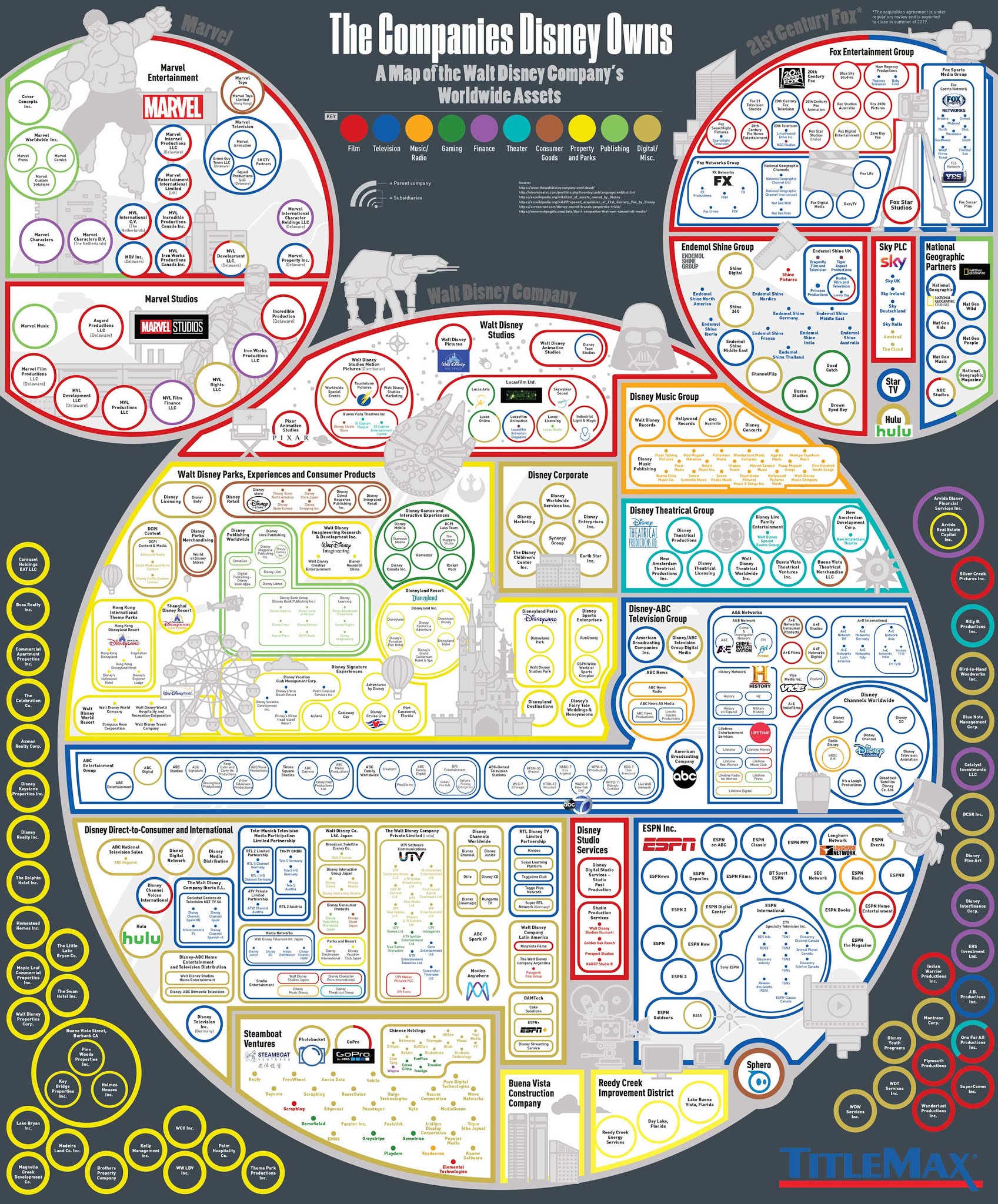
might be difficult to imagine, given that Disney today fluctuates between the first
and third media conglomerate in the world, but in the early 1980’s the company
was going bankrupt (Giroux and Pollack 2010). This staggering fact is only
seconded by what it reveals: that Disney went from near bankruptcy to a major
producer and owner of media content in only 36 years. As of this writing, Disney
holds around 30% of all media, alongside 3 other companies (At&T, Viacom, and
Comcast).This huge turnaround into bureaucratic
capitalism, exploitation, and the profit motive above all else was the work of
two men. Michael Eisner, and later, Bob Iger. Under the supervision of Eisner
and (later) Iger, Disney became more than just a household name, they became the
producers of culture. A culture that normalized irrational bureaucratic
policies that dehumanized and exploited both workers and consumers.
When
Eisner came on as President of the Walt Disney Corporation in 1984, he was the
first to recognize that “pop culture was soft power” and that Disney should
center itself as a major producer of US culture; thereby educating and
entertaining children to become lifelong customers of the Disney brand (Giroux
and Pollock 2010).This is what is known
as Brand Loyalty, a marketing term identifying the desired psychological
state producers want in their consumers; a commitment to buy their products.
This commitment is created by the status that is attached to the brand, the
social belief in its superiority regardless of its contents, and for nothing
more than the name recognition of the brand itself.
Under
the yoke of Eisner and (later) Iger, Disney became “ the new face of corporate
power” shaping the companies identity as the “ paragon of virtue and childlike
innocence” with the social and
historical context of each age, through cutthroat corporate policies and
perspectives (Giroux and Pollock 2010: 27).Since the 1990’s, Disney has been acquiring companies and folding in
their content into their ever growing stable of intellectual property, media
distribution and Property.Currently,
Disney is worth 130 Billion dollars encompassing
Parks, content, and companies leading to one of the biggest
Monopolies in the US. This happened, in part due to a political and economic
shift in the 1980’s and the apathy of a consumer culture.
The
election of Ronald Regan in 1980 began the intense deregulation of corporate
control. The process of Market Globalism,
by Regan and Thatcher allowed corporations (including Disney) to use other
countries as their own personal labor farms.This specifically led to the exploitation of the labor force in the
development of sweatshops; factories with unsafe, unhealthy working conditions
where the workers are worked to death for slave wages.This is a common practice in several
industries; many which Disney are involved in. Additionally, through their
corporate pedagogy of complete control, Disney shapes the understanding of the
countries and cultures their workforce represents, for the patrons of their
parks (which are normalized to be white)[7].
Through
its theme parks, produced content, and products, Disney participates in a
revisionist history. It continually presents racist aspects of the past as
folksy and charming, while mining the history, values, and norms of a variety
of non-white cultures, as well as whitewash and sanitize them, for the
consumption of white middle class America.Whether this is openly having racist caricatures in its films ( Song
of the South, Lady and the Tramp, Dumbo, Aladdin etc.), lack of
representation (many characters of color being played by white actors) and acquisition
misfires (trying to trademark Dia
de los Muertos); to non-diverse themed areas in parks (Main
Street USA, Adventureland, Frontierland and Tomorrowland) which “implicitly
proclaims the triumph of white culture”, and sanitizes the experiences and
history of people of color from their presentation, organization or operation (Giroux
and Pollock:41). This is the successful recreation of the myth of the 1950’s (and
its false imagining of the future), an oversimplification and commercialization
of the past that couches everything in an American ideological spirit, that only
reflects the experiences of middle-class white folk, Disney’s target audience.
According
to Giroux and Pollack (2010), through these actions, Disney has contributed to
the collapse of history in the public discourse, and replaced it with entertainment
and commercialism to the point where we cannot tell the difference anymore.
This is a part of the transformation of reality to “Hyper Reality” (Baudrillard
1994).We generally think of Disney,
regardless of what it is, and where it is located, to be its own continuous
entity.One can recognize that they are
always in the presence of something that is Disney. There are particular
sights, sounds, and even smells that become quintessentially associated with
Disney; regardless of what these things were before being incorporated into the
Disney brand (words like “magic”, “Mickey” and “wonderland” ).According to Baudrillard (1994), these are
representations of the simulacra and simulacrum. Nothing Disney has, or what is
represented in its theme parks, is real. From the interactions “guests” have
with “cast members”, to the street they walk on, the buildings they patron, or even
the air they breathe, is fake; all while not recognizing that they are still in
the state of either Florida or California…they are at Disney. Yet, the relationships
customers forge with their family and the experiences they have are real.
Therefore, the image of reality that Disney presents, is one that is more
desired and embraced by the public rather than the seedier reality of a global
corporate monolithic monstrosity. “Disneyland is more than fantasy because it
now provides the images and narratives based on which America constructs itself
(Giroux and Pollock 2010). That is, unless
you’ve worked for Disney.
Historically,
Disney not only underpays and creates unsafe working conditions abroad, but
continues these practices domestically in its stores and specifically its theme
parks.Giroux and Pollock (2010) note
that Disney disseminates an authoritarian ire to many of its employees,
requiring standards of quality and behavioral control that encroach on personal
freedoms, and borders on human rights abuses. “Every behavior and action, from
how one dresses to how one responds to questions raised by guests, is scripted
by someone of higher authority” (Giroux and Pollock 2010:49). Additionally,
there have been several reports of Disney employees having to be on government
assistance due to the Disney practices
of union
busting and lobbying to maintain a low
minimum wage. On top of which, Disney
furloughed over 32,000 (minimum wage) workers due to a
“loss of revenue” during the COVID-19 Pandemic.
Disney and The Princess Culture
Since
their first animated film, Snow White, Disney has been a major purveyor of
what Peggy Orenstein (2011) identifies as “The Princess Culture”. The Princess
Culture can be defined as the patriarchal framing of gender roles that encourages
girls to embrace a passively subservient role to men. To that end, girls are
encouraged to focus on the care of their male partner , completing domestic
chores, and only developing their identity in regards to achieving erotic
capital within society. Orenstein (2011) chronicles her
daughter’s descent into this abyss of glitter, pink and acquiescence that,
because of the monoculture of Disney, and its far-reaching manipulation it has
over gender socialization, seems unavoidable. This becomes so ubiquitous that
the words “girl” and “female” begins to equate to subservience and
superficiality that results in internalized forms of sexism. And, since the
target age demographic for the princess culture is several years younger than
the ages depicted, this internalization happens early. The classic examples of the princess culture
are from Disney (particularly the Renaissance period) and have completely
consumed how girls feel about themselves, and how they should interact with the
world around them.
Ariel
vs. Ponyo
Since
Disney’s The Little Mermaid and Ghibli’s Ponyo are stories that
are adapting the same source material, it is beneficial in this sociological
critique to look at the differences in the gendered messages presented in each
film.Yet to do that, we need some
sociological and historical context.
Gender socialization is the process by which
individuals learn what it means to be male, female, masculine, feminine, and
trans, within a particular society. The understanding and implementation of the
existent gender spectrum is variable based upon the cultural, institutional,
and political dynamics of a particular country. Indelibly, some cultures are
more progressive than others, and as the case in the US, “progress” is mainly
optical and always at a cost, for profit.
As
previously mentioned, since the “monoculture” corporate direction was charted
by Eisner in the 1980’s, Disney has been interested in controlling the culture
and development of children to create lifelong consumers, who will spend
hundreds of thousands of dollars throughout their lives on a variety of Disney
products. Therefore, Disney has purported to not just sell their image of
childhood innocence, but provide models for social groups and identities,
especially gender (Giroux and Pollock 2010). Yet, many of these retrograde gender
messages outside of an academic critique, have either been ignored, explained
away or rationalized rather than taken seriously in the public discourse.
Disney’s Ariel, the titular “Little Mermaid”[8] is depicted in line with
Orenstein’s (2011) critique of the princess culture. She is a young, white,
cisgender heterosexual who is, at the beginning of the film, an adventurous
scavenger with a wonderful singing voice. With this set up, Disney had the
ability to craft a coming-of-age story where Ariel struggles with creating space
for herself, while learning how to be part of a royal maritime family. Instead,
under the patriarchal framing of the princess culture, in rapid succession, she
sees a man[9], falls in love with him (without
ever meeting him),[10] trades her voice for legs[11] and tries to win him over.Now, even with this cringey sexist set up,
the creators could still give this film more progressive messaging of how changing
fundamental parts of yourself (especially your favorite parts) for someone else
is wrong, that love does not exist before you interact with someone, and girls
and women should not silence themselves in hopes that a partner might like
them.But the film does not do these
things. They do not present Ariel’s actions as a cautionary tale[12], they present it as a
guide.
1989’s The Little
Mermaid, and the Disney princess culture more broadly, has continued to
recreate the typical gender messages that girls receive in our culture. These
messages are usually coming from a limited binary understanding of the gendered
spectrum framework. Girls constantly get
the message that their value is in their bodies; either as a sex object[13] for male pleasure[14] or as a vessel for the
next generation (reproduction) in which, during said gestation, a woman’s body
is forfeit.While some of this gender
messaging has changed, presenting girls and women with an alternative, more
agency focused representation in recent years; that does not eliminate the
princess culture itself. Additionally, a lot of that “more progressive” messaging
happens much later than one’s introduction into the princess culture, so there
is an amount of “deprogramming” that must go on. This is of course if those
“progressive messages” aren’t tropes in and of themselves, which maintain the
delineation between the various dichotomous cages girls and women find
themselves in. Whether that be: the virgin/whore, wife/mother, “strength”/compassionate,
to “have it all”/ sacrifice. Then, set women up to fail, by requiring them to
do and be all of it.
Ghibli’s and Miyazaki’s Ponyo
avoids a lot of the sexist traps by skewing the ages of the characters in their
“little mermaid” to be considerably younger[15].The love that develops between Ponyo and
Sosuke is never interpreted in a crassly sexual way; but in the way that a
child’s innocence allows for full emotional investment and acceptance. However,
regardless of the age difference, Miyazaki still gives Ponyo more agency, drive,
and determination than Ariel ever had. Ponyo and Sosuke meet and share a whole
day together, cementing their bond when Ponyo is still a goldfish. She actively
expresses her affection for Sosuke (and ham). Her rebellion begins when her
father takes her away from Sosuke; at which time she not only decides that she
wants to be human, but she escapes to be with Sosuke. At every turn Ponyo’s actions are her own, and
Miyazaki shows her parents not trying to regress this rebellion but accept it, allowing
Ponyo to make her choice as long as she knows the overall consequences.This is a princess story, like the other “Ghibli
Princess” stories, rewards the determination, anti-establishment rebelliousness
of its heroine. It does not minimize her desires or encourages her to be less
than herself for the attention and affection of someone else.It is the antidote to Disney’s poison.
Half-Hearted, Transparent
attempts at Reconciliation
Recently,
Disney has made attempts to rectify some of their sexist and racist imagery in the
name of inclusion and focus on diversity. This change is less about equality
and more about the commodification of social justice for profit.Philosopher Savlov Zisek (2009) discusses
this tactic as “cultural capitalism” in which a person buys a product and
included in it is the ability to not feel like a consumerist. Thus, through the
process of purchasing a product you ultimately become a philanthropist, because
through “ethical consumerism” your money can be used to support ideas, causes,
and people you believe in.Feminist and Cultural
Critic Andi Zeisler (2016) takes this a bit further when she recognizes how
social movements like Feminism, anti-racism and environmentalism becomes
commodified in a series of identity displaying products; (think of BLM hats,
Che Guevara shirts, environmentalist pins, etc.) reducing the overall discourse
around activism to be nothing more than a shopping spree. This disrupts social
change, that might be a danger to the monolithic corporate control, while still
allowing corporations to profit off the individuals that are protesting them. Disney has repeatedly done this with issues
surrounding gay rights, representations of race, feminism, disability, and religious
and cultural diversity.These changes
that are made, are not because they believe in the cause of these social groups,
but because they find it lucrative. Therefore, they only make the change if
they believe said change will be profitable, the minute it isn’t, the messaging
again becomes regressive.
Additionally,
Disney has also attempted to deflect criticism from its Princess Culture by having
newer characters point out their own sexism, while still reproducing it. The
latest example of this is in the character of Vanelope Von Sweets of Wreck-It
Ralph and its sequel Ralph Breaks the Internet. At the end of the
first film, Vanelope is revealed to be a Princess, but rejects all the
trappings of “the princess culture” that Disney has peddled for decades. This
acts less like an indictment of the culture, and more like Disney trying to
capture the attention and money from girls that have never identified with the
princess culture itself.Disney
continued this faux deconstruction of its brand by having Vanelope meet all of
the other Disney Princesses and comment on the sexist misogyny in their stories.
This again plays more as a deflection through humor rather than actual
contrition. In this short 10-minute sequence, Disney gives their princesses
more agency and action than in any of their other solo films combined. This
also does not change the fact that they are still profiting off of and
reinforcing all of the sexist misogyny in the previous Princess films. They,
like any corporation, are trying to have their cake, and eat it too.
CONCLUSION
Ponyo
is
a celebrated masterpiece of animation. It is Miyazaki confirming, yet again,
the benefit of two-dimensional hand drawn animation in storytelling. The care,
craft, and artistry of this film are unmatched. Additionally, this is the best
adaptation of the “Little Mermaid” story I have seen, allowing for more
positive gender messages than the regressive gender norms touted by Disney’s
version (even at the time it was created). For this reason, the overall track
record of Miyazaki, and the monolithic entity of bureaucratic corporatism that
Disney has become over the last 35 years, if anyone needs to see a “Princess”
film, I am more than happy to recommend a “Ghibli Princess” over the morally
dubious Disney versions.
REFERENCES
Baudrillard, Jean 1994. Simulacra and Simulation
Michigan: University of Michigan Press.
Giroux,
Henry A. and Grace Pollock 2010. The Mouse That Roared: Disney and the End
of Innocence Updated and Expanded edition. New York: Roman and Littlefield.
Orenstein,
Peggy 2011. Cinderella Ate My Daughter: Dispatches From the Front Lines of
The New Girlie-Girl Culture. New York: Harper Publishing
Zeisler,
Andi 2016. We Were Feminists Once: From Riot Grrl to Covergirl, the Buying
and Selling of a Political Movement New York: BBS Public Affairs
Zizek,
Slavoj 2009. First as Tragedy, Then as Farce. New York: Verso Publishing
[1] I
would like to think it was a lot of the misogynistic and sexist tropes in
Disney’s Version of The Little Mermaid that was what pushed Miyazaki
over the line. A Sort of equivalent of: “We’ll what Disney did was a sexist
piece of trash, and everyone thinks my son has surpassed me. “Hey Suzuki, hold
my Tea, I am going to take all of these people to school
[2]
Yes, Kathleen Kennedy which would later go on to help the Disney Branch of Star
Wars.
[4]
Shout out to David Sims of the Blank Check podcast who, in their Ponyo
episode quips that Lisa (Sousuke’s mother) see Fugimoto and immediately assumes
that he is a pedophile ushering Sosuke into the car as quick as she can.
[5]
Phrase often used on the Podcast How’d this Get Made?
[6] Nausicaä,
Sheeta, San, and Poyo are Ghibli royalty
[8]
The use of the word” little” in the title is pejorative by itself; when you are
talking about a teenage “girl” it also adds a level of creepiness to it.
[14] Female
pleasure including masturbation is rarely part of the narrative
[15] For
comparison Disney did the opposite of this for their animated feature on Pocahontas
aging up the 12-year-old historical figure to someone in their twenties