*Author’s
Note: There is a lot to unpack with this film, its visuals, music and
especially its rich and textured themes. With any film like this much of the
themes, ideals and even plot points are up for interpretation. Thus, most of my
breakdown of the themes will come in the Social Analysis section where I will
use the Sociological Perspective to unpack the complexities that the film
presents.
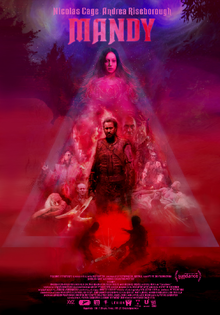
Mandy, the new
psychedelic horror film starring Nicolas Cage and Andrea Riseborough is at
times a soulful, almost mournful look at life, regret and an attempt to eke out
at a semblance of stability and tranquility in a harsh world; and at other
times a gonzo radical gore fest telling the tale of a drug induced bloody
revenge fantasy. Whose fantasy that is just one of the questions the audience
is left with when the film ends. The juxtaposition of these two wildly
divergent themes could be disastrous in less capable hands; but Director Panos
Cosmatos balances out each thesis clearly, while visualizing the causal
thematic link surrounding the film’s inciting incident. This is a brilliant film of both style and
substance; and given the
overwhelmingly positive reviews is ripe for sociological analysis and
dissection of the film’s content and themes.
PLOT
In 1983, somewhere near the Shadow
mountain’s lives Red (Cage) and Mandy (Riseborough). A logger and artist
respectfully, they have a quiet and lovingly simple life; full of sweet but
painfully cheesy inside jokes, and sanguinity in a world that seems to be
bleak. However, just beneath the surface, there seems to be something that both
Red and Mandy are trying to hide; and the happiness and contentment that they
experience is a thin veneer; that can be stripped away by the slightest
complication. That complication comes in the form of Jeremiah Sand (Linus
Roache) and his cult followers calling themselves “The Children of the New
Dawn.”. Seeing Mandy on the road, Jeremiah becomes obsessed with her and claims
her as his own. With the help of drugged out demon bikers, the cult is
successful in capturing Mandy and subduing Red.
Once Red is able to get free, he begins to cut a swath through bikers
and cult members alike to get to Jeremiah for a final confrontation.
FILM
ANALYSIS
The film’s mood, score and characterization
invokes the styles of epic metal bands, Dungeons and Dragons, Grindhouse Horror
and psychedelic films of the 1980’s. The film is difficult to classify and
understand because of the way that it amalgamates all of these influences into
a wonderful artful tapestry. We get a glimpse of this early in the film when we
are introduced to Mandy. As we are introduced to her, we see her working on a
particular art piece that will become emblematic of the film as a whole. Her
work, (which we only see glimpses of as we see her touch up, edit, and blend
together) becomes an allegory of the journey the characters will go on in the
film.
Cinematography
It is through the outstanding work of the
Director of Photography Benjamin Loeb, that the film comes alive through his
use of color. The muted opaque blues and greys of the film’s first half,
visualizes the sanctuary that Red and Mandy have created, far away from a harsh
past that is both implied and referenced through anecdotes; but never directly
addressed. The film’s somber mood is bathed in a gentle hue that reminds you of
early misty mornings upon a mountain. Yet, as the danger increases for the
couple, Loeb stylistically begins to seep the color red into their surrounding
environment. The deep crimson is used as the color of danger that the cult and
the bikers represent.
There is a wonderfully visual moment
(though not particularly sensitive for people with epilepsy, or prone to
seizures) in the film, when this color scheme reaches its zenith. Mandy and Red
are sleeping and they are saturated in the muted tranquility of blue and grey.
However, half way through the scene Loeb begins an intense strobing effect to
signify the terror and disorientation being felt by Red and Mandy as they are
accosted by the bikers. As Red is strung up, the colors of yellow and orange
begin seeping into the blue washed background and it isn’t until Mandy meets
Jeremiah that the entire scene is saturated in bloody crimson; so rich that it
washes out facial definitions. This color also is used to represent Red’s
transformation. With each step in his journey, he is slowly becoming soaked in
crimson, signifying that he is becoming what he is hunting, deliberately and
without remorse.
Loeb’s camera work is also important in
cultivating Mandy’s unique visual
style. Early in the film, the camera work is visibly steady; full of long takes
and close ups to immerse the audience in the relationship of Red and Mandy. Like
a glassy pond, the stillness of the camera exudes the intimacy felt by the
characters. Several times throughout the film, Loeb allows the camera to linger
on the faces, allowing them to sit with their emotions. Each of the main
primary characters are the centerpiece of a shot like this; as they manifest
laughter, anguishing rage, and disaffection. In one scene in particular, the
camera effect of overlaying images is used, and without cutting away, the camera
lingers in a moment that is both visually unsetting and full of pathos.
Soundtrack
Mandy is the final work
of Johann Johansson, an Icelandic composer who died on Feb 9th 2018
at age 48. I believe that it will be his Magnum Opus. To keep pace with the
plot and overall structure of the film, each part of the film has a different
melody. The first half of the film is melodically still, full of the films more
quieter moments. These early scenes are infused with Johansson’s more melodic
sensibilities as it plays off the earnestness of the character’s emotions. One
of the best tracks on the album titled “Mandy’s Love Theme”
This track is both the embodiment of the titular character, and the
characterization that Red holds onto as he seeks justice. This track is used
throughout the film in haunting fashion gently guiding Red on his quest of
retribution. The music overlays flashbacks with Red and Mandy, when and where
they met, and acts as an echo in the rest of the film to remind Red (and
frankly the audience) where we have been and how far we have come.
According to Cosmatos, he wanted Mandy to have a rock opera feel[1]
but he wasn’t sure if the usually lyrical Johansson would go for it. Cosmatos
added that he was fortunate to find out that Johansson grew up a metal head. While
there are more than one nod to epic metal, the film uses this to punctuate the
story of Red and Mandy as their world morphs into something that they, or
anyone has seen before. The film opens with a poem about the value of metal,
and it is through this metal focus that the film can harness its more
fantastical, magical elements These
ideas really start coming through during the films second half. The track that
embodies this shift is titled “Forging the Beast”.
When this rock opera 80’s fantasy magic montage begins, coupled with Loeb and
Cosmato’s style, it signifies that the audience better get on board for the
Gonzo Gore Grungefest that is about to ensue, because the ride isn’t stopping
for the faint of heart.

Andrea Riseborough
and Nicolas Cage
As I have eluded to above, this film is
bifurcated. It starts with a slower pace that is tranquilly ethereal then
shifts into a death metal rage of adrenaline. This bipolar atmosphere is
embodied in the films two leads. The first half of the film belongs to
Riseborough’s Mandy a soft spoken artist that has a penchant for metal band
t-shirts and reading dark fantasy novels. Riseborough plays her with such an
ethereal quality it is difficult to tell sometimes if she is real or not. She
glides on a whisper through the woods, like a nymph or a fairy, soft spoken and
slightly morose. Her affectation permeates through the entire film, but is
really haunting in the opening scenes where we follow Mandy in her art, at her
job and on her walks in the woods. In the subtleness of Riseborough’s
performance, we see small character choices that convince you that she could be
forgettable and the object of obsession at the same time. It is clear that
Mandy can make someone feel like they are the center of the universe or
insignificant. This balance is key to the films plot and Riseborough is sheer
perfection. The scene in which we truly get a glimpse into Mandy’s character is
when she recounts the killing of the starlings. Her evocative melancholy
delivery is full of so much raw pain and wonder that it adds a troubled and possibly
violent backstory. Yet, Riseborough has
a delicious delivery to her lines. They are like molasses; slow thick and heavy
with a hint of sweet innocence. The film emulates the pace of her dialogue in
the early scenes; allowing us to live with these characters. This is important
because Mandy is the driving force of the entire film. Yes, she is unfortunately someone that things
happen to in the film, but despite that, she expresses her true power through
an unforgettable act of defiance.[2]
It is from that act and the subsequent consequences that the film shifts in
focus from Mandy to Red.
Red (Nicholas Cage) at the start of the
film, is a soft spoken, gruff, yet principled person that seems to gain
strength and vitality by being in Mandy’s shining light. He loves this life
because he loves her. Yet, he has a commanding presence on screen that hints at
a darker, more violent past. As the film shifts to Red, he becomes the tip of
the spear that eviscerates the slow pace of the film and magnifies it to a face
melting cocaine rush of adrenaline; as if Mandy was the damn that kept the
consuming waters of intensity and rage at bay.
I have never seen a Nicolas Cage film
where the film lived up to Cage’s well known levels of intensity. This has
always made Nicolas Cage seem out of place in almost every film.[3]
Mandy breaks that streak. As the film
transitions to Red’s perspective, it is almost like both Panos and Cage are
trying to outdo each other. One elevating the stakes, and the other elevating
his performance. This is the first film
in which Nicolas Cage seems tame; as he is set against a transitory and
psychedelic backdrop and a haunting score. Yet, Cage is allowed to show all his
range, and in one single scene, shot using a single take, he shows his
brilliance by going from zero to a thousand and back again in under two
minutes. After that, the film unleashes itself (and Cage) to embrace the
violence gore and devastation that is the film’s final two acts. It is
magnificent to behold.

SOCIAL
ANALYSIS (spoilers ahead!)
“Men are afraid
that women will laugh at them, women are afraid that men will kill them.”-
Margaret Atwood
There may be many overarching themes and
points of analysis in Cosmatos’ Mandy that
many sociologists can spend copious amounts of time and energy dissecting.
However, the clear singular statement that is presented in the film’s plot,
character motivation, and behavior is the dismantling
of the Patriarchy and the cost one pays in order to do that. The film
goes to great lengths to position each character and/or group as a representation
of some aspect of the patriarchy. From Toxic Masculinity and “Incels” to
feminism and male ally-ship, the character’s journeys are a fantastical
referendum on subtle and overt male domination, gender socialization and
correlation between masculinity and violence; the end of which is tragically
bitter-sweet.

Demon Bikers of
Toxic Masculinity
Toxic Masculinity[4]
can be defined as to stereotypically masculine gender roles that restrict the
kinds of emotions allowable for boys and men to express, including social
expectations that men seek to be dominant (the "alpha male") and
limit their emotional range primarily to expressions of anger. These toxic
practices are a part of what RW Connell (2005) calls hegemonic masculinity as a practice that legitimizes men's dominant
position in society and justifies the subordination of women, and other
marginalized ways of being a man. It is the world perspective that results in
the creation and maintenance of the patriarchal structure and male dominant
social system.
In the film, the tenets of toxic
masculinity are represented by the demon bikers that are called by the cult “The
Children of a New Dawn.” These demon bikers are hyper violent, constantly high
on a variety of drugs, obsessed with aggressive violent sex and pornography,
and are physically imposing and intimidate even the cult members. They, like
the culture that they embody: destroy, rape and pillage everything around them.
The demon bikers are the cinematic
manifestation of a form of masculinity that all men have to confront. This
toxic masculinity is a constant cultural state that, like the bikers in the
film, everyone knows are out there, how to tap into [them], and how to avoid
[them]. Many men attempt to embrace this form of masculinity. Even though these
boys and men will fail, they still become indoctrinated to its ideology and
strive to achieve some aspects of its philosophy. Individual boys and men find
some way to measure up to this form of masculinity. For some, it might be the
amount of alcohol consumption, or how many sexual partners you’ve had. For
others, it will be their propensity for violence or their willingness to
withstand enormous amounts of pain and psychological stress without breaking
down. Many men are a part of and participate in the reinforcement of this type
of masculinity even if they are only partially successful. However, recently
there has emerged a rejection of the “alpha male” toxicity among some men
creating a new form of “beta male” sexism that is the new form of the
infestation of masculine domination.

Jeramiah Sand and
“Incel” Culture
“Beta” males are defined as men who
don’t identify/ fit the toxic forms of alpha male behaviors. Some men embrace
this position as a way to show how they are morally and intellectually superior
(the qualities they are using to define their masculinity) to the “alpha” male.
This superiority impacts their views on women. Because they believe themselves
to be superior to the “alpha” male, they should be garnering the attention of
women and not them. Thus, their perceived superiority over other men, results
in a sense of entitlement they believe they should have over women. This has
culminated in the birth of the violent “Incel”
movement.
“Incel”s (short for involuntary celibate)
are a relatively new form of misogyny. They are a subsect of “beta”
male sexism that is adopted by men who do not fit the masculine beauty or body
standards. Their ideology sees women’s bodies as a products that they pay for with
dinners, vacations, clothing etc. So, from this perspective, if these men provide
material goods for women, then they should have access to their bodies. They believe that if they are nice to women
and are “supreme
gentlemen”, then they have claim to women. Often “Incel” men frequent
predominantly online spaces like 4chan and reddit from which this isolated subculture
has developed this new warped sense of toxic masculinity that is both fragile
(able to be deconstructed with the slightest slip up) and preyed
upon by our veracious capitalism.[5] The result of which is a group of emboldened misogynists who’s lack of “sexual
conquest” of women they believe is due to feminism. In their mind, feminism is a movement that
hates men; and that any feminist progress is one that hurts men’s sexual access
to women. Thus, when their masculinity
is shattered by women being able to have free and equal choice, these men have lashed
out violently due to the imagined slights by women that they have perceived.
In Cosmatos’ Mandy, Jeramiah Sand is the quintessential “Incel” “beta” male
misogynist. He did not have the physique
or the looks to be an alpha male in his mind. He was a musician that crafted
this 1970’s free love folk god, and when he was eventually rejected by the
music industry he took that persona into the real world. He believed in that
godlike image and began to experiment with drugs and started the cult “The
Children of the New Dawn” He believes himself to be so superior and “special”
that he gains a sense of power in bartering with the demon bikers and being
worshipped. However, like all masculine fragility when put under stress this
false identity shatters at the slightest hint of rejection from Mandy. The
result, like his real life counterparts in Elliot Rodger and Alek Minassian, is
violence; when Jeremiah Burns Mandy alive for the rejection he felt.

Mandy and the
women of the “New Dawn”
The three women in the film: Mandy
Bloom, (Riseborough), Mother Marlene (Olwen Fouere)and Sister Lucy (Line
Pillet) represent three different reactions to the system of patriarchy that
exists in the world. In the plot of the film these women’s actions represent
the symbolic acquiescence, survival and resistance to the system of patriarchy
itself.
Mother Marlene being portrayed as an older
female in the film represents the acquiescence
to the patriarchy that has taken root in our culture by a lot of older
(typically) white women. Marlene’s constant rejection by Jeramiah, represents
the way that many older women are often devalued and cast aside within the
patriarchy when they gain the inability to bare children and/or cease to be
considered sexually attractive[6].
Jeramiah even has the line of dialogue: “You can do nothing for me.” This
pierces at the core of Mother Marlene,
but rather that direct her outrage in the proper direction (toward Jeramiah and
the gendered ageism that she is experiencing),she instead lashes out at Mandy
for capturing the attention of Jeramiah himself, berating Mandy for her hold
over him, telling her his attention won’t last.
This
reaction is common among older women who have lived within the restrictions of
a poisonous gendered system for so long, that they have adopted and help
recreate many problematic and dangerous practices that help to perpetuate the
patriarchy by being its support system. This is much in the same way that women
in the 1950’s maintained to adopt traditional gender norms (even if they didn’t
believe in it) for the purposes of survival. This survival mentality is supported
by the classic statistic that when white women began to enter into the
workforce in greater numbers the divorce rate also increased.
Second Wave Feminist authors Betty Friedan
( in her book The Feminine Mystique)
and Simone de Beauvoir (The Second Sex)
discuss independently that Females are not born women, they must become them
(de Beauvoir 2011) and that when they do, they have a crisis of gender identity
(what Friedan calls “the problem that has no name) because the way that they
are taught to become women is in the service of other people (namely their
husbands and children), so they define who they are by their relationship to
someone else. In the context of the film, Mother Marlene does not know her role
outside of this patriarchal domination which is why she works so hard to
support both it and her position. She seeks to punish Mandy for her actions
against Jeremiah, yet, when Jeremiah’s masculine strength wanes and is usurped
by Red and his crusade, she attempts in vein to manufacture a position for
herself in Red’s new world order.
Sister Lucy is the representation of the sex object stereotype that is given
to women as one of the few acceptable identities within the patriarchal system.
She is young, attractive, sexually available, silent and devoted. So devoted in
fact that she shows her “love” for Jeramiah by being willing to commit suicide
upon his command. In the film, Sister Lucy is there to show that what is
happening to Mandy has been done before. She is evidence that this “seduction”
concocted by Jeremiah is viable.
Yet, more broadly, she embodies young
women in our patriarchal rape culture getting warped by these toxic gender
messages. Again, de Beauvoir (2011) said it best when she said “[within a
Patriarchy], a real women is one that accepts herself as other” (273). Women
thoughtlessly buys into this feminine stereotype that is determined by a male
dominated society, conditioned in such a way to flee from her own freedom. For
de Beauvoir (2011) this creates a level of feminine inauthenticity that the
male majority creates in order to validate themselves by what they are not
(meaning women). Therefore, the subjugation of Sister Lucy is one that gives
Jeremiah power, reinforcing his masculinity, and his importance to his other
followers and most of all himself. This feeling is so intense that he believes
that this subjugation will work on everyone, including Mandy.
The character of Mandy embodies the resistance that is always pressuring
the patriarchal system to be dismantled. She is an independent self-possessed
artist that has agency and her choices are based upon her own desires.
Throughout the first hour of the film Mandy is presented to us as someone who
challenges the gender norms of the world around her. She soes not participate
in the established beauty standards and complicates the simple notions of
femininity that the patriarchy attempts to reinforce. Yet, Mandy’s ultimate act
of resistance is when she is brought before Jeramiah, drugged and surrounded by
his followers, she rejects him outright.
From Jeramiah’s introduction up until the point of this rejection, he is
seen as charismatic, powerful and one commanding respect. As he presents
himself to Mandy his body and his ego are on full display. Her reaction is
uncontrollable manic laughter. That
laughter as resistance is powerful enough to strip him of the façade of power
that he has cultivated and re-contextualized his image in the minds of his
followers. Though it costs her life, Mandy is the first one in the film to
damage the patriarchy; a charge that is taken up by the character of Red Miller

Red Miller
In the film, Red is a cypher for all men in the patriarchy. Like all men, he can be
either influenced by the patriarchal gender norms saturating is every waking
moment, or he can be influenced to see women as people and support them in
their own struggles and cultivate partnerships based upon trust, consent and
equality; to truly be an ally.
The beginning of the film, through the
first half, there are subtle hints as to Red’s and Mandy’s backstory. Though
not directly indicated on screen, it can be implied through various actions
(like not drinking a beer with his fellow worker) and his initial quiet and
gentle demeanor, that Red is trying to be a changed man from who he used to be.
Much of that change one can assume is because of Mandy’s influence.[7]
Thus, it is through Mandy that Red is detoxed from the pestilential forms of
masculinity that plague all men within this system. It is this ally-ship that
is key to the utter obliteration of this noxious amalgamated trifecta of terror
between Masculinity, violence and sexual objectification. However this is not
achieved without paying a high price.

Masculine Ally
ship
“The Master’s tools won’t dismantle
the Master’s House”- Audre Lorde
The one unfortunate trope that this film
needlessly falls into is the “Fridging” of a female character. Objectively, if
you look at the basic plot points of the film, it is pretty obvious that
Mandy’s death is used to motivate Red into taking revenge on the Bikers,
Jeremiah and the rest of the cult. This
is the textbook definition of “Fridging”. Yet, as indicated above male feminist
allyship rarely is created on its own. Women have always been the motivators of
men, not in small part to the historical alienation from positions of power
women have experienced. Thus, any type of feminist movement toward equality
have relied on male ally ship in power. No type of feminist legislation was
ever created without the help of likeminded men in power. Thus, even though
Mandy’s death is a sexist troupe, it is using the same call to action women
have been using to gain male support; to frame all women through their
relationship with men ala “She was someone’s daughter, wife, sister.”, which is
echoed in a lot of male ally-ship “ I have a wife, mother, sister daughter
etc.” While this is not the best nor clean strategy for smashing the patriarchy
(in part because it still frames women’s importance based in male relationships
rather than just seeing women as important outright), it does give the feminist
movement a weapon against institutionalized toxic and subtle patriarchy…men;
and since Mandy represents female resistance to the patriarchy, then Red Miller
in the second half of the film, is her weapon against it. Thus, reinforcing the
important history of men’s involvement in the liberation from this toxicity for
both men and women.
As Red crusades for the bloody and violent
annihilation of the patriarchy that takes up the latter half of the film,
slowly he begins to take on the mannerism and language of that which he is
trying to destroy. The more violence he
commits the easier that violence becomes to commit (his last kill is easier
than his first). Thus by using the
tools of the powerful, you cannot remove that power, just supplant it.
The tragedy of this story is that as Red becomes this embodiment of this
injuriousness, he believes he is justified at the end because it was in the
name of ally-ship. Thus he is willing to become the last sacrifice to
reconstitute Mandy and her ideology at the end of the film; much in the way
that men throughout history have risked their lives and careers for women in
order to do their part in advancing a feminist agenda.

CONCLUSION
This is one of the best movies of
the year. As an added bonus, it is a film ripe for sociological analysis even
beyond what has been mentioned in this review. This film represents the current
socio-political climate we find ourselves in. From “incels” and white national
toxic masculine violence to the #metoo movement and the push for the role back
of women’s rights; we are living in a scary time, and many of us wish we could
be Red Miller and violently extricate this cultural cancer from our society and
eradicate from the earth. However, as much as we would like to pretend, Red’s
revenge is in fact a fantasy, regardless of how cathartic it would feel to
emulate. The real solutions to these very real problems of which Mandy is an allegory for, are complex,
and must deal with diplomacy and compromise…lest we end up like Red himself
lost in violence, madness through a drug induced hallucination.
References
Connell, R. W.
(2005). Masculinities (2nd ed.). Berkeley, California: University of California
Press.
de
Beauvoir, Simone (2011) The Second Sex Vintage
Publishing New York
[2]
The more I think about it the more I like the fan theory that Mandy is the only
real person in the film; and that after the opening sequence what we see is the
story Mandy is telling through her art. The tale of a Paladin avenging the
death of his love goddess. If you look closely at the film, when we are
introduced to Mandy, if you look at her drawings you can see hints of events
that will eventually transpire
[3]
The one big exception is of course Vampire’s
Kiss
[6]
Because through gender specific norms we define sexual attraction through
youthfulness
[7]
Socially speaking, thee is a lot of evidence both academic and anecdotal that
suggest that men’s relationship with women is a gateway into feminist allyship