Monday, December 10, 2018

The Feminism of “Suspiria” terrifies the Patriarchy


INTRODUCTION

Luca Guadagnino’s “Suspiria” is a remake of the classic psychedelic horror film of the same name directed by Dario Argento in 1977. Due to the affection for both the original film and Argento himself, Guadagnino crafted (a sometimes literal) spellbinding film that both honors the original, updates the themes, and deeply explores the diversity of the female experience and the power of female unity in what Adrianne Rich calls the lesbian existence. It is through these themes, cinematography and Foley art that casts Suspira as a modern horror masterpiece. It is unfortunate that regardless of the brilliance of this hewed piece of artful cinema, this film has yet to catch on with audiences; critics and audiences alike citing the run time ( a hefty 151min) and pacing problems as some of the chief complaints with many a review calling the movie dull. The film’s tepid reception is not a reflection of the quality of the film, instead it is indicative of a culture that has become addicted to spectacle[1], and more acutely, unaccustomed to dark disturbing tales of femininity and the ascendency of women through a matriarchically hierarchy, as they vie for power. In short, this is a film completely about women and their relationships with themselves that has nothing to do with men, and for those with fragile masculinities, reinforces deep seeded cultural fears of female empowerment.[2]


PLOT

Set in 1977 against the backdrop of a hostage crisis in a still divided Germany, Suzie Bannion (Dakota Johnson) auditions for The Markos Company a prestigious, yet mysterious modern dance troupe in Berlin. Once accepted she is taken under the wing of choreographer Madame Blanc (Tilda Swinton) to be groomed as one of the group’s star dancers. As Suzie becomes deeply entrenched in the inner workings of the Markos house, she discovers a hidden world of Occultism, magic and witchcraft, fracturing from a power struggle between the organization’s top two matriarchs.    


FILM ANALYSIS

            Guadagnino’s Suspiria is a masterclass in filmmaking. Every aspect of this film is painstaking and meticulously planned out, there is nothing here that seems accidental. Guadagnino has stated that as a soft remake of the Argento film, he made choices about color, light music and mood that would separate the film from the much beloved Argento classic. Where Argento was colorful, Guadagnino was muted, Where Argento was blackly comedic and gonzo in the zeitgeist of the time, and Guadagnino was introspective and subtle. In fact, Guadagnino worked tirelessly to separate his film from the original in hopes to reducing comparisons due to the films specific diversions.  Suspiria (2018) is not Argento’s film and Guadagnino knew that any imitation would not be welcome. So he decided to make the film his own.  Unfortunately, we seem to still be stuck in the gravitational pull of popular nostalgia and the form of comfort that it can provide a mass audience. Thus, it is clear that many people were looking for an Argento update rather than the rich, layered, allegorical narrative that Guadagnino provides through the Cinematography, sound and soundtracks art and film directing, and a trifecta of performances by Tilda Swinton makes this version of Suspiria superior to its predecessor.

Cinematography

 It is though the film’s cinematography that Guadagnino solidifies the differences between this rendition of Suspiria and Argento’s vision.  As mentioned above, Argento’s film is full of bright neon and psychedelic colors that is more invoked by Panos Cosmatos’  Mandy than its own remake whereas cinematographer  Sayombhu Mukdeeprom subdues the gonzo maniacal intensity into something grimier and grainy that is far more evocative for a film about ethereal supernatural forces. Guadagnino’ s film seems to tap into a different style of the Post Civil Rights Zietgiest before the era of Reganist excess thus being more reminiscent of 1970’s crime thrillers[3] than the original film. The use of shadows and dark browns gives the audience a feeling of constant dread. It is this look that gives texture to the backdrop into which the story unfolds; adding to its bleak perspective. The harsh reality of an economically shattered and divided Germany weighs on the film and intensifies the story before us. Mukdeeprom and Guadagnino give us no respite and nowhere to hide. That results in a nail biting psychological tension that grips the audience like the taunt muscles of someone being drawn and about to be quartered.


Foley Art

            The other constructive style of this film that intensifies the atmospheric tension that Mukdeeprom creates is the use of sound.  The music for Suspiria was composed by Radiohead singer Thom Yorke and while his contributions to the films soundtrack and music are important in keeping the tone of the film, the more awe-inspiring work that adds to the distinctive ambiance is the work from the Foley team of Nicolas Becker, Olivier Guillaume, Carsten Richter, Hanse Warns and Olga Pasternak. Foley is the film term for the sound effects of everyday life named for sound effect artist Richard Foley.  It is their job to recreate the ambient sound within the film. Therefore, the Foley artist is attempting to create and or maintain a film’s mood through ambient noise.  However, the Foley team on Suspiria is not only integral in maintaining the bleak haunting texture of the film, but adding to the social commentary of the film’s prose.
            One of the best examples of the impact of the Foley art on the overall film is during Susie’s dance audition for the company. Guadagnino smartly strips all of the sound out of the scene which emphasizes the work of the Foley artists.  In the scene, the creaking and groaning of the wooden floor as Susie moves through her routine with a force that epitomizes the strength in her body.  We hear her deliberate and controlled breath as she strikes each pose hearing the twisting of her body, the whipping of her hair, and the magnitude of the density of her body as she crashes upon the floor. The result of the Foley’s work is the reinforcement of the power and athleticism of ballet dancers and the female form in general. While this power is on display throughout the film in other small ways (I am thinking of the “jumping” scene) none compare with this first scene.


            The other example that takes this inherit power of the female form and takes it into the realm of the Supernatural is the scene of Olga’s destruction. Here the power of Susie’s dancing is displayed through the violence upon Olga’s body.  The scene of Susie’s dancing of the lead of the new piece called “Volk” is intercut with the destruction of dissident and disillusioned dancer Olga. With each movement, Susie systematically breaks down Olga from the inside; until she is nothing but a contorted heap upon the floor. The Foley art on full display echoes each break of Olga’s bones and heightened screams as she is mangled through Susie’s movements. Through this Foley work the power of Susie and the power of the coven is on full display.


SOCIAL ANALYIS

Laying the Ground work

This film is dense and rich with distinct content that is ripe for Sociological analysis. There have been many reviews that reinforce the film’s social importance. Some comparisons to holocaust analysis and the parallels to the Alt-Right to a repudiation of masculinity. That being said, the major criticism that is levied against the film is just how feminist it is. There have been some arguments leveed against the film it is misogyny masquerading as feminism that, as one review noted:

[There is an] unintended, undercurrent of misogyny, epitomized not only by the theme of witchcraft (a manifestation of men’s fear of women’s power, if ever there was one), but in the film’s frequent nudity and violent objectification of women’s bodies. Two scenes feature female characters being grotesquely contorted by supernatural forces. There’s a thin line between indicting the male gaze, as Guadagnino claims to have intended, and reveling in it.”[4]

In social analysis, especially about gender, it is difficult to parse out whether the use of the male gaze and sexist troupes are subverting it or reinforcing it. This all comes down to individual interpretations on the execution of that theme.  For instance, Luca Guadagnino, in an interview with Jezebel outlines his feminist intent for the film[5], but that does not negate the fact that most of the individuals behind the scenes, the architects of the film are men. This then leads into the basic and fundamental questions of how well can men tell female stories, and can those stories be feminist?
Generally, if I could make a crude summation of the literature that I have head and been privy to, the answer is complicated. Yes, men can tell stories about women, and those stories can be feminist, as long as they involve women behind the scenes, making them integral to the process with the understanding that there is no one singular female voice. One of the most important roles of this collaboration is to make visible the internalized masculinity and or misogyny that the male creators have been socialized to. It is important for any male creative to be self-reflexive about their understandings of gender and be able to be challenged by others allowing the piece of art to be as egalitarian as possible.[6]  This is in addition to having a whole host of racially, economically and ability diverse female creators of new content.  But if men want to create, they also need to be inclusive. However, it is unfortunate that regardless of this increase in inclusivity, there are some, (granted a loud and vocal minority) that the feminist fundamentals of a film like Suspiria terrifies them; and this is where I believe the movie shines.


Witchcraft, Feminism and Rich’s Lesbian Existence


There has been a long history of Witchcraft being a feminist allegory in media The current resurgence of pagan attitudes and feminism can be traced back to fallen feminist ally Joss Whedon and his use of Witchcraft to not only reinforce feminist sentiments but also as an allegory for Queer identity.  There is an attraction to these pagan beliefs for any marginalized group, but especially for women. Witchcraft provides an independence and power to women that is often denied them in oppressive male dominant structures like the patriarchy.  To that end, actual witchcraft, has positioned itself as a trending alternative to more traditional and historically masculine religious institutions. Witchcraft has a collective component that is less emphasized or absent in those systems and plays on the strength of what Adrianne Rich calls “The Lesbian Existence”. In her article, Rich exclaims:

“Lesbian existence comprises both the breaking of a taboo and the rejection of a compulsory way of life. It is also a direct or indirect attack on male right of access to women. But it is more than these, although we may first begin to perceive it as a form of nay-saying to patriarchy, an act of resistance. It has of course included role playing, self-hatred, breakdown, alcoholism, suicide, and intrawoman violence; we romanticize at our peril what it means to love and act against the grain, and under heavy penalties; and lesbian existence has been lived (unlike, say, Jewish or Catholic existence) without access to any knowledge of a tradition, a continuity, a social underpinning. The destruction of records and memorabilia and letters documenting the realities of lesbian existence must be taken very seriously as a means of keeping heterosexuality compulsory for women, since what has been kept from our knowledge is joy, sensuality, courage, and community, as well as guilt, self-betrayal, and pain”
As the term "lesbian" has been held to limiting, clinical associations in its patriarchal definition, female friendship and comradeship have been set apart from the erotic, thus limiting the erotic itself. But as we deepen and broaden the range of what we define as lesbian existence, as we delineate a lesbian continuum, we begin to discover the erotic in female terms: as that which is unconfined to any single part of the body or solely to the body itself, as an energy not only diffuse but, as Audre Lorde has described it, omnipresent in "the sharing of joy, whether physical, emotional, psychic," and in the sharing of work; as the empowering joy which "makes us less willing to accept powerlessness, or those other supplied states of being which are not native to me, such as resignation, despair, self-effacement, depression, self-denial[7]

Rich identifies in this stitched together passage, (as in the article as a whole) that in a patriarchal system women are taught to see other women as a source of contention and competition for male attention (Thus making heterosexuality compulsory through socialized behaviors, reinforced by rewards from social structural institutions (Marriage, family, Military economy etc.)), and denying the reality of the power women have among and with each other by placing undue emphasis on the type and nature of a relationship rather than what that relationship provides for the individuals involved. Thus, women are socially trained through compulsory heterosexuality and patriarchal oppression that the most important relationships that they have are with men, and that all other relationships are secondary within this structure. This is fundamentally the opposite of what Witchcraft is, and the very thing that Guadagnino’s Suspiria challenges in its story and character representation.   
                 In the story, we find out that the coven was created as a refuge for women after WWII and the Nazi regime. This places the coven in direct opposition to war which is an obvious thinly veiled allegory for masculinity. Additionally, the only male character Jozef Klemperer in the film doomed his wife by not listening to her protests and prophetic statements about the spread of Nazism and in the story he only functions as a witness to the unbridled power of the coven, doomed to forget everyone, including his wife. As Klemperer, is being dragged down to bear witness to the final ritual, the coven’s feminist thesis is succinctly spoken. Miss Huller (RenĂ©e Soutendijk) states “When women tell you these things, you don’t believe them. Instead, you call them delusional.”  Additionally, Guadagnino’s remake has no principle male actor’s in any major role. All of the roles, are played by women including Klemperer played to perfection by Tilda Swinton (in one of three roles in the film: the others being Madame Blanc and Madame Markos) thus it is a feminist story portrayed entirely by women[8].


Male Panic disguised as Criticism

There have been critiques of this film, usually by men, that attempt to use feminist thinking to “out” this work as being offensive and antifeminist. This technique is called “Abstract Liberalism”.  A technique that is often associated with a critique of Anti-Racism, it is when individuals invoke a liberal idea as a way to justify the dismantling of a behavior, policy or action that would eliminate oppression. A famous example is from Sociologist Eduardo Bonilla-Silva’s book White Supremacy and Racism in a Post-Civil Rights Era where he identifies abstract liberal language as such “I am for equality that is why I am against affirmative action.” When we apply this notion to the critique of feminism in Suspiria the issues that are often invoked are shallow understandings of feminism (such as people critiquing the female on female violence in this film) or feminist understanding still steeped in a heterosexual male gaze perspective.
 One such instance was when the aforementioned male reviewer believes that the amount of female nudity in the film is offensive and oppressive. This is only offensive and oppressive because, due to the male gaze, the writer cannot see, because our society has not taught him, to see female nudity as anything but exploitative. The writer does not recognize the possibility that female nudity could be empowering, and that his distaste for it, is not a feminist ally critique, but a representation of oppression. He didn’t like the nudity in the film because it wasn’t sexualized in the context of the film. By displaying female nudity as not only something powerful, but also to have nothing to do with men shatters the construction of fragile masculinity that our culture pieces together; Thus, by lashing out at a depiction of the female body that is not designed for sexual titillation of men, reinforces the patriarchal structure rather than dismantles it. Additionally, this male panic was legitimized, and validated in the way that many of the promotional materials for the film visually depicting a source of power in the film as vaginal was later obfuscated in the final film.


 Anecdotally, I saw this disguised male panic happen in every screening I went to. As I would exit the theater, there would be one of my fellow male audience members that would be complaining about the film, (initially citing the film’s length or pace) and as the complaint continued is very quickly shifted into a thinly veiled sexist rant. However, if this film illicit such a visceral response in insecure mediocre white men, then it must be doing something right.


CONCLUSION
In his article The Globalization of Nothing[9]  Sociologist George Ritzer defines nothing as anything that is general mass produced and which ultimately is devoid of distinct and rich content; conversely he identifies “Something” that is uniquely created and that is rich in content and structure. The problem that people have with something is that usually it both has a built in audience that may or may not include a specific individual’s tastes and that it is making a particular statement. Thus, Ritzer concludes that most people believe that they want something rich and distinct, but in reality, based upon consumption patterns, we instead want a large variety of nothing.  The variety of nothing gives the illusion of something while retaining a mass market appeal, and making those products impermanent so they can be replaced. It is a process that supports continuous capitalist consumption and commodification.  To this end, those who were just looking for a carbon copy, updated version of Argento’s film were looking to be satisfied with Nothing. However, it was through the cinematography, art and film direction to the Foley work and casting coupled with rich and dense themes that accompany it, Guadagnino’ s film makes a statement about feminism, women’s relationship with other women and its inherent power. It is the embodiment of Something over so many other films that disappointingly turn out to be nothing.


[1] The only movies that are making money anymore are the big superhero tent poles. This causing an overall reduction of the numbers of films being made from original content.
[2][2]  Thus, if men find that they cannot relate to what is happening on screen, they assume that it is a fault of the film, rather than their own fallibility, and the oversaturation of male stories within our culture.
[6] Though if you listen to the cheeky brilliance of Chief Justice Ruth Bader Ginsberg, she believes the only way to have equality on the Supreme Court is if you have an all-female court structure for as long as there was an all-male supreme court. J
[7] Compulsory Heterosexuality and the Lesbian Existence by Adrianne Rich
[8] This of course means that is also passes the Bechdel test with flying colors, in terms of representation.

Sunday, October 28, 2018

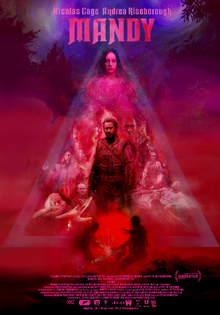
Mandy Review


*Author’s Note: There is a lot to unpack with this film, its visuals, music and especially its rich and textured themes. With any film like this much of the themes, ideals and even plot points are up for interpretation. Thus, most of my breakdown of the themes will come in the Social Analysis section where I will use the Sociological Perspective to unpack the complexities that the film presents.


Mandy, the new psychedelic horror film starring Nicolas Cage and Andrea Riseborough is at times a soulful, almost mournful look at life, regret and an attempt to eke out at a semblance of stability and tranquility in a harsh world; and at other times a gonzo radical gore fest telling the tale of a drug induced bloody revenge fantasy. Whose fantasy that is just one of the questions the audience is left with when the film ends. The juxtaposition of these two wildly divergent themes could be disastrous in less capable hands; but Director Panos Cosmatos balances out each thesis clearly, while visualizing the causal thematic link surrounding the film’s inciting incident.  This is a brilliant film of both style and substance; and given the overwhelmingly positive reviews is ripe for sociological analysis and dissection of the film’s content and themes.


PLOT

In 1983, somewhere near the Shadow mountain’s lives Red (Cage) and Mandy (Riseborough). A logger and artist respectfully, they have a quiet and lovingly simple life; full of sweet but painfully cheesy inside jokes, and sanguinity in a world that seems to be bleak. However, just beneath the surface, there seems to be something that both Red and Mandy are trying to hide; and the happiness and contentment that they experience is a thin veneer; that can be stripped away by the slightest complication. That complication comes in the form of Jeremiah Sand (Linus Roache) and his cult followers calling themselves “The Children of the New Dawn.”. Seeing Mandy on the road, Jeremiah becomes obsessed with her and claims her as his own. With the help of drugged out demon bikers, the cult is successful in capturing Mandy and subduing Red.  Once Red is able to get free, he begins to cut a swath through bikers and cult members alike to get to Jeremiah for a final confrontation.


FILM ANALYSIS

The film’s mood, score and characterization invokes the styles of epic metal bands, Dungeons and Dragons, Grindhouse Horror and psychedelic films of the 1980’s. The film is difficult to classify and understand because of the way that it amalgamates all of these influences into a wonderful artful tapestry. We get a glimpse of this early in the film when we are introduced to Mandy. As we are introduced to her, we see her working on a particular art piece that will become emblematic of the film as a whole. Her work, (which we only see glimpses of as we see her touch up, edit, and blend together) becomes an allegory of the journey the characters will go on in the film.

Cinematography

It is through the outstanding work of the Director of Photography Benjamin Loeb, that the film comes alive through his use of color. The muted opaque blues and greys of the film’s first half, visualizes the sanctuary that Red and Mandy have created, far away from a harsh past that is both implied and referenced through anecdotes; but never directly addressed. The film’s somber mood is bathed in a gentle hue that reminds you of early misty mornings upon a mountain. Yet, as the danger increases for the couple, Loeb stylistically begins to seep the color red into their surrounding environment. The deep crimson is used as the color of danger that the cult and the bikers represent.
There is a wonderfully visual moment (though not particularly sensitive for people with epilepsy, or prone to seizures) in the film, when this color scheme reaches its zenith. Mandy and Red are sleeping and they are saturated in the muted tranquility of blue and grey. However, half way through the scene Loeb begins an intense strobing effect to signify the terror and disorientation being felt by Red and Mandy as they are accosted by the bikers. As Red is strung up, the colors of yellow and orange begin seeping into the blue washed background and it isn’t until Mandy meets Jeremiah that the entire scene is saturated in bloody crimson; so rich that it washes out facial definitions. This color also is used to represent Red’s transformation. With each step in his journey, he is slowly becoming soaked in crimson, signifying that he is becoming what he is hunting, deliberately and without remorse.
Loeb’s camera work is also important in cultivating Mandy’s unique visual style. Early in the film, the camera work is visibly steady; full of long takes and close ups to immerse the audience in the relationship of Red and Mandy. Like a glassy pond, the stillness of the camera exudes the intimacy felt by the characters. Several times throughout the film, Loeb allows the camera to linger on the faces, allowing them to sit with their emotions. Each of the main primary characters are the centerpiece of a shot like this; as they manifest laughter, anguishing rage, and disaffection. In one scene in particular, the camera effect of overlaying images is used, and without cutting away, the camera lingers in a moment that is both visually unsetting and full of pathos. 


          Soundtrack
Mandy is the final work of Johann Johansson, an Icelandic composer who died on Feb 9th 2018 at age 48. I believe that it will be his Magnum Opus. To keep pace with the plot and overall structure of the film, each part of the film has a different melody. The first half of the film is melodically still, full of the films more quieter moments. These early scenes are infused with Johansson’s more melodic sensibilities as it plays off the earnestness of the character’s emotions. One of the best tracks on the album titled “Mandy’s Love Theme” This track is both the embodiment of the titular character, and the characterization that Red holds onto as he seeks justice. This track is used throughout the film in haunting fashion gently guiding Red on his quest of retribution. The music overlays flashbacks with Red and Mandy, when and where they met, and acts as an echo in the rest of the film to remind Red (and frankly the audience) where we have been and how far we have come.


According to Cosmatos, he wanted Mandy to have a rock opera feel[1] but he wasn’t sure if the usually lyrical Johansson would go for it. Cosmatos added that he was fortunate to find out that Johansson grew up a metal head. While there are more than one nod to epic metal, the film uses this to punctuate the story of Red and Mandy as their world morphs into something that they, or anyone has seen before. The film opens with a poem about the value of metal, and it is through this metal focus that the film can harness its more fantastical, magical elements  These ideas really start coming through during the films second half. The track that embodies this shift is titled “Forging the Beast”. When this rock opera 80’s fantasy magic montage begins, coupled with Loeb and Cosmato’s style, it signifies that the audience better get on board for the Gonzo Gore Grungefest that is about to ensue, because the ride isn’t stopping for the faint of heart.


Andrea Riseborough and Nicolas Cage

As I have eluded to above, this film is bifurcated. It starts with a slower pace that is tranquilly ethereal then shifts into a death metal rage of adrenaline. This bipolar atmosphere is embodied in the films two leads. The first half of the film belongs to Riseborough’s Mandy a soft spoken artist that has a penchant for metal band t-shirts and reading dark fantasy novels. Riseborough plays her with such an ethereal quality it is difficult to tell sometimes if she is real or not. She glides on a whisper through the woods, like a nymph or a fairy, soft spoken and slightly morose. Her affectation permeates through the entire film, but is really haunting in the opening scenes where we follow Mandy in her art, at her job and on her walks in the woods. In the subtleness of Riseborough’s performance, we see small character choices that convince you that she could be forgettable and the object of obsession at the same time. It is clear that Mandy can make someone feel like they are the center of the universe or insignificant. This balance is key to the films plot and Riseborough is sheer perfection. The scene in which we truly get a glimpse into Mandy’s character is when she recounts the killing of the starlings. Her evocative melancholy delivery is full of so much raw pain and wonder that it adds a troubled and possibly violent backstory. Yet,  Riseborough has a delicious delivery to her lines. They are like molasses; slow thick and heavy with a hint of sweet innocence. The film emulates the pace of her dialogue in the early scenes; allowing us to live with these characters. This is important because Mandy is the driving force of the entire film.  Yes, she is unfortunately someone that things happen to in the film, but despite that, she expresses her true power through an unforgettable act of defiance.[2] It is from that act and the subsequent consequences that the film shifts in focus from Mandy to Red.
Red (Nicholas Cage) at the start of the film, is a soft spoken, gruff, yet principled person that seems to gain strength and vitality by being in Mandy’s shining light. He loves this life because he loves her. Yet, he has a commanding presence on screen that hints at a darker, more violent past. As the film shifts to Red, he becomes the tip of the spear that eviscerates the slow pace of the film and magnifies it to a face melting cocaine rush of adrenaline; as if Mandy was the damn that kept the consuming waters of intensity and rage at bay.
I have never seen a Nicolas Cage film where the film lived up to Cage’s well known levels of intensity. This has always made Nicolas Cage seem out of place in almost every film.[3] Mandy breaks that streak. As the film transitions to Red’s perspective, it is almost like both Panos and Cage are trying to outdo each other. One elevating the stakes, and the other elevating his performance.  This is the first film in which Nicolas Cage seems tame; as he is set against a transitory and psychedelic backdrop and a haunting score. Yet, Cage is allowed to show all his range, and in one single scene, shot using a single take, he shows his brilliance by going from zero to a thousand and back again in under two minutes. After that, the film unleashes itself (and Cage) to embrace the violence gore and devastation that is the film’s final two acts. It is magnificent to behold.


SOCIAL ANALYSIS (spoilers ahead!)

“Men are afraid that women will laugh at them, women are afraid that men will kill them.”- Margaret Atwood


There may be many overarching themes and points of analysis in Cosmatos’ Mandy that many sociologists can spend copious amounts of time and energy dissecting. However, the clear singular statement that is presented in the film’s plot, character motivation, and behavior is the dismantling of the Patriarchy and the cost one pays in order to do that. The film goes to great lengths to position each character and/or group as a representation of some aspect of the patriarchy. From Toxic Masculinity and “Incels” to feminism and male ally-ship, the character’s journeys are a fantastical referendum on subtle and overt male domination, gender socialization and correlation between masculinity and violence; the end of which is tragically bitter-sweet.


Demon Bikers of Toxic Masculinity
Toxic Masculinity[4] can be defined as to stereotypically masculine gender roles that restrict the kinds of emotions allowable for boys and men to express, including social expectations that men seek to be dominant (the "alpha male") and limit their emotional range primarily to expressions of anger. These toxic practices are a part of what RW Connell (2005) calls hegemonic masculinity as a practice that legitimizes men's dominant position in society and justifies the subordination of women, and other marginalized ways of being a man. It is the world perspective that results in the creation and maintenance of the patriarchal structure and male dominant social system.
In the film, the tenets of toxic masculinity are represented by the demon bikers that are called by the cult “The Children of a New Dawn.” These demon bikers are hyper violent, constantly high on a variety of drugs, obsessed with aggressive violent sex and pornography, and are physically imposing and intimidate even the cult members. They, like the culture that they embody: destroy, rape and pillage everything around them.
The demon bikers are the cinematic manifestation of a form of masculinity that all men have to confront. This toxic masculinity is a constant cultural state that, like the bikers in the film, everyone knows are out there, how to tap into [them], and how to avoid [them]. Many men attempt to embrace this form of masculinity. Even though these boys and men will fail, they still become indoctrinated to its ideology and strive to achieve some aspects of its philosophy. Individual boys and men find some way to measure up to this form of masculinity. For some, it might be the amount of alcohol consumption, or how many sexual partners you’ve had. For others, it will be their propensity for violence or their willingness to withstand enormous amounts of pain and psychological stress without breaking down. Many men are a part of and participate in the reinforcement of this type of masculinity even if they are only partially successful. However, recently there has emerged a rejection of the “alpha male” toxicity among some men creating a new form of “beta male” sexism that is the new form of the infestation of masculine domination.


Jeramiah Sand and “Incel” Culture

            “Beta” males are defined as men who don’t identify/ fit the toxic forms of alpha male behaviors. Some men embrace this position as a way to show how they are morally and intellectually superior (the qualities they are using to define their masculinity) to the “alpha” male. This superiority impacts their views on women. Because they believe themselves to be superior to the “alpha” male, they should be garnering the attention of women and not them. Thus, their perceived superiority over other men, results in a sense of entitlement they believe they should have over women. This has culminated in the birth of the violent “Incel” movement.
 “Incel”s (short for involuntary celibate) are a relatively new form of misogyny. They are a subsect of “beta” male sexism that is adopted by men who do not fit the masculine beauty or body standards. Their ideology sees women’s bodies as a products that they pay for with dinners, vacations, clothing etc. So, from this perspective, if these men provide material goods for women, then they should have access to their bodies.  They believe that if they are nice to women and are “supreme gentlemen”, then they have claim to women. Often “Incel” men frequent predominantly online spaces like 4chan and reddit from which this isolated subculture has developed this new warped sense of toxic masculinity that is both fragile (able to be deconstructed with the slightest slip up) and preyed upon  by our veracious capitalism.[5] The result of which is a group of emboldened misogynists who’s lack of “sexual conquest” of women they believe is due to feminism.  In their mind, feminism is a movement that hates men; and that any feminist progress is one that hurts men’s sexual access to women.  Thus, when their masculinity is shattered by women being able to have free and equal choice, these men have lashed out violently due to the imagined slights by women that they have perceived.


In Cosmatos’ Mandy, Jeramiah Sand is the quintessential “Incel” “beta” male misogynist.  He did not have the physique or the looks to be an alpha male in his mind. He was a musician that crafted this 1970’s free love folk god, and when he was eventually rejected by the music industry he took that persona into the real world. He believed in that godlike image and began to experiment with drugs and started the cult “The Children of the New Dawn” He believes himself to be so superior and “special” that he gains a sense of power in bartering with the demon bikers and being worshipped. However, like all masculine fragility when put under stress this false identity shatters at the slightest hint of rejection from Mandy. The result, like his real life counterparts in Elliot Rodger and Alek Minassian, is violence; when Jeremiah Burns Mandy alive for the rejection he felt.


Mandy and the women of the “New Dawn”

            The three women in the film: Mandy Bloom, (Riseborough), Mother Marlene (Olwen Fouere)and Sister Lucy (Line Pillet) represent three different reactions to the system of patriarchy that exists in the world. In the plot of the film these women’s actions represent the symbolic acquiescence, survival and resistance to the system of patriarchy itself.
 Mother Marlene being portrayed as an older female in the film represents the acquiescence to the patriarchy that has taken root in our culture by a lot of older (typically) white women. Marlene’s constant rejection by Jeramiah, represents the way that many older women are often devalued and cast aside within the patriarchy when they gain the inability to bare children and/or cease to be considered sexually attractive[6]. Jeramiah even has the line of dialogue: “You can do nothing for me.” This pierces at the core of  Mother Marlene, but rather that direct her outrage in the proper direction (toward Jeramiah and the gendered ageism that she is experiencing),she instead lashes out at Mandy for capturing the attention of Jeramiah himself, berating Mandy for her hold over him, telling her his attention won’t last.
 This reaction is common among older women who have lived within the restrictions of a poisonous gendered system for so long, that they have adopted and help recreate many problematic and dangerous practices that help to perpetuate the patriarchy by being its support system. This is much in the same way that women in the 1950’s maintained to adopt traditional gender norms (even if they didn’t believe in it) for the purposes of survival. This survival mentality is supported by the classic statistic that when white women began to enter into the workforce in greater numbers the divorce rate also increased.  
Second Wave Feminist authors Betty Friedan ( in her book The Feminine Mystique) and Simone de Beauvoir (The Second Sex) discuss independently that Females are not born women, they must become them (de Beauvoir 2011) and that when they do, they have a crisis of gender identity (what Friedan calls “the problem that has no name) because the way that they are taught to become women is in the service of other people (namely their husbands and children), so they define who they are by their relationship to someone else. In the context of the film, Mother Marlene does not know her role outside of this patriarchal domination which is why she works so hard to support both it and her position. She seeks to punish Mandy for her actions against Jeremiah, yet, when Jeremiah’s masculine strength wanes and is usurped by Red and his crusade, she attempts in vein to manufacture a position for herself in Red’s new world order.  
Sister Lucy is the representation of the sex object stereotype that is given to women as one of the few acceptable identities within the patriarchal system. She is young, attractive, sexually available, silent and devoted. So devoted in fact that she shows her “love” for Jeramiah by being willing to commit suicide upon his command. In the film, Sister Lucy is there to show that what is happening to Mandy has been done before. She is evidence that this “seduction” concocted by Jeremiah is viable.
Yet, more broadly, she embodies young women in our patriarchal rape culture getting warped by these toxic gender messages. Again, de Beauvoir (2011) said it best when she said “[within a Patriarchy], a real women is one that accepts herself as other” (273). Women thoughtlessly buys into this feminine stereotype that is determined by a male dominated society, conditioned in such a way to flee from her own freedom. For de Beauvoir (2011) this creates a level of feminine inauthenticity that the male majority creates in order to validate themselves by what they are not (meaning women). Therefore, the subjugation of Sister Lucy is one that gives Jeremiah power, reinforcing his masculinity, and his importance to his other followers and most of all himself. This feeling is so intense that he believes that this subjugation will work on everyone, including Mandy.
The character of Mandy embodies the resistance that is always pressuring the patriarchal system to be dismantled. She is an independent self-possessed artist that has agency and her choices are based upon her own desires. Throughout the first hour of the film Mandy is presented to us as someone who challenges the gender norms of the world around her. She soes not participate in the established beauty standards and complicates the simple notions of femininity that the patriarchy attempts to reinforce. Yet, Mandy’s ultimate act of resistance is when she is brought before Jeramiah, drugged and surrounded by his followers, she rejects him outright.  From Jeramiah’s introduction up until the point of this rejection, he is seen as charismatic, powerful and one commanding respect. As he presents himself to Mandy his body and his ego are on full display. Her reaction is uncontrollable manic laughter.  That laughter as resistance is powerful enough to strip him of the façade of power that he has cultivated and re-contextualized his image in the minds of his followers. Though it costs her life, Mandy is the first one in the film to damage the patriarchy; a charge that is taken up by the character of Red Miller


Red Miller      

In the film, Red is a cypher for all men in the patriarchy. Like all men, he can be either influenced by the patriarchal gender norms saturating is every waking moment, or he can be influenced to see women as people and support them in their own struggles and cultivate partnerships based upon trust, consent and equality; to truly be an ally.
The beginning of the film, through the first half, there are subtle hints as to Red’s and Mandy’s backstory. Though not directly indicated on screen, it can be implied through various actions (like not drinking a beer with his fellow worker) and his initial quiet and gentle demeanor, that Red is trying to be a changed man from who he used to be. Much of that change one can assume is because of Mandy’s influence.[7] Thus, it is through Mandy that Red is detoxed from the pestilential forms of masculinity that plague all men within this system. It is this ally-ship that is key to the utter obliteration of this noxious amalgamated trifecta of terror between Masculinity, violence and sexual objectification. However this is not achieved without paying a high price.


Masculine Ally ship

            “The Master’s tools won’t dismantle the Master’s House”- Audre Lorde   

The one unfortunate trope that this film needlessly falls into is the “Fridging” of a female character. Objectively, if you look at the basic plot points of the film, it is pretty obvious that Mandy’s death is used to motivate Red into taking revenge on the Bikers, Jeremiah and the rest of the cult.  This is the textbook definition of “Fridging”. Yet, as indicated above male feminist allyship rarely is created on its own. Women have always been the motivators of men, not in small part to the historical alienation from positions of power women have experienced. Thus, any type of feminist movement toward equality have relied on male ally ship in power. No type of feminist legislation was ever created without the help of likeminded men in power. Thus, even though Mandy’s death is a sexist troupe, it is using the same call to action women have been using to gain male support; to frame all women through their relationship with men ala “She was someone’s daughter, wife, sister.”, which is echoed in a lot of male ally-ship “ I have a wife, mother, sister daughter etc.” While this is not the best nor clean strategy for smashing the patriarchy (in part because it still frames women’s importance based in male relationships rather than just seeing women as important outright), it does give the feminist movement a weapon against institutionalized toxic and subtle patriarchy…men; and since Mandy represents female resistance to the patriarchy, then Red Miller in the second half of the film, is her weapon against it. Thus, reinforcing the important history of men’s involvement in the liberation from this toxicity for both men and women.
As Red crusades for the bloody and violent annihilation of the patriarchy that takes up the latter half of the film, slowly he begins to take on the mannerism and language of that which he is trying to destroy.  The more violence he commits the easier that violence becomes to commit (his last kill is easier than his first). Thus by using the tools of the powerful, you cannot remove that power, just supplant it. The tragedy of this story is that as Red becomes this embodiment of this injuriousness, he believes he is justified at the end because it was in the name of ally-ship. Thus he is willing to become the last sacrifice to reconstitute Mandy and her ideology at the end of the film; much in the way that men throughout history have risked their lives and careers for women in order to do their part in advancing a feminist agenda. 


CONCLUSION
            This is one of the best movies of the year. As an added bonus, it is a film ripe for sociological analysis even beyond what has been mentioned in this review. This film represents the current socio-political climate we find ourselves in. From “incels” and white national toxic masculine violence to the #metoo movement and the push for the role back of women’s rights; we are living in a scary time, and many of us wish we could be Red Miller and violently extricate this cultural cancer from our society and eradicate from the earth. However, as much as we would like to pretend, Red’s revenge is in fact a fantasy, regardless of how cathartic it would feel to emulate. The real solutions to these very real problems of which Mandy is an allegory for, are complex, and must deal with diplomacy and compromise…lest we end up like Red himself lost in violence, madness through a drug induced hallucination.   

References

Connell, R. W. (2005). Masculinities (2nd ed.). Berkeley, California: University of California Press.
de Beauvoir, Simone (2011) The Second Sex Vintage Publishing New York       


[2] The more I think about it the more I like the fan theory that Mandy is the only real person in the film; and that after the opening sequence what we see is the story Mandy is telling through her art. The tale of a Paladin avenging the death of his love goddess. If you look closely at the film, when we are introduced to Mandy, if you look at her drawings you can see hints of events that will eventually transpire
[3] The one big exception is of course Vampire’s Kiss
[6] Because through gender specific norms we define sexual attraction through youthfulness
[7] Socially speaking, thee is a lot of evidence both academic and anecdotal that suggest that men’s relationship with women is a gateway into feminist allyship