Sunday, April 3, 2022

The Chambara Films of Akira Kurosawa: Yojimbo and Sanjuro


                The fifth and sixth films in my analysis of the Chambara films of Akira Kurosawa are the delectable duology of Yojimbo and Sanjuro. This review is going to tackle both amazing films simultaneously, as this is the first and only pair of films in Kurosawa’s filmography that are anthological sequels to each other (involving the same primary protagonist). While these films were very commercially successful, they also continued the cycle of cinematic influences and homages between Chambara films and the Western film genre. Additionally, the westernization of the Ronin (Masterless Samurai) became an ideal, and its archetype was inserted into a variety of stories masking the interesting aspects and differences of class, status, and prestige just before the Meji era.


PLOT

            Yojimbo

            Sanjuro, a Ronin (Toshiro Mifune) comes upon a town under the thumb of two warring factions. After witnessing the plight and poverty of the townspeople he sets a plan in motion to wipe them both out and free the people from under their yoke. After demonstrating his sword skills, he hires on as a “bodyguard” for both factions attempting to undermine both and pit them against each other. Following a few setbacks, he releases the town from their oppressors through a impressive display of violence, and moves on to the next adventure


            Sanjuro

            Sanjuro (Toshiro Mifune) overhears a group of young Samurai plotting to weed out the corruption in their clan. Out of a combination of compassion and veiled hopeful idealism, the masterless samurai decides to help them free their clan’s Chamberlain. As in Yojimbo, he employs subtle trickery to gain the confidence of the immoral Superintendent and his honorable Henchman Hanbei. After the mission’s success, the young Samurai witness a fatal duel Sanjuro has with Hanbei on the outskirts of town; after which, Sanjuro, “the Bodyguard” moves on to the next adventure.


HISTORICAL CONTEXT


            By looking at the production of these two films, along with the cyclical relationship between Chambara films and the Hollywood Western, Yojimbo and Sanjuro, changed filmmaking and help make Akira Kurosawa into an international cinematic icon, while creating a template for action filmmaking that often gets reused for its cinematic palpability.

Production

Kurosawa wrote both Yojimbo and Sanjuro with his regular collaborators Ryūzō Kikushima and Hideo Ogun; the same team behind a lot of his Chambara films (such as Seven Samurai and Throne of Blood). In addition to western classics like High Noon and Shane, Kurosawa also took inspiration from film noir, another popular genre at the time. This was also the second collaboration with cinematographer Kazuio Miyagawa, reteaming for the first time since Rashomon, where Miyagawa, had to come up with a way to film directly at the sun without burning the (film) stock. On Yojimbo, Kurosawa wanted Miyagawa to maintain Pan-focus. According to Miyagawa, in an interview with Criterion:

 Everything had to be in the perfect focus, whether it was right in front of you or in the very rear of the shot. So, we decided work on a spectrum of tones that would accentuate the contrast as much as possible and give objects a hard metallic edge.”  (Criterion 2006).

Miyagawa also tells the story of this one shot set underneath the floor of the house where Sanjuro (Toshiro Mifune) was trying to escape his captors. Because there was minimal space underneath the set as it was built, he could not fit himself or a cameraman in the space with Mifune. Thus, he had to marionette different lenses during the shot to keep everything in focus during each take.

            One common understanding in film production is that if you want an environmental effect to show up on camera, the intensity of that effect must be increased in order for it to register on camera. There seems to be a 1 to 5 ratio from real life to camera. If a director wanted to see rain on camera, the quantity and size of the drops must be increased 5-fold. Similarly, if the director wanted to depict strong wind, as Kurosawa did in Yojimbo, every fan that Toho Studios had, which included fans with a Cessna propeller engine, two V8Ford Engines, and 5 horsepower engines.  Additionally, the actors instructed to “keep their eyes as open as possible”, minimizing their ability to blink (Criterion 2006). This led to a very difficult shooting schedule and an obsession to acquire the perfects shots.

            This desire for perfection continued into Sanjuro in its creation of both the production design and special effects. According to Production Designer Yoshiro Muraki:

            Every morning, we’d all gather before the shooting started to [create and] stick artificial flowers and sakaki leaves on the camellia branches…You can’t be lackadaisical sticking on the flowers either, or they just fall off and be crushed underfoot [each flower cost the same as a pack of cigarettes]   

Moreover, because the script highlighted the importance of the red color of the camellia flowers, Kurosawa was considering shooting the flowers in color. Unfortunately, he did not have the technology available to him at the time, so he required Muraki and his staff to painstakingly paint all the fake camellia flowers a deep crimson so they would be picked up by the black and white film.


The biggest special effect in Sanjuro happens at the ending duel when Sanjuro’s slash results in a fount of blood from Hanbei’s chest. In the script, the description of the duel is sparse, saying “The Duel that follows between the two men can not be put into words. After a long, agonizing build up, it is decided in a lightning quick flash of the sword” (Criterion 2006). There was no clear description of the blood flow’s volume or arc of arterial spray. So, when they set up the shot, Shoji Jinbo opened the valve on the air compressor sending fake blood shooting through the hose around Nakadai’s body nearly lifting him off his feet. This mistake was captured on the first take and managed to be kept in the film because the actors thought that it was intentional, and they did not want to ruin the shot. This goof went on to define the Samurai genre of 60’s and 70’s as some of the bloodiest action of the time.   


            The Ronin and the Cowboy

As stated previously in this series, one of Kurosawa’s primary influences in his career was John Ford, acclaimed Western film director of such classics Stagecoach, Rio Grande and The Searchers, (many including John Wayne). Kurosawa stated that “I pay close attention to [John Ford] Production and are influenced by them.” (Cardullo, 2008).  Kurosawa was so influenced by Ford’s shot composition, the use of wide lenses, and the addition of Pan focus, all of which gave his films a vastness that was not previously seen in Japanese cinema at the time; resulting in Kurosawa being admonished as “The most Western Direrctor.” in Japan. This is despite his previous masterpieces (Ikiru, Seven Samurai, The Bad Sleep Well, Throne of Blood, The Lower Depths and The Hidden Fortress) doing so much to move Japanese Cinema away from the negative stereotypes of World War II (Sesonske 2010). Thus, when prepping for Yojimbo, Kurosawa seemed to lean into these influences rather than hide them, as if he said “I’ll show you how Western I can be!.” (Sesonske, 2010) With that, Kurosawa solidified the cinematic marriage of The Ronin and The Cowboy eventually birthing the Samurai Cowboy trope.

According to Daniel Choi (2021) the commonality between the ronin and the cowboy begins with looking at the similarities in their morality and sense of Honor. The Bushido code  and The Code of the West often overlap in the areas of chivalry, Self-Dependence, the duel code, and vigilantism. Additionally, when we look at the specific image of the “Ronin” (Masterless Samurai) there is this flavor of libertarian distrust of the government and the perception of these warriors were much in the same flavor of the Cowboys in the Western genre, were former soldiers, whether they be enlisted, conscripted, or deserted.   

Outside of the motivations of the principal Protagonists, the setting of each genre are vastly similar. Both the Ronin Chambara films and the classic Western take place during times of rapid social change and expansion due to conflict. Most Westerns and Ronin-style Chambara films usually take place between 1860-1870’s’s While in the US there was westward expansion and the fighting of the Civil War, Japan was going through its own Civil War (The Boshin War and later the Seinan War) that rejected imperial Japan opening itself up to the West. The resulting Imperial victory dissolved the Shogunate and left many Samurai released from the employ of their Daimyo to become “masterless”. Yet, while both the Ronin and the Cowboy cultivate a vagabond image, there is a reinforcement of class status and a romanticism of the Noble poor Trope among them: the Ronin through the class status of the Samurai Class, and the validation of the independent entrepreneurialism of the Cowboy. Because of the similarity of these conflicts, the landscape of war is also parallel. The lack of resources, high unemployment, destruction of crops leading to dry dusty conditions, and an increase in bandits and roving gangs in need of “frontier/ Samurai” justice, leads to a resemblance of set and setting between the Chambara and the Western, culminating in the continuing legacy between these two genre’s synchronicities, especially for Kurosawa.


Legacy

            A lot of Kurosawa’s work has been retooled, remade, reworked into overcooked facsimiles of itself. Yet, it is through the duology of Yojimbo and Sanjuro that he manifests an archetype in his central Character that becomes desirable to western filmmakers especially the work of the 70’s hot shot directors Spielberg, Scorsese, Lucas, and Coppola. Through Yojimbo, Kurosawa made a western better than a lot of previous other directors, at a time when the western was at its peak. Yet, the result was outright imitation, or in the case of “The Dollars Trilogy” outright stealing.

            “The Dollars Trilogy” aka “The Man with No Name” movies, are a series of films by Italian director Sergio Leone starring Clint Eastwood in the titular role, kicking off the “Spaghetti Western” sub-genre (Westerns made by Italian directors).  The first of these films, “Fist Full of Dollars” is a direct, and in some cases a shot for shot remake of Yojimbo without giving credit to Kurosawa, or his team. In 1961, Kurosawa famously sent a letter of intent to sue to Leone stating “I’ve seen your movie. It is a very good movie. Unfortunately, it is my movie.”. In the end, the film was delayed 3 years and Leone paid Kurosawa 15% of the profits[1].  There is a bit of Irony here given that the plot of Yojimbo is also an adaptation of Dashiell Hammett’s two novels Red Harvest and The Glass Key.

            Because of influential cycle of Western to Chambara and back to the Western continues to impact filmmaking and overall storytelling, this has given rises to the “Samurai Cowboy” an amagmatic trope that transcends the original genres. Many long form (films) and Short form (TV) content use this trope, coming in a variety of flavors in the 60 years since Kurosawa’s original films.Shows and films like: Cowboy Bebop, Kill Bill, The Warrior’s Way, Trigun, and a variety of other individual episodes invoke the same “Cowboy/Samurai” spirit.

 Most of the examples given romanticize the Bushido/Code of the West, overrepresenting the perceived positive characteristics of Honor, Duty, Loyalty, and Respect, while downplaying the lawlessness that they operate under, and the destabilization that their actions create. And once that destabilization occurs (usually through the creation of a “power vacuum”) the protagonist often gets to literally “ride off into the sunset”; leaving the difficult work of reconstruction to the civilians who have survived. Also, the positive qualities that have been gleaned from these cultural codices is one that is used to validate, define, and recreate masculinity. The perpetuation of the romantic notions of these morality/spirituality doctrines through its ubiquity in a majority of media content marketed to men, results in the creation of various “toxic” forms of masculinity that promote violence to solve problems and rationalized as a legitimate form of protection. Both Mifune and Eastwood have been revered for their actions in their subsequent films as the epitome of masculinity to the point that, in the 60 years hence, they become not only a masculine archetype, but its paragon for generations of boys and men that watch it. The endless recreation of this trope results a reproduction of myths, symbols, and metaphors [of masculinity] that are dangerous (Serttas and Gurkan 2017). Ironically, Kurosawa wanted “to revise the cinema's attitude towards onscreen violence. He wanted to show the damaging effect of violence, rather than the slightly anodyne way that it usually had been depicted before. (He would later come to regret this move, as it spawned a mass movement in international cinema that hasn't abated even today.)” (IMDB trivia). Once again this is another example of the public taking the exact opposite message from the creator’s intension. 


SOCIAL ANALYSIS   


The Complexities of Social Class     

Person’s social class status is defined as the social position that a person possesses within the economy that then impacts other social positions, they have within the rest of society It is important to remember the intersectional nature of class dynamics. In that, your social class is determined by and can be influenced by several different social factors. For Example: poverty impacts more women than men, and disproportionally more people of color and people with disabilities.  Additionally, a higher social class can mitigate the inequality and barriers that one might feel in other areas but will not eliminate them completely. This is the same for privileges that people experience in other aspect of their lives. This is because all lives are a complex web of individual and structural privileges and barriers. There are aspects where we have a great number of privileges and other aspects where we experience barriers. The privileges mitigate the effects of the barriers, and the barriers minimize the privileges that the person experiences. Thus, it is not just money or wealth that determines and individuals social class position. Instead, many sociologists, especially those of us who teach, combine ideas of social class to include a variety of components:


Components that impact Social Class Status

                        1. Wealth (a combination of your Income (wages) and Assets (property, stocks etc)

                        2. Education (The kind (Major), type (AA, BA, MA, Ph.D)

3. Occupational/Educational Prestige (The perceptive value of an occupation/Education within society)

4. Cultural Capital- The value of a person’s knowledge skills and experiences

within a society ( AKA “What you know”)

5. Social Capital- The value of a person’s social relationships within society (AKA

“Who you know.”)

6. Symbolic Capital- Value of demographics of identity (race, gender, sexuality disability) The level of acceptability of demographics, keeps doors open, or shuts them accordingly. The ability for white people to have an easier time accumulating generational wealth than other People of Color due to systemic barriers

6. The Class Culture- norms and ritualized behaviors localized to represent a particular class status.


According to Bourdieu (1987), The Class Culture is something that is not often considered as important as the other components on this list.  The idea that each social class level has its own rules, regulations, rituals, language, norms, and physical objects that represent them, makes upward social mobility very difficult. Because, even if you have acquired the basic criteria to be considered a member of the upper class, you may have difficulty assimilating into the class culture, whether by required behaviors or by acceptance by peers.   The rich are often a specific and segregated subculture. Their access to resources (or lack thereof) determines their own reality. This reality results in class segregation by geography, relationships, and daily experiences.

However, there have been a couple of recent examples of individuals (Anna Delvey/Sorkin and Elizabeth Holmes) whom, without many of the components of social class, were able to acquire status through mimicking the trappings of wealth in their clothing, mannerisms, and language which allowed them to acquire social and cultural capital and giving them access to upward social mobility they desired, thereby validating their social class performance. Even though these individuals were eventually caught and charged with various counts of fraud; they were able to exist in these exclusive spaces due to (at least initially) their adherence to a particular class cultural script.  The same could be said for Samurai turned Ronin after the dissolving of the Feudal system. As long as they “act the part of a Samurai” in their clothing, mannerisms, temperament and the carrying of swords they could hold on to the level of respectability and status afforded to them; even though they may be as penniless as the peasants that they look down upon. 

The complex vagaries of social class status are always at the forefront of the Samurai in Kurosawa’s films. In addition to Sanjuro in Yojimbo and Sanjuro, the poverty of Samurai is a plot point in Seven Samurai  and The Hidden Fortress,  Kurosawa using the desire to help peasants and townspeople alike as a window into the Samurai’s morality that puts them above other individuals in their station. For Kurosawa, these are not just members of a broken caste system who are just trying to, like Holmes and Sorkin, “Fake it till they make it.”. Instead through these acts of benevolence, they embody the romanticized “spirit” of the Samurai one that we can both hold and aspire to.     


CONCLUSION

Like all of Kurosawa’s work the Yojimbo/Sanjuro duology are masterpieces. They both have changed cinema and left their legacy stamp on the industry. While these twin theatrical titans (both making record amounts of money) involve the same character, it is an anthology rather than a direct sequel and they can be watched in any order. If you can find it , I recommend watching The Ambush: Incident at Blood Pass while not directed by Kurosawa, does star Toshiro Mifune in a role analogous to the role in these Kurosawa classics, and with it, can round out a Samurai version of “The man with No Name” trilogy that could not exist without Kurosawa’s or Mifune’s brilliance.


REFERENCES

Bourdieu Pierre 1987. Distinction: A Social Critique of the Judgement of Taste Massachusetts: Harvard University Press

Cardullo, Bert 2008. Akira Kurosawa: interviews. Conversations with Filmmakers. University Press of Mississippi

Choi, Daniel 2021. “Cowboys and Samurai – A Study Of Genre | An In-Depth Analysis” in The Hollywood Insider retrieved on 4/1/2022 Retrieved at https://www.hollywoodinsider.com/cowboys-and-samura-genre-analysis/

The Criterion Collection 2006. “ Director of Photography: Kazuo Miyagawa: Yojimbo’s Pan-Focus” in Yojimbo Interview Booklet Janus Films

The Criterion Collection 2006. “Production Designer Yoshiro Muraki: No Regrets for our Sets” Sanjuro Interview Booklet Janus Films      

Serttas, Aybike and Hasan Gurkan 2017. “The Representation of Masculinity in Cinema and on Television: An analysis of Fictional Male Characters” Presented at 12th International Conference on Social Sciences: Amsterdam. Retrieved on 4/1/2022 Retrieved at:  https://www.researchgate.net/publication/328314572_The_Representation_of_Masculinity_in_Cinema_and_on_Television_An_Analysis_of_Fictional_Male_Characters

Sesonske, Alexander 2010. “West Meets Eastin Current.  The Criterion Collection Retrieved on 4/1/20222 Retrieved at  https://www.criterion.com/current/posts/60-west-meets-east  


[1] The Film was remade again, years later, as a Prohibition era gangster film titled Last Man Standing starring Bruce Willis. However, the director, Walter Hill , gave Kurosawa a story credit in the film.


Saturday, March 5, 2022

The Chambara Films of Akira Kurosawa: The Hidden Fortress


The fourth film in my continued analysis of the Chambara Films of Akira Kurosawa is the inspirational adventure The Hidden Fortress. A “road movie” with Samurai flair, this 1958 classic was Kurosawa’s first big hit since 1954’s Seven Samurai.   A film that is often overshadowed by other Kurosawa hits that seem to have stuck longer in the memory of the public, The Hidden Fortress is still the catalyst for one of the biggest pop cultural properties in US history. This analysis will cover the historical context and rich social analysis of this wonderful film, including being unfortunately eclipsed by an (inter)stellar film that is a “far, far”  less compelling watered-down popcorn drivel, than the Kurosawa masterpiece.


PLOT

Two greedy peasants, living in a region in Japan between two warring factions, stumble upon the secret base of one of the faction’s leaders (Misa Uehara) and her general (Toshiro Mifune) after being mistakenly imprisoned as her soldiers. Together, the unlikely quartet travel incognito behind enemy lines, caring gold, in hopes to reach the safety of the peasants’ homeland without being detected by the enemy.


HISTORICAL CONTEXT

            Production

            The Hidden Fortress was one of the first films shot in Tohoscope. With Kurosawa’s use of long lenses, this became an important stylistic achievement for the director creating, shots and sequences that, yet again, have never been seen on screen. In fact, this style became so iconic that they eventually were assimilated as an industry standard.

On The Hidden Fortress, in addition to using the wider Tohoscope, Kurosawa developed a technique to keep focus on an object in motion while using a wide shot. During the shot when General Rokurota Makabe (Mifune) is riding his horse into the enemy’s camp, Kurosawa used two telephoto lenses and pulled the shot back with dollies. Additionally, he tunneled the viewfinder of a camera using cloth and placed it on one of the operator’s heads to black out the light. The result was as shot like no other in cinema at the time. However, this shot goes by so quickly few people outside of film school students rarely notice.   


            Legacy

With previous films like Rashomon (1950), Ikiru (1952) and Thone of Blood (1957), Kurosawa was beginning to be known as an “art housed director”, and upon looking at the shift away from the enthusiastic nation building of Seven Samurai (1954), many of the critics looked upon The Hidden Fortress  as simple “frivolous entertainment” (Russell 2014). A New York Times review by Bosley Crowther in 1962 called the film “superficial” and that it “was stooping to Hollywoodism”. The unfortunate tragic irony of the eventual success and recognition of this film as a masterpiece, is only after its blatant theft by George Lucas whom rather than give full creator credit to Kurosawa for Star Wars, just cited the film as an influence; even though it shares basic plot points, shots scenes and characters with The Hidden Fortress. They are basically the same film. But before I get to that, first, some groundwork.

Everything is like Everything else  

We like to repeat stories…. a lot. In 1895, Christina Stead and George Pierce Baker authors of Dramatic Technique outlined that all of storytelling only has around 36 dramatic situations. Psychologist Christopher Booker (2004) synthesizes this even further down to 7 basic and repeating plots:

1.      Overcoming the Monster

2.      Rags to Riches

3.      The Quest

4.      Voyage and Return

5.      Comedy

6.      Tragedy

7.      Rebirth

All stories, in all cultures, are derivative and influenced by what has come before it. Stories involving humans tend to repeat, as we constantly try to work through the same stuff (of being human) from one generation to the next. In fact, even stories not involving humans are still repeating the same story beats. Thus, we cannot get around similar storytelling structures. Yet, as we have repackaged these stories ad nauseum, seeping into every single genre and subgenre, we often do not publicly recognize the influences (direct or indirect) in film and TV credits.

Part of the reason for this repetition is our Capitalist drive to maintain and open new markets/ “revenue streams”.  This is done through an endless churning over of products that are repackaged riffs on something that we already have, leaving us with little distinct and unique content. George Ritzer and Michael Ryan (2003) discusses that all products inhabit a place a long the scale of “Nothing” vs “Something”.  Something: is a social form that is generally indigenously conceived and locally controlled that is rich in distinct and Substantive content This is something that is individually driven and not corporately controlled. Whereas Nothing is a particular social form of globalization that is generally centrally received and controlled by the overarching systems and devoid of any distinct nor Substantive content.   With nothing, there is no independent conceptualization- there is only control. Thus, the value of the product decreases both in terms of price and of the product’s worth to the consumer. As consumers in a capitalist system, we are conditioned into thinking that price dictates individual personal value (the more expensive = the more valuable), and we often have less social and emotional investment in something when it is a dime a dozen, or just easily replaceable. This is of course reversed if, through nostalgic marketing, there is a manufacturing of desire for that product because it connects to an emotionally resonant time for the consumer (usually childhood) or invokes a past/current relationship.  

According to Ritzer and Ryan (2003) rather than something, that is complex and unique, the mass public would rather have large varieties of “Nothing.” This is because it gives the illusion of quality and content, (the illusion that it is in fact ‘something’ when it is not) while making it easier for producers to create something for the broadest and simplistic tastes.

  • The General public has a greater demand for ‘nothing’ rather than ‘something’ in part because ‘Nothing’ tends cheaper through Mass Production
  • ‘Something’ is harder to reproduce (for one it takes more time) because it is complex and distinct
  • ‘Nothing’ being devoid of distinct content is often more desired because it does not take a stance. It is not trying to say anything with its content. It is often not political and sold to the broadest audience possible
  • Because of its lack of appeal (in terms of interest and personal satisfaction) More advertising dollars are put into the selling of ‘Nothing’ because advertisers must “Manufacture desire” for that thing in the minds of consumers. ‘Something’ usually has a built-in audience a nesh group that already desires the product…making it less marketable.


  Therefore, rather than something interesting and distinct, a lot of our popular culture are unnecessary reconfigurations of human struggles, overtilled for the purposes of profit. We eventual turn the nuanced and novel into tropes. Granted, this happens because these universal human stories are reproduced to better resonate with every subsequent generation, and regardless of the quality of the storytelling, some stories, made at a certain place in the socio-cultural context, do not invigorate the current generation because they either cannot engage with the story on the surface, or the filmmaking style does not capture their attention, regardless of thematic resonance. Yet, this does not stop the industry from trying to construct a loyal customer base.  

Brand Loyalty is a marketing term explaining the desire for companies to increase the positive feelings consumers have for a brand and will continue to purchase the product(s) regardless of the products flaws. Often, filmmaking auteurs, and even studios develop a particular style that becomes sought after by film geeks, critics, and the public. Production Companies like A24, and Neon, to writer/directors like Robert Eggers, Karyn Kusama, Ari Aster, Lynne Ramsey, Jennifer Kent, their name(s) becomes synonymous with quality. However, this is nothing new, and is a part of the assimilationist nature of the industry, 45 years ago, the young genius auteurs went by the names Spielberg, Coppola, Scorsese, and Lucas who “revolutionized filmmaking” and became deified for their efforts by film school bros since. It should be said that this assimilation into the industry, like Immigration, is a lot easier if you are white and male, and the ability to become a part of the system, in the way that these 70’s auteurs began, resulting in becoming the system through the running of their own companies/studios.

In the way that directors, producers, and companies recently have brought superheroes and comic book characters from the fringes into the dominant monoculture of today, Lucas, Coppola, Spielberg, and Scorsese idolized Akira Kurosawa; making sure his films got a wider international audience (with reparatory screenings of his earlier work) and helped the aging director develop his last films. Coppola and Lucas helped produce Kagemusha (which led to Ran), while Spielberg and Scorsese helped to produce and direct segments in Dreams.  It is a hard reality to accept that, in the United States, Kurosawa wouldn’t be as known and beloved as he is without the efforts of the 70’s auteurs that idolized him.  Perhaps, because I too love Kurosawa’s work, I am just a bit salty that his influence is not as recognized as I think it should be in the general culture, especially around Star Wars.


Star Wars and Kurosawa   

            As mentioned above, and by Lucas’s own admission, there is a lot of Kurosawa’s work and influence in The Star Wars franchise.  The basic plot elements of A New Hope and Phantom Menace are directly lifted from The Hidden Fortress:

1.      Story following the lowliest Characters (Peasants/ Droids)

2.      A frenetic duel between old Masters

3.      Imperial and Samurai crests in Hidden Fortress  are the Same

4.      A self-assured Princess of a annihilated clan must sneak past enemy lines to seek refuge in a neighboring Fiefdom/ Star System

5.      Disguising the Princess as a Handmaid

6.      The existence and destruction of a hidden rebel base

7.      A wide ceremonial shot at the end of the film.

Additionally, the general aesthetic of Star Wars owes everything to Kurosawa:

1.      Japanese period pieces are known as Jidaigeki often involving Samurai (Jedi)

2.      A lot of the wipe transitions in Star Wars came right out of Hidden Fortress

3.      Toshiro Mifune was offered the role of Obi-Wan Kenobi

4.      Episodes of The Mandalorian and The Clone Wars rework the plot of Seven Samurai

5.      A good majority of Star Wars: Visions has a Kurosawa aesthetic

6.      Clone Wars episode “Lightsaber Lost” is an adaptation of Stray Dog

7.       The Jedi after Order 66 become Ronin (Yojimbo/Sanjiro)

8.      The use of the Western Gunslinger aesthetic (itself fueled by Samurai) in Star Wars is doubling down

As I stated in the previous section, this is a part of the cycle of storytelling and is not necessarily the problem. What I take umbrage with is that so many fans of Star Wars do not actively know or praise its roots. To me, if you are a fan of Star Wars, on any level, you must also be a fan of Kurosawa, or at the very least, acknowledge his influence. Yet, so many fans of Star Wars speak about their love of it without also mentioning or even knowing Kurosawa. A person who can love Star Wars and not know who Akira Kurosawa is, should not exist. Meaning, if you love Star Wars get to know, and at least appreciate Kurosawa’s work; because without it, Star Wars would just be a Campbell-esque “Heroes Journey” of another two-dimensional boring white dude.[1]       


SOCIAL ANALYSIS

            A lot of the social analysis that is encompassed in The Hidden Fortress is not in the forefront of Kurosawa’s storytelling. He instead strings together minimal statements of class and gender politics that are rarely given either its due or meaningful analysis; instead opting for is characters’ personality to reflect the social stereotypes that exist. 

            Class Dynamics

            The economy of war is stratification. As private companies are glad handed billions of dollars by the Department of Defense, making their CEO’s Billionaires in their own right, a key strategy during times of aggression, to end conflict is the use of economic sanctions against an opponent. Economic sanctions can range from trade tariffs on goods to a complete embargo.

The idea behind the use of economic sanctions is typically twofold: the restrictions will either motivate the leaders of a country to halt aggressive actions and violence to maintain the health and safety of their own people, which the sanctions put in jeopardy; or motivate the people to rise up and overthrow their government because the economic conditions have unraveled.  Yet, the main reason to use economic sanctions, a common tactic of the US liberal left to convince themselves they are not Warhawks, and therefore morally superior to the uber violent “run and gun” position taken by many of those on the right, is also a major criticism of the practice. The economic punishment of an entire country for the actions of the elected officials is both misplaced passive aggressions, and a violation of their Human Rights (Pape 1997).

The notion that economic sanctions that strip away human livelihood, rights and the ability to survive as being less aggressive than the use of munitions is a farce. The end result is the same; the difference is that economic sanctions are a more indirect and emotionless action that is perceived as more humanitarian because we only define and think about violence in a militaristic way. Economic Sanctions while still a form of Hard power of an authority to express domination, also has symbolic elements, in the Bordieuan sense, because of its use of non-physical violence to establish power differences between groups (Bourdieu 1998). Thus, in the US, we use economic sanctions which have potentially a longer lasting impact than direct violence, to act as a motivator for those effected by it (often under dictatorial rule) to institute a political coup (which usually begets physical violence) while presenting ourselves as benevolent.

Additionally, the sustained use of economic sanctions increases the flow of refugees from the impacted country. As many flee the oppression and potential violence by their own country’s authorities, there are those that also flee because of the economic depression brought on by the extended economic restrictions. Yet, because of xenophobia and a threat of terrorism many countries have had a long history of immigration restrictions from countries under conflict, even when it is their economic and social pressure that manifested the refugee crisis to begin with. 

In The Hidden Fortress, the two Peasant characters are from a region between two warring Daimyos, which has resulted in their overall economic position.  Unfortunately, rather than point to the social and political root of their problem, depicting the peasants as refugees of the crisis, Kurosawa instead individualizes the issue, depicting the peasants as conniving cowards, that will do anything in the name of wealth. While the peasant’s arc in the story eventually quells this greed, it does not go far enough to show the overall macro level problems of which their greed is a symptom.


CONCLUSION

Kurosawa’s The Hidden Fortress is a masterpiece with a long reaching influence that has been invisibly woven into Pop Culture through its homage in the films of the 1970’s. Regardless of recognition by current consumers or not, Kurosawa’s work (specially this film) has left an indelible impact on many of the things people love today. Yet, even though this film is absent a lot of direct social commentary, the questions about the collateral damage against civilians, and the value of economic sanctions are quite prescient for our current context.


REFERENCES


Booker, Christopher 2004. The Seven Basic Plots: Why We Tell Stories. New York: Continuum

Bourdieu, Pierre 1998. Masculine Domination. Stanford: Standford University Press

Pape, Robert A. 1997. “Why Economic Sanctions Do Not Work.” In International Security Vol 22 Num 2 pp 90-136

Ritzer, George and Michael Ryan 2003. “The Globalization of Nothing.” In Social Thought and Research, Vol. 25, No. 1/2, pp. 51-81

Russell, Catherine 2014. “Three Good Men and a Princess.” In The Current New York: The Criterion Collection. Retrieved on March 5, 2022. Retrieved at https://www.criterion.com/current/posts/3101-the-hidden-fortress-three-good-men-and-a-princess


[1] Fuck Luke Skywalker! In the original trilogy he is just a cypher for the white male audience, to make them feel like they too can be the hero and save the Galaxy. He is a paper-thin character, a shallow shrill, that through legends became a white dude power fantasy of an unstoppable badass that fanboys could emulate and drool over. The only compelling depiction of Luke Skywalker is in The Last Jedi showing the dangers and ramifications of this earlier depiction and a nuanced understanding of balance. Yet, these fucking white male fanboys could not take a alteration and progression of a character away from the image of the heroic badass they have in their heads (that is likely a member of their Reference group) thus they rejected The Last Jedi and demanded that Luke’s legacy be corrected. They were then kowtowed to by Dave Feloni and Jon Favereau to make their (wet) dreams come true.  


Sunday, February 6, 2022

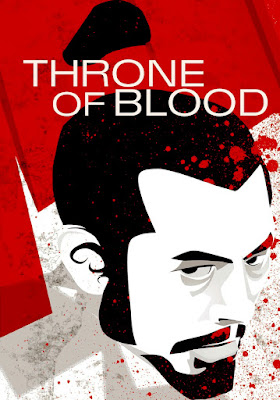
The Chambara Films of Akira Kurosawa: Throne of Blood


The third film in my analysis of the chambara films of Akira Kurosawa, is the “positively Shakespearean Throne of Blood. An adaptation of Shakespeare’s tragedy, Macbeth, about hubristic intentions, ambitions for power, and madness, Throne of Blood contextualizes these ideas through the prism of late 15th century Japan. Kurosawa masterfully weaves a jidaigeki (period film) with Noh theater creating an amalgamated Masterpiece of adaptation, isolating the themes of power, fragile masculinity and the patriarchal bargain, as well as the dangers of selfish individualism in a collectivist culture. Kurosawa takes Throne of Blood beyond just a derivate, to give an experience that is wholly unique.


PLOT

After a successful victory over their Daimyo’s enemies, Generals Washizu (Toshiro Mifune) and Miki (Minoru Chiaki) find themselves lost as they travel to “Spider’s Web Castle”. Upon the road, they happen upon a Spirit who tells them their fate. Washizu will be the next Daimyo and Miki’s children will be the first in a long line of feudal era Lords.  Each takes no stock in this ethereal prognostication until the Daimyo satisfies the first of the phantom’s predictions.  This confirmation plants seeds of ambition and desire that ultimately leads to a bloody violent conclusion and confirmation of the specter’s foreshadowing.


HISTORICAL CONTEXT

            As stated previously in other essays in this series, Kurosawa is infamous for his western influences. For his literary influences, while Shakespeare takes a close second to Dostoevsky, Macbeth is the first of of three Shakespeare plays Kurosawa adapted (The Bad sleep Well/Hamlet, and Ran/King Lear). Throne of Blood is not a typical shot for shot remake of the classic play. Instead, Kurosawa also pulls from Noh, a classical form of dance-drama theater cultivated in period Kurosawa wanted to depict, the 1400’s, to fuse theater and cinema (Prince 2014). Blending dance, song, poetry and mime with bare sets, and stylized performances which provided paradoxically powerful movements of its principal cast, the inclusion of Noh allowed the film to develop a coldness that is often absent of previous (and future) adaptations (Prince 2014).

            Kurosawa’s “Macbeth” is an amalgamation of western and eastern influences, giving us a different cultural way of seeing this classic story.  Due to its Nohist inspirations: the emptiness of space, and the inky black, white and grey pallet of how it is shot, gives the film a unique calligraphical quality that hasn’t been repeated (until recently). By tying in Buddhist principles to a very western structure, Kurosawa produces the same story of betrayal, power, and violence without the source materials reassuring conclusion (Prince 2014). Rather, in Kurosawa’s tale, the cycle of human violence never ends.

               Production

Kurosawa’s original desire to adapt Macbeth first came to him after the release of Rashomon. However, after learning about Orson Wells’ adaptation released in 1948, he decided to move on to Seven Samurai and later Ikiru.  He eventually circled back to Throne of Blood when he believed enough time had passed from Wells’ film. Kurosawa was not originally slated to direct Throne of Blood, but when the budget ballooned in pre-production, the only way that Toho believed they could recoup the costs and eventually make a profit, is if the film was directed by Kurosawa.  

Shot on sound stages and two specific locations, Kurosawa constructed the exterior of the castle on Mt Fuji for its black volcanic soil, which would add to the stark color pallet he was trying to construct. This decision proved difficult, as they then had to bring in truck loads of Fuji volcanic soil to the Toho soundstage (where the scenes in the interior of the Castle were being shot) so that it would match the exterior shots. This back and forth up and down the mountain proved both economically and emotionally taxing for Kurosawa and his crew, eventually seeking aid from an entire battalion (typically 300-1000 soldiers) of US Marines for transportation and the building of sets.

Yet, the most interesting and radical aspect of production came narratively during the films climax. When Washizu attempts in vain to rally his soldiers to go out and fight the coming onslaught from Noriyasu’s forces, rather than listen and follow the orders of their commander, the army, previously established as having a penchant for overwhelming their enemies with a hail of arrows, begin to loose them upon their Lord. This sequence was shot with real arrows while star Toshiro Mifune was in frame. Instead of achieving this through special effects, trained archers were used; creatin a choreography between them and Mifune, involving Mifune waving his hands during the sequence to indicate the direction he was moving to the archers off screen.  Every arrow hit was real, (except for the shot through the neck) taken by Mifune who wore wooden blocks of protection under his costume. Some of the closer arrow shots were hollowed out and launched on wires for added safety. This process resulted in Mifune showing real fear during the sequence which added to the gravity of the climax and the overall legacy of the film.


SOCIAL ANALYSIS

            A lot has been written and analyzed about Macbeth and its many adaptations. The themes of greed, hubris, and ascending the ladders of power have been tilled over for centuries.  Yet, the elements that Kurosawa uses to demonize individualism through his changes to Shakespeare’s original story, the mechanisms of power, and the expressions of fragile masculinity and the patriarchal bargain, are Sociologically interesting and valuable to explore.


            Individualism vs. Collectivism

            What makes Kurosawa’s adaptation of Macbeth interesting and popular, regardless of the narrative changes and liberties, is the criticism of individualism in favor of a collectivist mindset. Individualism, prominent in Western cultures, support egocentric ambition and grasps at money and power. Your ability to succeed is not based in any sort of loyalty to a collective or other group, but in your own cunning, ingenuity, and uniqueness. Thus, focusing on the rights of the individual as opposed to the group.  Collectivism, common in Eastern cultures, sees value in the social group and group formation as valuable and important to the overall function of society.  The changes made by Kurosawa to Macbeth in Throne of Blood, highlights this difference and places individualism, not the theatrical tragic flaw of hubris (commonly the downfall of Sir and Lady Macbeth in the play), as the catalyst for the demise of its central characters. 

            The replacement of the thematic catalyst of hubris for Individualism in Throne of Blood happens through minimal narrative changes. Firstly, Asaji becomes pregnant (unlike Lady Macbeth) which motivates Washizu to furthering the plans to kill Miki. This then allows for greater context for Asaji’s mental breakdown motivated by the birth of a stillborn child, rather than just guilt and paranoia. Once Washizu becomes Daimyo at the beginning of the film, he clearly states that he has no intention of any further malevolent machinations. He is resigned and almost happy to both have his position, and then give that position up to Miki’s heir. Yet, it is the temptation of his own dynasty that motivates his later actions in the film. Secondly, the death of Washizu is not from single combat with Noriyasu (the Macduff proxy) as it is in the play. In its place, Washizu dies by being felled by arrows from his own troops. In that last action, Kurosawa highlights Washizu’s individualistic ambitions to retain power as madness; one that needs to be eliminated by the collective action of his people. This anti-individualism is reinforced by the chorus at the end of the film, indicating to the audience that Washizu’s soul never made it to the afterlife. His soul remained on earth in eternal purgatory, and thus is presented as a cautionary tale of western individualism.

     Fragile Masculinity and The Patriarchal Bargain

            One of the powerful mechanisms of socialization (social learning) in any society is gender socialization. The process by which individuals learn what it means, and how to perform the gender identities that are considered acceptable within their society. These messages are then reinforced by various social institutions for the purposes of governance and social control. Typically, in western Patriarchal (male centered) societies: the values, ideals, and behaviors associated with masculinity and maleness are exalted, encouraged, and normalized; made both invisible and hegemonic.  Yet, because masculinity is valued and expected (especially among men), this minimizes the way that identified boys and men can express themselves. Because these masculine standards are so rigid, they can only perform (a narrow form of) masculinity without sanction. Thus, any social situation identified boys and men find themselves in (especially cis gendered men) they may be called upon to validate their masculinity. This also means that every social situation, is another chance their masculine performance will be interrogated and revoked. The revocation and reinstatement of individuals’ masculinity is a cycle of cis gendered social control that makes masculinity itself fragile.

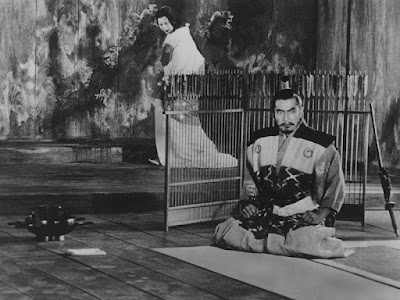
 According to Bourdieu (1998) “the social order functions as an intense symbolic machine tending to ratify the masculine domination on which it was founded.”(p 9).  Thus, men need to be men, or they are sanctioned until they reclaim their masculinity in ways that reinforce the narrowly defined and dangerous forms of masculinity accepted by the Patriarchy (usually using sex or violence to achieve it). It is not just cishet men that police other men in this system. Cis gendered women are also socialized to critique men’s performance of masculinity; the result of which is immediate emasculation. It is this masculine sanctioning that Asaji uses against Washizu in Throne of Blood when she questions his resolve to their agreed upon actions (and therefore his masculinity). Mifune’s long vacant stares indicate the depth of her evisceration of his fragile masculinity with such a simple look. Washizu is then pressured to salvage his masculinity through the added violence against Miki and his sons.

Women, socialized into a misogynistic and patriarchal culture are given value in their bodies, and in their relationships (especially with cishet men). Thus, cishet women are often taught to find value in themselves in this system through their relationships with other people, rather than believing they have value outright. Not only does this reinforce the norm of women performing a lot of emotional labor for all their male relationships (sons, husbands, fathers etc.); this also encourages the patriarchal bargain.  The patriarchal bargain is the different strategies employed by women in a patriarchal system to maximize security and optimize life options with varying potential for active or passive resistance in the face of oppression (Kandiyoti 1988).  Given that Throne of Blood is set in the 1400’s, in a masculine emphasized caste system, the patriarchal bargain is presented as one of the only legitimate avenues for women to gain status and power. Asaji motivates and berates her husband into violence to seize power for herself through him. Her ruthlessness (overtly gendered male in Feudal Japan) is hidden behind a façade of diminutive femininity, manipulating her husband through social and symbolic castration to be able to access the power that is denied her through a gendered social system.

Power and its lure      

The Weberian definition of power is the ability to realize your will even when others resist (Weber 1978). This presupposes that a person has already acquired said power (in whatever material or symbolic form it takes). To acquire power, you need to understand where power resides, and while there are many forms of power that exist, the masculine misogynistic domination of the patriarchal rule that resides in the institutional system seems to take precedence in Throne of Blood.

Power is usually generated by those who are in positions of high authority in powerful social institutions (usually men) who set the value of the different forms of capital (Financial, cultural, and Symbolic)[1], and as such, have an undue advantage in the struggles for power within a particular field[2].  The habitus (habitual behaviors/norms) that is affected by those types of capital is a form of bio power[3] that “The Power Elite” (again usually men) has over the rest of the structure, especially those within the “mass society” (the everyday public outside positions of power).  Therefore, the ignorance and apathy of “the mass society” is the product of the inability to acquire multiple forms of capital and habitual behaviors even if they are potentially able to access it through the symbolic capital. (Mills 2000, Foucault 1977, hooks 2000, Bourdieu, 1987). This raises a couple of important and seemingly opposite points:

1.      Symbolic Capital- abstract forms of privilege based upon a variety of intersecting identities (race, gender expression, sexuality, disability) does not guarantee access to, nor exercise of other forms of power, while also not acting as a barrier to that power (as it does for marginalized identities)  

2.      Symbolic Capital does make the acquisition of other forms of power easier through Symbolic Power: the ability to impose meanings upon others as “normal” or “natural” without seeming coercive. This happens when a power system sets cishet able-bodied white men as the default. This makes the symbolic power invisible to those that have it, transforming expectation into entitlement

   In Throne of Blood, both Washizu and Miki are introduced as “Men of Power” through their Military prowess and command over their armies. At the outset of the film, both understand their power and where it comes from. (Mills 2008). However, after their encounter with the Spirit in Spider’s Web Forrest, and the fulfillment of its first proclamation, for Washizu, this privilege becomes invisible. Then, as the story progresses, his ambition to amass power becomes an expectation. As the bodies begin to pile, and the blood continues to flow, that expectation is rationalized into entitlement to explain the violent murders he either performs or condones; using the words of the spirit as evidence.  This is the demagoguery of masculinity, one that needs to be dismantled.

According to de Beauvior (2011):

            Indeed, [man] is a child , a contingent and vulnerable body, an innocent, an unwanted drone, a mean tyrant, an egotist, a vain man: and he is also a liberating hero, the divinity who sets the standards. His desire is a gross appetite, his embrace a degrading chore: yet his ardor and virile force are also a demiurgic energy…that woman confined to immanence tries to keep man in this prison as well; thus the prison will merge with the world and she will no longer suffer from being shut up in it: the mother, the wife, the lover are all jailers; society codified by men decrees that women is inferior: she can only abolish this inferiority by destroying male superiority (p 655, 754)

Given Beauvior’s point, this could be an interesting motivation for Lady Macbeth to manipulate her husband into the killing of Duncan in other (future) adaptations of Macbeth, that I have yet to see.


CONCLUSION

Throne of Blood is a Masterpiece and is heralded as one of the greatest Shakespeare adaptations in history. Even without the romanticized dialogue, typically retained in most adaptations, Kurosawa invokes the classic emotions of the play in a Japanese cultural context. It’s recontextualization of the Scottish story into Feudal Japan speaks to the universality of desire, greed and cunning within a militarized patriarchal system. One that endlessly rewards violence and deception with more of the same.  Yet, regardless of its organization as a cautionary tale, that does not guarantee the public perception and consumption of it will see it as such.


REFERENCES

Bourdieu Pierre 1987. Distinction: A Social Critique of the Judgement of Taste Massachusetts: Harvard University Press


_____________ 1998. Masculine Domination. Stanford: Standford University Press


  de Beauvior Simone 2011. The Second Sex New York: Vintage Books


Foucault Michel 1977. Discipline and Punish: The Birth of the Prison. New York: Vintage Books   


hooks bell 2000. Feminist Theory: From Margin to Center 2nd edition  Massachusetts: South End Press  


Kandiyoti, Deniz. 1988. “Bargaining with Patriarchy.” In Gender and Society 2, no. 3 pp 274–90. Retrieved on 1/3/22 Retrieved at http://www.jstor.org/stable/190357


 Mills, C. Wright 2000. The Power Elite New York: Oxford University Press


______________2008 “On Knowledge and Power” Pp. 125-137 in The Politics of Truth: Selected Writings of C. Wright Mills New York


 Prince, Stephen 2014. “Shakespeare Transposed” in The Current New York: The Criterion Collection Retrieved on Feb 6 2022. Retrieved at https://www.criterion.com/current/posts/270-throne-of-blood-shakespeare-transposed


Weber Max 1978. Economy and Society  California: University of California Press.


[1] Economic Capital- wealth (income and assets)

Cultural Capital – Education and other forms of knowledge, skills, goods and services

Social Capital- Family, acquaintances and other Social Networks

Symbolic Capital- legitimation, Abstract forms of privilege (white, male, hetero, able bodied) 


[2] 1)          They are arenas of struggle for control over valued resources (forms of capital) which become social relations of power.

2)            They are structured spaces of dominant and subordinate positions based upon types and amounts of capital  Usually unequally distributed

3)            The impose upon actors (individuals) specific forms of struggle they are the space in which conflict resides

4)            Fields are often structured by their own internal mechanisms of development allowing them to hold some autonomy

Bio Power is the ability to control how a person experiences their body Through:

-Controlling how their body functions (when they can eat, sleep, use the restroom).

-Controlling how the body is represented (restrictions on how the body is expressed