The fourth film in my
continued analysis of the Chambara Films of Akira Kurosawa is the inspirational
adventure The Hidden Fortress. A “road movie” with Samurai flair, this
1958 classic was Kurosawa’s first big hit since 1954’s Seven
Samurai. A film that is often overshadowed by other
Kurosawa hits that seem to have stuck longer in the memory of the public, The
Hidden Fortress is still the catalyst for one of the biggest pop cultural
properties in US history. This analysis will cover the historical context and
rich social analysis of this wonderful film, including being unfortunately
eclipsed by an (inter)stellar film that is a “far, far” less compelling watered-down popcorn drivel,
than the Kurosawa masterpiece.
PLOT
Two greedy peasants,
living in a region in Japan between two warring factions, stumble upon the secret
base of one of the faction’s leaders (Misa Uehara) and her general (Toshiro
Mifune) after being mistakenly imprisoned as her soldiers. Together, the
unlikely quartet travel incognito behind enemy lines, caring gold, in hopes to
reach the safety of the peasants’ homeland without being detected by the enemy.
HISTORICAL CONTEXT
Production
The
Hidden Fortress was one of the first films shot in Tohoscope. With
Kurosawa’s use of long lenses, this became an important stylistic achievement
for the director creating, shots and sequences that, yet again, have never been
seen on screen. In fact, this style became so iconic that they eventually were
assimilated as an industry standard.
On The Hidden Fortress,
in addition to using the wider Tohoscope, Kurosawa developed a technique to
keep focus on an object in motion while using a wide shot. During the shot when
General Rokurota Makabe (Mifune) is riding his horse into the enemy’s camp,
Kurosawa used two telephoto lenses and pulled the shot back with dollies. Additionally,
he tunneled the viewfinder of a camera using cloth and placed it on one of the
operator’s heads to black out the light. The result was as shot like no other
in cinema at the time. However, this shot goes by so quickly few people outside
of film school students rarely notice.
Legacy
With previous films like Rashomon(1950),
Ikiru (1952) and Thone
of Blood(1957), Kurosawa was
beginning to be known as an “art housed director”, and upon looking at the
shift away from the enthusiastic nation building of Seven Samurai (1954),
many of the critics looked upon The Hidden Fortress as simple “frivolous entertainment” (Russell 2014).
A New York Times review by Bosley Crowther in 1962 called the film “superficial”
and that it “was stooping to Hollywoodism”. The unfortunate tragic irony of the
eventual success and recognition of this film as a masterpiece, is only after its
blatant theft by George Lucas whom rather than give full creator credit to
Kurosawa for Star Wars, just cited the film as an influence; even though
it shares basic plot points, shots scenes and characters with The Hidden
Fortress. They are basically the same film. But before I get to that, first,
some groundwork.
Everything
is like Everything else
We like to repeat stories….
a lot. In 1895, Christina Stead and George Pierce Baker authors of Dramatic
Technique outlined that all of storytelling only has around 36 dramatic
situations. Psychologist Christopher Booker (2004) synthesizes this even further
down to 7 basic and repeating plots:
1.Overcoming
the Monster
2.Rags
to Riches
3.The
Quest
4.Voyage
and Return
5.Comedy
6.Tragedy
7.Rebirth
All stories, in all
cultures, are derivative and influenced by what has come before it. Stories
involving humans tend to repeat, as we constantly try to work through the same
stuff (of being human) from one generation to the next. In fact, even
stories not involving humans are still repeating the
same story beats. Thus, we cannot get around similar storytelling structures. Yet,
as we have repackaged these stories ad nauseum, seeping into every single genre
and subgenre, we often do not publicly recognize the influences (direct or
indirect) in film and TV credits.
Part
of the reason for this repetition is our Capitalist drive to maintain and open
new markets/ “revenue streams”. This is done
through an endless churning over of products that are repackaged riffs on
something that we already have, leaving us with little distinct and unique
content. George Ritzer and Michael Ryan (2003) discusses that all products
inhabit a place a long the scale of “Nothing” vs “Something”. Something: is a social form that is generally
indigenously conceived and locally controlled that is rich in distinct and Substantive content This is something
that is individually driven and not corporately controlled. Whereas Nothing
is a particular social form of globalization that is generally centrally
received and controlled by the overarching systems and devoid of any distinct nor Substantive content. With nothing, there is no independent
conceptualization- there is only control. Thus, the value of the product
decreases both in terms of price and of the product’s worth to the consumer. As consumers
in a capitalist system, we are conditioned into thinking that price
dictates individual personal value (the more expensive = the more valuable), and
we often have less social and emotional investment in something when it is a
dime a dozen, or just easily replaceable. This is of course reversed if,
through nostalgic marketing, there is a manufacturing of desire for that
product because it connects to an emotionally resonant time for the consumer
(usually childhood) or invokes a past/current relationship.
According to Ritzer and Ryan (2003) rather
than something, that is complex and unique, the mass public would rather have
large varieties of “Nothing.” This is because it gives the illusion of quality and
content, (the illusion that it is in fact ‘something’ when it is not) while making it easier for
producers to create something for the broadest and simplistic tastes.
The
General public has a greater demand for ‘nothing’ rather than ‘something’
in part because ‘Nothing’ tends cheaper through Mass Production
‘Something’
is harder to reproduce (for one it takes more time) because it is complex
and distinct
‘Nothing’
being devoid of distinct content is often more desired because it does not
take a stance. It is not trying to say anything with its content. It is
often not political and sold to the broadest audience possible
Because
of its lack of appeal (in terms of interest and personal satisfaction) More
advertising dollars are put into the selling of ‘Nothing’ because
advertisers must “Manufacture desire” for that thing in the minds of
consumers. ‘Something’ usually has a built-in audience a nesh group that
already desires the product…making it less marketable.
Therefore, rather than something interesting
and distinct, a lot of our popular culture are unnecessary reconfigurations of
human struggles, overtilled for the purposes of profit. We eventual turn the
nuanced and novel into tropes. Granted, this happens because these universal
human stories are reproduced to better resonate with every subsequent
generation, and regardless of the quality of the storytelling, some stories,
made at a certain place in the socio-cultural context, do not invigorate the current
generation because they either cannot engage with the story on the surface, or
the filmmaking style does not capture their attention, regardless of thematic resonance.
Yet, this does not stop the industry from trying to construct a loyal customer
base.
Brand Loyalty is
a marketing term explaining the desire for companies to increase the positive
feelings consumers have for a brand and will continue to purchase the product(s)
regardless of the products flaws. Often, filmmaking auteurs, and even studios
develop a particular style that becomes sought after by film geeks, critics,
and the public. Production Companies like A24, and Neon, to writer/directors
like Robert Eggers, Karyn Kusama, Ari Aster, Lynne Ramsey, Jennifer Kent, their
name(s) becomes synonymous with quality. However, this is nothing new, and is a
part of the assimilationist nature of the industry, 45 years ago, the young genius
auteurs went by the names Spielberg, Coppola, Scorsese, and Lucas who “revolutionized
filmmaking” and became deified for their efforts by film school bros since. It
should be said that this assimilation into the industry, like Immigration, is a
lot easier if you are white and male, and the ability to become a part of the
system, in the way that these 70’s auteurs began, resulting in becoming the
system through the running of their own companies/studios.
In the way that
directors, producers, and companies recently have brought superheroes and comic
book characters from the fringes into the dominant monoculture of today, Lucas,
Coppola, Spielberg, and Scorsese idolized Akira Kurosawa; making sure his films
got a wider international audience (with reparatory screenings of his earlier
work) and helped the aging director develop his last films. Coppola and Lucas
helped produce Kagemusha (which led to Ran), while Spielberg and Scorsese
helped to produce and direct segments in Dreams. It is a hard reality to accept that, in
the United States, Kurosawa wouldn’t be as known and beloved as he is without
the efforts of the 70’s auteurs that idolized him.Perhaps, because I too love Kurosawa’s work,
I am just a bit salty that his influence is not as recognized as I think it
should be in the general culture, especially around Star Wars.
Star Wars and Kurosawa
As
mentioned above, and by Lucas’s own admission, there is a lot of Kurosawa’s
work and influence inThe Star Wars franchise. The basic
plot elements of A New Hope and Phantom Menace are directly
lifted from The Hidden Fortress:
1.Story
following the lowliest Characters (Peasants/ Droids)
2.A
frenetic duel between old Masters
3.Imperial
and Samurai crests in Hidden Fortress are the Same
4.A
self-assured Princess of a annihilated clan must sneak past enemy lines to seek
refuge in a neighboring Fiefdom/ Star System
5.Disguising
the Princess as a Handmaid
6.The
existence and destruction of a hidden rebel base
6.Clone
Wars episode “Lightsaber Lost” is an adaptation of Stray Dog
7. The Jedi after Order 66 become Ronin (Yojimbo/Sanjiro)
8.The
use of the Western Gunslinger aesthetic (itself fueled by Samurai) in Star
Wars is doubling down
As I stated in the previous section, this is a part of
the cycle of storytelling and is not necessarily the problem. What I take umbrage
with is that so many fans of Star Wars do not actively know or praise
its roots. To me, if you are a fan of Star Wars, on any level, you must
also be a fan of Kurosawa, or at the very least, acknowledge his influence.
Yet, so many fans of Star Wars speak about their love of it without also
mentioning or even knowing Kurosawa. A person who can love Star Wars and
not know who Akira Kurosawa is, should not exist. Meaning, if you love Star
Wars get to know, and at least appreciate Kurosawa’s work; because without
it, Star Wars would just be a Campbell-esque “Heroes Journey” of another
two-dimensional boring white dude.[1]
SOCIAL ANALYSIS
A lot of the social analysis that is
encompassed in The Hidden Fortress is not in the forefront of Kurosawa’s
storytelling. He instead strings together minimal statements of class and
gender politics that are rarely given either its due or meaningful analysis; instead
opting for is characters’ personality to reflect the social stereotypes that
exist.
Class
Dynamics
The
economy of war is stratification. As private companies are glad handed billions
of dollars by the Department of Defense, making their CEO’s Billionaires in
their own right, a key strategy during times of aggression, to end conflict is
the use of economic sanctions against an opponent. Economic sanctions can range
from trade tariffs on goods to a complete embargo.
The idea behind the use
of economic sanctions is typically twofold: the restrictions will either
motivate the leaders of a country to halt aggressive actions and violence to
maintain the health and safety of their own people, which the sanctions put in jeopardy;
or motivate the people to rise up and overthrow their government because the
economic conditions have unraveled.Yet,
the main reason to use economic sanctions, a common tactic of the US liberal
left to convince themselves they are not Warhawks, and therefore morally superior
to the uber violent “run and gun” position taken by many of those on the right,
is also a major criticism of the practice. The economic punishment of an entire
country for the actions of the elected officials is both misplaced passive aggressions,
and a violation of their Human Rights (Pape 1997).
The notion that economic
sanctions that strip away human livelihood, rights and the ability to survive
as being less aggressive than the use of munitions is a farce. The end result
is the same; the difference is that economic sanctions are a more indirect and
emotionless action that is perceived as more humanitarian because we only
define and think about violence in a militaristic way. Economic Sanctions while
still a form of Hard power of an authority to express domination, also has
symbolic elements, in the Bordieuan sense, because of its use of non-physical
violence to establish power differences between groups (Bourdieu 1998). Thus, in
the US, we use economic sanctions which have potentially a longer lasting impact
than direct violence, to act as a motivator for those effected by it (often under
dictatorial rule) to institute a political coup (which usually begets physical
violence) while presenting ourselves as benevolent.
Additionally, the sustained
use of economic sanctions increases the flow of refugees from the impacted
country. As many flee the oppression and potential violence by their own country’s
authorities, there are those that also flee because of the economic depression
brought on by the extended economic restrictions. Yet, because of xenophobia and
a threat of terrorism many countries have had a long history
of immigration restrictions from countries under conflict, even when it is
their economic and social pressure that manifested the refugee crisis to begin with.
In The Hidden Fortress,
the two Peasant characters are from a region between two warring Daimyos,
which has resulted in their overall economic position.Unfortunately, rather than point to the
social and political root of their problem, depicting the peasants as refugees of
the crisis, Kurosawa instead individualizes the issue, depicting the peasants as
conniving cowards, that will do anything in the name of wealth. While the peasant’s
arc in the story eventually quells this greed, it does not go far enough to
show the overall macro level problems of which their greed is a symptom.
CONCLUSION
Kurosawa’s The Hidden
Fortress is a masterpiece with a long reaching influence that has been
invisibly woven into Pop Culture through its homage in the films of the 1970’s.
Regardless of recognition by current consumers or not, Kurosawa’s work (specially
this film) has left an indelible impact on many of the things people love today.
Yet, even though this film is absent a lot of direct social commentary, the questions
about the collateral damage against civilians, and the value of economic
sanctions are quite
prescient for our current context.
REFERENCES
Booker, Christopher 2004. The Seven Basic Plots:
Why We Tell Stories. New York: Continuum
Bourdieu, Pierre 1998. Masculine Domination. Stanford:
Standford University Press
Pape, Robert A. 1997. “Why Economic Sanctions Do Not
Work.” In International Security Vol 22 Num 2 pp 90-136
Ritzer,
George and Michael Ryan 2003. “The Globalization of Nothing.” In Social
Thought and Research, Vol. 25, No. 1/2, pp. 51-81
[1] Fuck
Luke Skywalker! In the original trilogy he is just a cypher for the white male
audience, to make them feel like they too can be the hero and save the Galaxy.
He is a paper-thin character, a shallow shrill, that through legends became
a white dude power fantasy of an unstoppable badass that fanboys could emulate
and drool over. The only compelling depiction of Luke Skywalker is in The
Last Jedi showing the dangers and ramifications of this earlier depiction
and a nuanced understanding of balance. Yet, these fucking white male fanboys
could not take a alteration and progression of a character away from the image
of the heroic badass they have in their heads (that is likely a member of their
Reference group) thus they rejected The Last Jedi and demanded that Luke’s
legacy be corrected. They were then kowtowed to by Dave Feloni and Jon Favereau
to make their (wet) dreams come true.
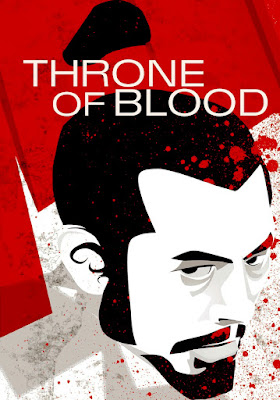
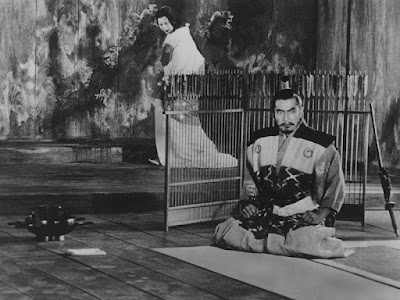
The third film in my
analysis of the chambara films of Akira Kurosawa, is the “positively
Shakespearean Throne of Blood. An adaptation of Shakespeare’s tragedy, Macbeth,
about hubristic intentions, ambitions for power, and madness, Throne of
Blood contextualizes these ideas through the prism of late 15th
century Japan. Kurosawa masterfully weaves a jidaigeki (period film) with Noh
theater creating an amalgamated Masterpiece of adaptation, isolating the themes
of power, fragile masculinity and the patriarchal bargain, as well as the
dangers of selfish individualism in a collectivist culture. Kurosawa takes Throne
of Blood beyond just a derivate, to give an experience that is wholly
unique.
PLOT
After a successful victory
over their Daimyo’s enemies, Generals Washizu (Toshiro Mifune) and Miki (Minoru
Chiaki) find themselves lost as they travel to “Spider’s Web Castle”. Upon the road,
they happen upon a Spirit who tells them their fate. Washizu will be the next Daimyo
and Miki’s children will be the first in a long line of feudal era Lords.Each takes no stock in this ethereal
prognostication until the Daimyo satisfies the first of the phantom’s predictions.This confirmation plants seeds of ambition
and desire that ultimately leads to a bloody violent conclusion and
confirmation of the specter’s foreshadowing.
HISTORICAL CONTEXT
As
stated previously in other
essays in this series, Kurosawa is infamous for his western
influences. For his literary influences, while Shakespeare takes a close second
to Dostoevsky, Macbeth is the first of of three Shakespeare plays
Kurosawa adapted (The
Bad sleep Well/Hamlet, and
Ran/King
Lear). Throne of Blood is
not a typical shot for shot remake of the classic play. Instead, Kurosawa also
pulls from Noh, a classical form of dance-drama theater cultivated in period Kurosawa
wanted to depict, the 1400’s, to fuse theater and cinema (Prince 2014).
Blending dance, song, poetry and mime with bare sets, and stylized performances
which provided paradoxically powerful movements of its principal cast, the
inclusion of Noh allowed the film to develop a coldness that is often absent of
previous (and future) adaptations (Prince 2014).
Kurosawa’s
“Macbeth” is an amalgamation of western and eastern influences, giving us a
different cultural way of seeing this classic story.Due to its Nohist inspirations: the emptiness
of space, and the inky black, white and grey pallet of how it is shot, gives
the film a unique calligraphical quality that hasn’t been repeated (until
recently). By tying in Buddhist principles to a very western
structure, Kurosawa produces the same story of betrayal, power, and violence without
the source materials reassuring conclusion (Prince 2014). Rather, in Kurosawa’s
tale, the cycle of human violence never ends.
Production
Kurosawa’s original
desire to adapt Macbeth first came to him after the release of Rashomon.
However,
after learning about Orson Wells’ adaptation released in 1948, he decided to
move on to Seven
Samurai and later Ikiru. He eventually circled back to Throne of
Blood when he believed enough time had passed from Wells’ film. Kurosawa
was not originally slated to direct Throne of Blood, but when the budget
ballooned in pre-production, the only way that Toho believed they could recoup
the costs and eventually make a profit, is if the film was directed by Kurosawa.
Shot on sound stages and
two specific locations, Kurosawa constructed the exterior of the castle on Mt
Fuji for its black volcanic soil, which would add to the stark color pallet he was
trying to construct. This decision proved difficult, as they then had to bring
in truck loads of Fuji volcanic soil to the Toho soundstage (where the scenes
in the interior of the Castle were being shot) so that it would match the
exterior shots. This back and forth up and down the mountain proved both
economically and emotionally taxing for Kurosawa and his crew, eventually
seeking aid from an entire battalion (typically 300-1000 soldiers) of US Marines
for transportation and the building of sets.
Yet, the most interesting
and radical aspect of production came narratively during the films climax. When
Washizu attempts in vain to rally his soldiers to go out and fight the coming
onslaught from Noriyasu’s forces, rather than listen
and follow the orders of their commander, the army, previously established as
having a penchant for overwhelming their enemies with a hail of arrows, begin
to loose them upon their Lord. This sequence was shot with real arrows while
star Toshiro Mifune was in frame. Instead of achieving this through special
effects, trained archers were used; creatin a choreography between them and
Mifune, involving Mifune waving his hands during the sequence to indicate the direction
he was moving to the archers off screen.Every arrow hit was real, (except for the shot through the neck) taken
by Mifune who wore wooden blocks of protection under his costume. Some of the
closer arrow shots were hollowed out and launched on wires for added safety. This
process resulted in Mifune showing real fear during the sequence which added to
the gravity of the climax and the overall legacy of the film.
SOCIAL ANALYSIS
A
lot has been written and analyzed about Macbeth and its many adaptations.
The themes of greed, hubris, and ascending the ladders of power have been tilled
over for centuries.Yet, the elements
that Kurosawa uses to demonize individualism through his changes to
Shakespeare’s original story, the mechanisms of power, and the expressions of
fragile masculinity and the patriarchal bargain, are Sociologically interesting
and valuable to explore.
Individualism
vs. Collectivism
What makes Kurosawa’s adaptation of Macbeth
interesting
and popular, regardless of the narrative changes and
liberties, is the criticism of individualism in favor of a collectivist mindset.
Individualism, prominent in Western cultures, support egocentric ambition and
grasps at money and power. Your ability to succeed is not based in any sort of
loyalty to a collective or other group, but in your own cunning, ingenuity, and
uniqueness. Thus, focusing on the rights of the individual as opposed to the
group. Collectivism, common in Eastern cultures,
sees value in the social group and group formation as valuable and important to
the overall function of society.The changes
made by Kurosawa to Macbeth in Throne of Blood, highlights this
difference and places individualism, not the theatrical tragic flaw of hubris (commonly
the downfall of Sir and Lady Macbeth in the play), as the catalyst for the
demise of its central characters.
The replacement
of the thematic catalyst of hubris for Individualism in Throne of Blood
happens through minimal narrative changes. Firstly, Asaji becomes pregnant (unlike
Lady Macbeth) which motivates Washizu to furthering the plans to kill Miki.
This then allows for greater context for Asaji’s mental breakdown motivated by
the birth of a stillborn child, rather than just guilt and paranoia. Once
Washizu becomes Daimyo at the beginning of the film, he clearly states that he
has no intention of any further malevolent machinations. He is resigned and
almost happy to both have his position, and then give that position up to
Miki’s heir. Yet, it is the temptation of his own dynasty that motivates his
later actions in the film. Secondly, the death of Washizu is not from single
combat with Noriyasu (the Macduff proxy) as it is in the play. In its place,
Washizu dies by being felled by arrows from his own troops. In that last
action, Kurosawa highlights Washizu’s individualistic ambitions to retain power
as madness; one that needs to be eliminated by the collective action of his
people. This anti-individualism is reinforced by the chorus at the end of the
film, indicating to the audience that Washizu’s soul never made it to the
afterlife. His soul remained on earth in eternal purgatory, and thus is
presented as a cautionary tale of western individualism.
Fragile
Masculinity and The Patriarchal Bargain
One
of the powerful mechanisms of socialization (social learning) in any society is
gender socialization. The process by which individuals learn what it means, and
how to perform the gender identities that are considered acceptable within their
society. These messages are then reinforced by various social institutions for
the purposes of governance and social control. Typically, in western
Patriarchal (male centered) societies: the values, ideals, and behaviors
associated with masculinity and maleness are exalted, encouraged, and
normalized; made both invisible and hegemonic.Yet, because masculinity is valued and expected (especially among men), this
minimizes the way that identified boys and men can express themselves. Because
these masculine standards are so rigid, they can only perform (a narrow form of)
masculinity without sanction. Thus, any social situation identified boys and
men find themselves in (especially cis gendered men) they may be called upon to
validate their masculinity. This also means that every social situation, is
another chance their masculine performance will be interrogated and revoked.
The revocation and reinstatement of individuals’ masculinity is a cycle of cis gendered
social control that makes masculinity itself fragile.
According to Bourdieu (1998) “the social order
functions as an intense symbolic machine tending to ratify the masculine
domination on which it was founded.”(p 9).Thus, men need to be men, or they are sanctioned until they reclaim
their masculinity in ways that reinforce the narrowly defined and dangerous
forms of masculinity accepted by the Patriarchy (usually using sex or violence
to achieve it). It is not just cishet men that police other men in this system.
Cis gendered women are also socialized to critique men’s performance of masculinity;
the result of which is immediate emasculation. It is this masculine sanctioning
that Asaji uses against Washizu in Throne of Blood when she questions
his resolve to their agreed upon actions (and therefore his masculinity).
Mifune’s long vacant stares indicate the depth of her evisceration of his fragile
masculinity with such a simple look. Washizu is then pressured to salvage his
masculinity through the added violence against Miki and his sons.
Women, socialized into a
misogynistic and patriarchal culture are given value in their bodies, and in
their relationships (especially with cishet men). Thus, cishet women are often
taught to find value in themselves in this system through their relationships
with other people, rather than believing they have value outright. Not only
does this reinforce the norm of women performing a lot of emotional labor for all
their male relationships (sons, husbands, fathers etc.); this also encourages
the patriarchal bargain. The patriarchal
bargain is the different strategies employed by women in a patriarchal system
to maximize security and optimize life options with varying potential for
active or passive resistance in the face of oppression (Kandiyoti 1988). Given that Throne of Blood is set in
the 1400’s, in a masculine emphasized caste system, the patriarchal bargain is
presented as one of the only legitimate avenues for women to gain status and
power. Asaji motivates and berates her husband into violence to seize power for
herself through him. Her ruthlessness (overtly gendered male in Feudal Japan)
is hidden behind a façade of diminutive femininity, manipulating her husband
through social and symbolic castration to be able to access the power that is
denied her through a gendered social system.
Power and its lure
The Weberian definition
of power is the ability to realize your will even when others resist (Weber 1978).
This presupposes that a person has already acquired said power (in whatever
material or symbolic form it takes). To acquire power, you need to understand
where power resides, and while there are many forms of power that exist, the masculine
misogynistic domination of the patriarchal rule that resides in the institutional
system seems to take precedence in Throne of Blood.
Power is usually
generated by those who are in
positions of high authority in powerful social institutions (usually men) who set
the value of the different forms of capital (Financial, cultural, and Symbolic)[1],
and as such, have an undue advantage in the struggles for power within a
particular field[2].The habitus (habitual behaviors/norms) that
is affected by those types of capital is a form of bio power[3]
that “The Power Elite” (again usually men) has over the rest of the structure,
especially those within the “mass society” (the everyday public outside positions
of power).Therefore, the ignorance and
apathy of “the mass society” is the product of the inability to acquire
multiple forms of capital and habitual behaviors even if they are potentially
able to access it through the symbolic capital. (Mills 2000, Foucault 1977,
hooks 2000, Bourdieu, 1987). This raises a couple of important and seemingly
opposite points:
1.Symbolic Capital-
abstract forms of privilege based upon a variety of intersecting identities
(race, gender expression, sexuality, disability) does not guarantee access to,
nor exercise of other forms of power, while also not acting as a barrier to
that power (as it does for marginalized identities)
2.Symbolic
Capital does make the acquisition of other forms of power easier through Symbolic
Power: the ability to impose meanings upon others as “normal” or “natural”
without seeming coercive. This happens when a power system sets cishet able-bodied
white men as the default. This makes the symbolic power invisible to those that
have it, transforming expectation into entitlement
In Throne
of Blood, both Washizu and Miki are introduced as “Men of Power” through their
Military prowess and command over their armies. At the outset of the film, both
understand their power and where it comes from. (Mills 2008). However, after their
encounter with the Spirit in Spider’s Web Forrest, and the fulfillment of its
first proclamation, for Washizu, this privilege becomes invisible. Then, as the
story progresses, his ambition to amass power becomes an expectation. As the
bodies begin to pile, and the blood continues to flow, that expectation is rationalized
into entitlement to explain the violent murders he either performs or condones;
using the words of the spirit as evidence.This is the demagoguery of masculinity, one that needs to be dismantled.
According to de Beauvior
(2011):
Indeed, [man] is a child , a contingent and vulnerable body, an
innocent, an unwanted drone, a mean tyrant, an egotist, a vain man: and he is
also a liberating hero, the divinity who sets the standards. His desire is a
gross appetite, his embrace a degrading chore: yet his ardor and virile force
are also a demiurgic energy…that woman confined to immanence tries to keep man
in this prison as well; thus the prison will merge with the world and she will
no longer suffer from being shut up in it: the mother, the wife, the lover are
all jailers; society codified by men decrees that women is inferior: she can
only abolish this inferiority by destroying male superiority (p 655, 754)
Given Beauvior’s point,
this could be an interesting motivation for Lady Macbeth to manipulate her
husband into the killing of Duncan in other (future) adaptations of Macbeth,
that I have yet to see.
CONCLUSION
Throne of Blood is a
Masterpiece and is heralded as one of the greatest Shakespeare adaptations in history.
Even without the romanticized dialogue, typically retained in most adaptations,
Kurosawa invokes the classic emotions of the play in a Japanese cultural
context. It’s recontextualization of the Scottish story into Feudal Japan
speaks to the universality of desire, greed and cunning within a militarized patriarchal
system. One that endlessly rewards violence and deception with more of the same.Yet, regardless of its organization as a
cautionary tale, that does not guarantee the public perception and consumption of
it will see it as such.
REFERENCES
Bourdieu Pierre 1987. Distinction: A Social
Critique of the Judgement of Taste Massachusetts: Harvard University Press
_____________ 1998. Masculine
Domination. Stanford: Standford University Press
de Beauvior Simone 2011. The Second Sex New
York: Vintage Books
Foucault Michel 1977. Discipline and Punish:
The Birth of the Prison. New York: Vintage Books
hooks bell 2000. Feminist Theory: From Margin
to Center 2nd editionMassachusetts:
South End Press
Kandiyoti, Deniz. 1988. “Bargaining
with Patriarchy.” In Gender and Society
2, no. 3 pp 274–90. Retrieved on 1/3/22 Retrieved at http://www.jstor.org/stable/190357
Mills, C. Wright 2000. The Power Elite New
York: Oxford University Press
______________2008 “On
Knowledge and Power” Pp. 125-137 in The Politics of Truth: Selected Writings
of C. Wright Mills New York
Author’s Note:
This paper’s focus, interpretation of theoretical concepts, and their
implications to The Matrix franchise, is only one of many ways these
texts can be interpreted. It in no way claims to be a definitive or universally
valid approach. The author encourages other Sociologists, media scholars, and those
in interdisciplinary studies who are interested in the analysis of The
Matrix properties; to research, write, and publicly provide their own analysis
if they haven’t done so already.If you need
a brief explanation of bolded terms look at the Glossary at the end of the
essay.
INTRODUCTION
The Matrix
franchise is a socio-cultural phenomenon. Upon the release of the first film, The
Matrix in 1999, The Wachowski’s both transformed and reflected the cultural
zeitgeist of the late 90’s. The film revolutionized filmmaking, ignited
fashion, and introduced individuals into a basic
understanding of philosophical concepts that had beneficial and detrimental
effects on culture. The impact of the first film was so immense, that it set a
bar that the subsequent films in the franchise could not clear in the eyes of the
public majority. Even with another attempt at clarification, in the form of
2021’s The Matrix Resurrections,most
people are not embracing the complete story the way they had
the first chapter in the saga. This essay
is an attempt to analyze the cultural and social impact of The Matrix
Franchise through The Sociological perspective. By invoking Sociologists and
their specific theories, this essay will interrogate the bifurcated obsession
and revulsion that seems to be invoked whenever the franchise is brought up in
public discourse. Additionally, this essay will present the ways in which the
fourth film in the franchise clarifies the socio-political messages of the films
as a whole and rebukes their popularized public perception as being both misguided
and shallow.
PLOT
The Matrix franchise
is set in a dystopian future where the last of humanity are grown to be
batteries for advanced artificial intelligence. The machines siphon the body’s
energy while maintaining human passivity by plugging them into a “virtual
simulated dream world” called “The Matrix”. The First three films in the franchise revolve
around the identification of “The One”: a human able to manipulate the matrix
itself, his subsequent freedom, and humanity’s fight for peace against the
machines. The fourth film, set 60 years after the end of the third film, identifies
the impact of the brokered peace “The One” negotiated, offset by the
complexities of a co-existent symbiosis between humans and machines.
PRODUCTION
By looking at select
parts of the production of each film, and the expanded multi-media franchise,
we can better understand and begin to unpack the films’ importance in shaping
(and simultaneously being influenced by) the cultural Zeitgeist of the
historical period in which it exists.
Timeline
Coming off their success
of Bound (1996), The Wachowski’s used their current cultural capital to
pen and helm The Matrix. From the very beginning, the Wachowski’s had a
very philosophically dense and ambitious project in mind. Before the actors
were allowed to read the script, the Wachowskis required them to read Jean Baudrillard’s
Simulacra and Simulations. While not fully on board at the jump, Warner
Bros executives were given a 600-page story board of the entire first script, and
the opening 10 minutes of the first film during its principal photography. Upon
viewing the footage and the storyboards, executives gave full support to the
film’s production. After The Matrix’s initial success, the studio
quickly greenlit two sequels, released in 2003.
During this time, the
Wachowski’s became trailblazers of corporate synergistic media marketing when
they released The Animatrix and Enter the Matrix. The former being
an animated anthology of short stories which gave more background and context
to the world of the Matrix, including character motivations and crucial plot
information needed in the sequels. The latter was a video game; taking place
during one of the live action films and featuring a playable character that is
introduced in live action during the second film. Now, 20 years later, a lot of
big budget “tentpole” films have multi-media tie ins: comic books, board games,
video games, books etc. to create an all-consuming immersive experience, and
has become standard practice.
The Matrix’s
cross media immersive experience was designed to increase the anticipation for the
sequel films (Reloaded and Revolutions), which the studio allowed
the Wachowskis to make simultaneously[1] (a practice pioneered
successfully by Lord of the Rings)[2]
and release them approx. 6 months apart. At first glance, this may seem foolish
as you could have more time to build anticipation if the studio waited 1 to 3
years for “the final installment”. Yet, this decision becomes clearer upon
reflection, especially when you watch these two films back-to-back, and you
realize they are a single story. Again, it is important to separate them,
because on the surface, no one is going to sit through a 5-hr. film in the theater[3]. The problem was not in the
splitting of the story into two films, but in where they split them. At their
current separation point, it is in the third act of the overall story structure.
Neo just needs to be found by Trinity and face Smith, Morpheus needs to get to
Zion, and Zion needs to defend itself against the machines; that’s it. Both
films become far more compelling (without changing the edit that the Wachowskis
already approved) if you just shift the climax of Reloaded to end when
Neo goes through the door. This creates the tension of not knowing what Neo is
going to find. Meanwhile, Trinity is fighting agents and you don’t know if she
will survive, and Smith is a virulent program controlling the Matrix. By having
the conversation with the architect at the beginning of the third film, Neo
making a different choice than his predecessors, is now part of the titular Revolutions
encompassed in the film. This shift does not fix a lot of the problems in
the third film, but like “The
Machete” watching order of the Star Wars films,
it makes the rewatch a better experience.
Due to the overall
lukewarm to frigid reception of these sequels by the public, both the studio
and the creators were unwilling to continue the story. Lilly Wachowski, stating
in an interview in 2011, that [returning to The Matrix] "[was] a particularly
repelling idea in these times" when studios preferred to green-light
sequels, reboots, and adaptations over original material (Lang 2015).
While in 2015, Lana acknowledged that they were outside the loop in Hollywood,
and that there might be a reboot happening, but it was likely they were going
to be replaced (Winetraub 2015). Also, The Wachowski’s gave their blessing for
other creators to continue the story. This is what allowed The Matrix Online
game to be considered cannon for a time. Yet, this was later retconned with
the release of the fourth film in 2021, The Matrix Resurrections; an
unexpected and beautiful love story; born out of the tragedy of Lana Wachowski losing
her parents and one of her friends in a single year. Wachowski felt that while she couldn't have
her parents back, she could at least bring back Neo and Trinity;
feeling very comforted to see them alive again (Romano 2021). Unfortunately, because of the continuing COVID-19
pandemic (now with a more contagious variant, Omicron) and the WB
deal
with HBOMAX to release
the film on their streaming platform same day and date, the
box office for The Matrix Resurrections was next to nothing, undercutting
the film and evaporating any chances in continuing the story.[4]
Cinematography
The
first three films in the franchise were photographed by Bill Pope, with visual
effects by John Gaeta. The visual effects of these films were highly praised
for their invention of “Bullet Time”; a filmmaking technique where the position
of the camera is able to move within a shot, rotating that image while the
action is being played out in slow motion. Additionally, the cinematography of the first
film consciously made a distinction in cinematic language between “the real
world” and “The Matrix”. The shots in “the real world” were undersaturated,
while the world of the matrix” was enveloped in a computerized green hue, reminiscent
of the encrypted “digital rain” that opened the films. This color became so
iconic that it was eventually known as “Matrix green”. Ironically, this green tint wasn’t the initial
visual language to connote the difference between the matrix and the real world.
This only became apparent in the sequels as the
color pallet changed from the blue/grey of the first film, to the greens and
blacks of the second and third films. It wasn’t until the Blu-ray
release(s), and subsequent streaming, where the uniform green color was added
to the original film for continuity.
For the
return to the Matrix in 2021’s Resurrections, Jon Toll was set to be
behind the camera. However, once the production resumed in November 2020 after the
COVID-19 lockdown of March 2020, Jon Toll opted not to return. Lana Wachowski
then turned to camera operator, and frequent collaborator, Daniele Massaccesi
who could shoot the film with a more eclectic spontaneity and a greater
emphasis on natural light than the previous films, to convey the warmth and
love between Neo and Trinity (Hemphill 2021).
Fight Choreography
Because the Wachowskis
are fans of Hong Kong cinema, particularly Shaw
bros films, they wanted to make The Matrix, and its first
two sequels, embody the flavor of the Kung Fu films of the 1970’s; particularly
those of Bruce Lee and Jackie Chan. To achieve this, they hired legendary fight
choreographer, stunt coordinator, and director Yuen Woo Ping. The Matrix became
Yuen’s first film outside of China and introduced his signature “wire fu”; a
style of martial arts choreography (particularly Kung fu) to western audiences.
This “wire fu” style is a combination of the typical Peking Opera approach to Wu
Shu
(found in a lot of Chinese films) coupled with the use of wires in order to
make the characters in the film look like they can defy gravity, even fly.[5] This featured style was important
to the filmmakers, as it signifies ways in which the boundaries of the matrix could
be broken by someone who has been “freed”.
On The Matrix, Yuen
had all the principal actors begin fight training for several months prior to the
beginning of filming, to get comfortable with the choreography and wire work. The
training eventually paid off, with several fight sequences and wire work being
heavily praised as revolutionary: with one of the most famous sequences in the
original film, the dojo fight between Morpheus and Neo, becoming culturally
iconic in the genre. Yet, sociologically, this feeling of revolutionary
transformation is coming from a place of culture shock and ethnocentrism. A lot
of the Hong Kong films of the 1970’s used “Wire Fu” (look at Wuxia films of King
Hu:
Dragon
Inn,
or A
Touch of Zen), yet they did not get a wide release, or
universal acclaim until much later. Thus, the culture shock the western
filmmaking industry experienced in 1999 with the release of The Matrix, was
due to it being the first exposure many filmgoers had to this style of action
photography. This ethnocentric ignorance unfortunately led to Yuen and the
Wachowski’s being unfairly labeled trailblazers and trend setters for their
action choreography, when all they did was bring something to the attention of
the American public that had been used for decades internationally. Secondarily,
this newfound action focus, resulted in several films using this same action
style; whether they be appropriate period pieces like Ang Lee’s Crouching
Tiger, Hidden Dragon; or Zhang Yimou’s House of Flying Daggers and Hero,
to many western American productions of the early 2000’s, such as Charlie’s
Angels (2000), Kill Bill Vol 1+2 and of course The Matrix sequels.
The practice of “wire fu” became fully adopted and incorporated into the
American film culture by 2005, allowing a lot of actors and stunt performers to
achieve actions and movements beyond their physical capabilities (Shohini
2005).
While this
standardization (and eventual oversaturation) did not negatively impact the
reception of The Matrix, it did impact the sequels, especially Resurrections.
By their release in the Spring and Fall of 2003, Reloaded and Revolutions
were released into an ether that had already oversaturated the public’s
appetite for this style of action. Instead, in the interim between the original
Matrix and Reloaded, the public attention and hunger had shifted to a
more frenetic action style showcased in 2002’s The Bourne Identity, which
continuedall the way through Daniel Craig’s time as James Bond.
Additionally, the 2003 subsequent sequels to The Matrix had less martial
arts choreography than the first film; instead relying on a lot of visual and
special effects to represent powers both programs and humans possess in the
matrix. This is best exemplified by the fight choreography in The Matrix:
Resurrections.
Fight choreography, like
the rest of film culture, has trends; peaks and valleys of tastes and standard
behavior, shaped by the reactionary nature of Hollywood, in major studio’s
attempt to grasp at higher profits. So, if an action or sci-fi film is popular,
a lot of the style and aesthetic of the fighting will be repeated. Since the
release of The Matrix Revolutions in 2003, the action film genre has
gone through several different flavors of action filmmaking. Yet, 2021’s The
Matrix Resurrections neither presents an action framework that we are
currently familiar with, nor uses the same wuxia inspired “wire-fu” we may be
nostalgic for these 18 years later.Instead, it rests on the quick cutting chaotic camera movements
popularized in early 2002, coupled with the heavy use of special effect “powers”
one can have in the matrix. This lessens the experience of the action and its
ability to tell a story, transforming it into muddled garbage.
Subjective Aside: Editing
Fight Choreography
Before I begin this rant,
a bit of personal context. I grew up a fan of Japanese and Hong Kong cinema,
much like the Wachowskis.What makes that
style action choreography superior, in my opinion, has less to do with the
movements being performed, and more about camera placement and editing.When
you look at a lot of Japanese (Kurosawa, Kobayashi, or Suzuki) or Hong Kong
films (Lo Wen, Jackie Chan) they often use a lot of wide shots, with fewer camera
angles and shifts in focus. These films let the action unfold in front of the camera
by showcasing the actors’ and stunt performers’ abilities. The result is action
choreography that is clearly visible and easy to track through an environment.
This way, the action is allowed to tell a story. Unfortunately, in Western
Cinema, action is often created in the editing of the film.
One of the main reasons for the recent failure
of western action cinema to be able to tell a compelling, let alone a coherent
story, is through its use of multiple camera shots and quick cut editing. In
Hollywood today, for both safety and to make up for a lack of experience among
novice actors and performers, a lot of action and martial arts choreography is
performed at half, to one third the speed shown; and memorized in very small
chunks. This choreography is then shot
using multiple cameras “for coverage”.Once
the scene is shot, the raw footage is given to the editor, and they create the
fight scene. This is done first by speeding up the film footage (by removing
individual frames) and quickly cutting between shots to make the fight
choreography seem more dynamic.
The use of cuts in the
editing process is a tool for cinematic storytelling. You can create emotion,
investment and intrigue depending on how, where, and when you cut, and what
shot you use. However, in action filmmaking, cuts are usually used for two
reasons: to create tension, or to hide a mistake. With the way a lot of action
films are currently shot, and the fight being found in the edit rather than in
camera, it is often difficult for an audience to understand what is going on,
and how the scene unfolds through the fight.This is the product of the filmmakers trying to perform a slight of
hand. By speeding up the film and removing frames, coupled with shaky handheld
camera movement, the filmmakers are creating tension and confusion for the
audience so they will not realize the poor, unoriginal, or sloppy fight
choreography that they are witnessing on screen.
·Here is a Fun film exercise for those
interested in a comparison of Eastern and western action filmmaking: Compare
the fight between Bruce Lee and Chuck Norris in 1973’s The Way of the Dragon
with the fight between Neo and Smith in The Matrix Resurrections.
Every time you notice a cut mark it by clapping. Guaranteed you will miss some
cuts, but the fight in Resurrections will undoubtably illicit thunderous
applause.
What this exercise illustrates is that a lot of modern
action films do not use action to tell the story. Instead, it is the spectacle
between the story; the bridge between the plot points rather than an
exploration of the character, thereby helping to develop the story in and of
itself.Therefore, a lot of action
sequences in western films today all look the same; its either a lot of CGI
characters ramming into each other, or a bunch of quickly edited still frame
poses set to music. Either way, it has
become a boring, convoluted mess that has left me annoyed and disheartened. End
of rant.
HISTORICAL CONTEXT
The cultural
importance of The Matrix on the American film industry cannot be overstated.
So many of the same adjectives have been overused to explain its impact. “The
Matrix “changed the game”, it was “revolutionary”, it was “Iconic”, or any
other metaphor for “transformation” was applied to describe this late 20th
century Sci-fi Cyberpunk Neo-noir. Yet, as the list of adjectives I’ve just
used can attest, it is not something brand new. A lot of the content of the
original film is derivative of several influences Lana and Lilly had in the
late 80’s early 90’s.
The Cyberpunk Movement
When
you look at the original film, you can see camera shots of the 40’s noir films,
a set design reminiscent of Blade Runner, and a lot of stylizations from Japanese
Anime; most notably Akira and Ghost in the Shell (the latter
being the inspiration for the text and type face of the matrix’s encryption
(aka the “digital rain”)). These films, along with The Matrix became a
huge part of the cyberpunk genre which I
explain in a previous essay:
Cyberpunk
is a branch of the science fiction genre that is differentiated by a lawless or
institutionally oppressive society that is dominated by advanced computer
technology.This extends into the
creation of cyborgs and other biotech science fiction. The mood of cyberpunk is
both style and substance. It has the neon of the 1980’s punk, dance aesthetic
with the grimier world of Noir. This makes the usually pristine imagery of
advanced societies/ technology seem more tactile and lived in. A lot of
futuristic Neo-Noir films and stories have a cyberpunk edge to them.
So, while The Matrix is of historical importance
to the Cyberpunk aesthetic, it did not create the genre. Cyberpunk was born out
of the new age science fiction of the 1960s and 70’s with the work of J G
Ballard and William S Boroughs. Yet, when citing the foundational texts of the
Cyberpunk aesthetic, the work of William Gibson, Neal Stephenson, Bruce
Sterling, Bruce Bethke, Pat Cadigan, Rudy Rucker, and Philip K. Dick are also invoked.
While none of the films in The Matrix franchise saturate the audience in
a neon bubble gum world of harsh bright lighting evocative of modern Japan in
current cyberpunk imagery; instead coating its visuals with a Neo-noir garage grunge
of Gen Xers of the time, while still incorporating the Cyberpunk basics:
1)It
centers around Artificial Intelligence and Hackers
2)Set
in a post-apocalyptic dystopia
3)A
protagonist sense of rebellion against a non-governmental entity
The
incorporation of the merging of human and technology is ingeniously woven into
the first Matrix film in the way that people “free” from the matrix
could “jack back in”. While The Matrix films are light on the body
horror focus, a lot of these amalgamate depictions, still have a grand appeal
to the disenfranchised youth culture of any generation.
Experiencing “The Matrix”
By taking the grunge music of Gen Xers, and
styling the characters in vinyl, latex and PVC, also tying into the BDSM
culture, which at the time of production on the first film, was still in the cultural
fringes, the filmmakers are steeping their heroes in a counterculture of
anti-capitalist robber barons and misfits, which regardless of the generational
cultural iconography they drape their characters in, speaks to the youth in a
very direct way. This is because of the way that our integrated capitalist
system works. The youth culture, again of any generation, is going to be
far more radical (and therefore these films can speak to them more) in part
because they have little to no social power, and less investment in the system
as it currently operates; and therefore, have more to gain with its reformation
or elimination.Granted this is
deliberate, but more on that in the social analysis section.
No one could realize just
how prophetic the Wachowskis were in 1999 with their depiction of the rise and
integration of technology into culture. And while this is a staple of the
Cyberpunk genre,the extent to which “living in The Matrix” can be analogous
to the ways in which all of us engage with the world through our screens (for
both work, pleasure, and social contact), operating through a variety of
avatars that allow us to have a “real presence” in digital space. Sure, we do
not have a digital autonomously conscious avatar that can consequently interact
with the world in real life; but since everything involving human interaction
is digitized and exists in the space of the world wide web, dating, education, shopping,
and socializing are all done through our digital avatars, with which we make
real, concrete decisions to take that class, go on that date, buy that food etc.It may not be visually represented in the
same cinematic way that the Wachowskis depicted it, but if we are looking at
screens, we are living in the world of The Matrix.
Wrong lessons from The
Matrix
One of the walls that I
often run into being an academic media critic, is that most people believe that
art is individually subjective. This position makes any analysis from a
Sociological perspective difficult, because of the focus the sociological
perspective has with broader cultural and social knowledge. Understandably
then, I bristle when people give their individual opinions as evidence to
negate the conclusions of a sociological analysis of media content; as if the
two are equivalent, and sociological evidence is just another opinion. This
happens repeatedly online where all conversations are unfortunately equalized. We
believe everyone’s positions on content are valid. By extension, this has
allowed dangerous and vile interpretations of media content to be born and
flourish, especially in social media spaces. The Matrix has not avoided individuals
generating “bad takes” and learning the “wrong lessons” from the film
franchise, especially the first film.
When you look at The
Matrix (1999), it is a sci-fi film for and of the time. Yet, it also plays
on a lot of Western, particularly American, narratives that we have seen before,
and love to revisit.The first film,
aside from the post-modern philosophy garnish on top, tells the very linear story
of the typical hero’s journey (Joseph Cambell would be proud). But like a lot
of characters on the hero’s journey embodying epic heroism,[6] Neo in the first film, is
a two dimensional shrill who realizes he is a digital messiah[7]. A messiah who doesn’t
really have any agency until the end of the second film, when he makes a
different choice (than his predecessors) after meeting with The Architect. Yet,
that agency is scoffed at by the public who seem to not be bothered by a lack
of dimension if the empty character in question is “ungodly powerful and kicks
ass.” When that happens, the public, and fans specifically, eat it up with a spoon.
What this points to is
that, like a lot of things in the US, Americans like simple stories and
solutions; especially when what they are presented with seems complex.This also socializes the desire of epic
heroism in individuals. The idea that the public needs to do something with
their life that is grand, and on the scale of the heroes in the stories that
they consume. Otherwise, they have somehow failed.This is especially part of the socialization
of boys and men. Through masculine gender socialization boys and men are
marketed this ideal, and it is enculturated as a part of their own masculine
identity, to “be the hero of their own story”. This is in direct opposition to
the Everyday
heroism of human existence that is often gendered feminine. The
everyday heroism of giving birth, or raising a family for example, are often
minimized in a lot of storytelling marketed to boys in favor of the epic hero’s
journey. Thus, in the first film, like a lot of other stories, boys and men
could see themselves as Neo, the hero, the savior, the god who defeats the evil
corporate machines and gets the girl in the end.[8] However, this gets upended
and complicated with the sequels (especially the amazing Resurrections) resulting
in a lot of boys hating it, feeling alienated, and end up questioning why the
Wachowskis had to ruin a story that they, the male audience, could so easily insert
themselves into before.
Secondly, if we maintain
a simple individualistic focus on media consumption through this “art is subjective”
scripture (which also seems to be pro-capitalist, since everything should be
for everyone, and mean whatever it is they want it to mean), we allow for some
of the more disgusting and despicable interpretations to find support, fester,
and grow.Such is what happened with The
Matrix and “The Red pill” movement. The Red Pill movement appropriated the
iconography of the Matrix (itself signifying gender transitioning by taking
estrogen pills that are red) to rally INCELS (involuntary celibate) and other
misogynistic men to “wake up” to the tyranny they believe is being inflicted on
them by feminism and general female autonomy.This movement, beginningas a sub
reddit page, has
been connected to the alt- right and a few
Extreme right lawmakers whose beliefs and opinions often
intersect with those who
stormed the Capital on Jan 6th.
Having a acceptance of these interpretations under the guise of “all art is
subjective”, does more harm than good. But by encouraging artists to speak out
against any interpretation of their art that is aggressively against their intentions,
or speak out against an interpretation that can damage social stability, by
promoting any type of violence and dehumanization; that challenge can hopefully
provide evidence against these skewed interpretations of content and minimize
the spreading of toxic, dangerous ideas that inevitably will end up helping to
shape both public perception, and overall decision making.
SOCIAL ANALYSIS
The social analysis of The
Matrix franchise is dense in socio-cultural theory. From post structuralism/
Post modernism, and Body Theory, to systems theories of Rationalization
and Surveillance. In this section, I will go over a brief general
analysis of the basic overarching themes of the entire franchise, before diving
into the theories and themes of each film individually.
General Theme: Agency and
Structure
At first glance, the
story of The Matrix films is one of conflict. The conflict between the
machines and humans. Typically, whenever anyone says the word “Conflict” around
a Sociologist, that conjures images of Karl Marx and basic Conflict theory: conflict
as a natural state within society, and that those in power try to maintain and
expand their power through the maintenance and prevalence of socio-political
laws that benefit them. This perspective might have worked if there was
only one film. What the additional films reveal, is that the story they are
telling is not just about conflict. The conflict is a function of a larger
system of organization attempting to rationalize the irrationality of human
choice.Thus, when looking at allThe Matrix films, conflict is the mechanism of control. If people are
too busy fighting, they ignore the system that might be the overarching cause of
their disenfranchisement.
This push and pull
between control and choice is epitomized in the Sociological ebb and flow
between agency and structure.Agency
is defined as the ability to have free, non-coerced choice. The term may also
be used in conjunction with Autonomy, the ability to make your own decisions
and trajectory of your life. Structure is defined as any relatively
stable pattern of social behavior often coalesced into a series of groups and
institutions for the purposes of governance.The existence of every society rest along this spectrum between agency
and structure. The more agency the society has, the weaker the cohesive social order,
and the greater focus on the satisfaction of individual desires.This leads to normlessness, what Emile Durkheim
called “Anomie”.The more structure
there is within society, the less there is independence, potentially leading to
Totalitarianism. This necessary balancing between agency and structure (equal
or not) is epitomized by Rousseau’s (and later Weber’s) idea of the Social
Contract: the idea that individuals must give up some amount of
personal freedom to enjoy the stability and security that the structure may
provide. How much personal freedom for how much stability is, in a “democratic”
bureaucratic rational system, consistently in flux, as opposed to other systems
with a tighter or more relaxed grasp.
For generations, Americans
(especially white middle class men) have been fed the dangerous rhetoric of
American Exceptionalism and a sense of individualism that is both polarizing
and isolating. This is because it frames Agency as “all good” and The Structure
as “all bad”, not as a necessary balanced compromised between the two. It is this
bifurcation that maintains complex problems, because through this paradigm, we
are only looking for simple solutions. This is the lens through which the first
Matrix film was seen by several Americans, and subsequently contributed
to the film’s overall success and popularity.
Through such an
individualist focus, The Matrix (1999) is a simple story of a deified
Messiah and his revolutionaries breaking the yoke of their machine oppressors
to be free (pure agency) in the “real” world.To be “woke” in this context is to be free of machine control and see
the world “the way it is, a dystopian hellscape of war. This freedom is
perceived as always desired, to the point where the one character that wants to
“go back to the Matrix” is painted as a betrayer, villain, as evil. Suddenly, The
Matrix fits in the socio-political paradigm of agency over structure, in
part because the simplistic storytelling of a messianic figure liberating
people is compatible with Judeo-Christian religious mythology that has
dominated the American culture since its inception. It also reaffirms the
individualism and American Exceptionalism message, while maintaining white male
interests through violence, explosions, and the sexualization of its female characters.
This perceived reinforcement of these American, pro agency perspective
indicative of a white male gaze, was rewarded through capitalism by the film
being popular and making a worldwide gross of $466,625,730 off a 63-million-dollar
budget. However, when the subsequent
films began to question this individualism, the simple pro capitalist public
rejected its complexity.
In the context of agency
and structure, the complication of Neo’s journey and purpose in the sequels, points
to an understanding of the fluidity between these two concepts, rather than a
strict and valued binary.The
realization that Neo’s path, and his liberation of people, were all an
anticipated part of the operation of the Matrix in Reloaded; even though
he makes “a different” choice at the end of that film and eliminates the
virulent Smith from the Matrix in Revolutions, Neo does not eradicate
the machines. Those that want to stay in the matrix can remain, while those
that want out will be released. In Resurrections, the matrix (through its
construction by the Analyst) prey on this individualism and desire for agency to
better control us. The Analyst says to Neo: “The closest emotions are desire
and fear. You desire what you don’t have, and fear to lose which you do.” Then
later to Trinity: “The sheeple aren't going anywhere. They like my world. They
don't want this sentimentality. They don't want freedom or empowerment. They want
to be controlled. They crave the comfort of certainty.”[9] Essentially, what the
entire franchise is saying, from a broad context, is that people want stories
of Freedom (The Matrix) without going through the messy complexity of
change to achieve it (Reloaded and Revolutions); and that many of us
would rather use those empowerment stories to make our systemic prisons more
comfortable (Resurrections), rather than actually be liberated.
The Matrix (1999)
Specific Themes: Hyperreality
Outside of the simplistic
linear narrative of the hero’s journey that the first Matrix film
comports itself to be, there is a greater post-modernist/post-structural sheen
that is far more compelling to dig into. One of the reasons the principal cast
was given Baudrillard’s Simulacra and Simulation, is that the matrix in
the film is an allegory for Baudrillard’s (1994) concept of Hyperreality. The
Matrix is explained to Neo as a simulated dream world in which human beings are
grown to be a power source for sentient machines. In the opening moments of the
film, Thomas Anderson/Neo keeps his hacking programs in a copy of Jean Baudrillard’s
text open to the chapter titled “On Nihilism”. In this chapter, Baudrillard (1994) explains
that “the universe and all of us have entered live into simulation”, from which
nihilism has been realized (p159). But that state was not achieved specifically
on the first try, instead there are three orders of Simulacra, the first is
represented by the utopia (Baudrillard 1994). This corresponds to the film when
Smith tells Morpheus that the first Matrix was constructed as a paradise. But
too many people rejected it as reality because, as he states, humans define
their reality by the pain and suffering they endure, rather than pleasure. At
first glance, the matrix that “worked” might be considered one that faithfully
copies the reality of the world of the late 20th century, thus,
being the faithful copy, the simulacra of Simulation. This is incorrect.
Instead, in the context of the film, you must compare the matrix world with the
world established in story as “the real world”. By that comparison, the matrix
is Pure Simulacrum. Even if you compare the matrix with the actual
reality of the historical time period of when the film was released, it is not
a faithful copy. Theentire Matrix Franchise is the Pretense
of reality; something to distract us, giving us hope, while we’re
imprisoned.The major diversion between
Baudrillard (1994) and the Wachowskis is in their level of hope. The Wachowskis
believed that you could break through to actual reality, whereas Baudrillard
(1994) states that not only is society in a state of Pure Simulacrum, but
that it is completely indistinguishable from what we would call “real”. For
Baudrillard (1994), there is no way to escape it. Unfortunately, you cannot
make an interesting sci-fi film about dystopian revolution, if there is no
mechanism by which people can free themselves.A constant unending prison, while fascinating when looking at the social
order, it is not narratively satisfying nor cinematic.
Secondarily, when looking
at the Matrix franchise as this multi-media cross promotional platform
that includes films, games, comics etc. and its impact on culture, especially
the way that it changed the science fiction genre, is proof for Baudrillard
(1994) that the film is not an exploration of his work or his ideas, but its
bastardization, a gross misrepresentation, by way of a simple science fiction
film.
The opening moments of The
Matrix (1999) gives the audience a lot of imagery of State authority and
State actors. This becomes a fundamental representation of the overall
Surveillance State we live in. These “Agents” of the matrix are dressed, act,
and are treated like an extension of the governmental system. They are easy to
spot because both film and reality have crafted a specific image of the
standard government agent. It doesn’t matter who they are working for, they are
all uniformly the same. In the context of the film, these men are “Agents of
the Matrix”. Because of this, even before we as the audience know “the agents
are programs” of the matrix; we understand their ability to track and capture
individuals because of the invocation of the “Government Agent” type. We’ve
seen and experienced surveillance in our lives, therefore we understand their
capabilities through this imagery. Yet, in both the Criminal Justice System (CJS)
and in the depictions of the Agents in The Matrix, there is a limited
use of, and miniscule number of government agents when compared to the populace.
Whether the comparison is among local police, to FBI, CIA or any of the other
alphabet organizations, there are still more people than State Actors/ “agents”.
Thus, the CJS and other institutions cannot rely on constant individual surveillance
by specific personnel. Rather, they must rely on the perception of constant
surveillance to maintain order. The social system, and the institutions of its
contents, require individual self-regulation. The assumption, and possibility
of being watched, is more effective and efficient to the systems than actual continuous
constant vigilance by an authority (Foucault 1975).
In The Matrix this
Panopticon (Surveillance) is explained to Neo by Morpheus, during the
agent training program.He explains that
anyone that is still “jacked in”, is a potential threat. Because, at any time,
someone’s body can be taken over (over written) by an Agent. Morpheus bleakly
states, “if you are not one of us, you are one of them.”[10]. Additionally, one of the
reasons that the Agents can be anyone and everywhere, is because the bodies
that are still a part of the matrix are Foucauldian docile bodies, experiencing
body boundaries, from the machines that have biopower over them. Simultaneously,
those that are freed from the Matrix, but can go back into the simulation, are
able to engage in Butler’s body construction; allowing them to look and
express their body based on their own desires and self-perception.
By acknowledging Butler’s
body construction, or as the Wachowski’s put it “the mental projection
of your digital self…you look how you want to look.”, this allows for body
presentation to come to the forefront, and where The Matrix as an
allegory for gender transition and gender expression along the spectrum
begins.In addition to the taking of the
red pill to be able to wake up to reality also being emblematic of taking
estrogen; with the taking of pills a marker for transition (as previously
stated), one of the crew of the Nebuchadnezzar, named “Switch” could present as
a man in the “real world” but present as a “woman” in the matrix.Even early drafts of the script had Neo
present as male in The Matrix but present as female in “the real world”.[11]
The Matrix (1999)
Specific Themes: Deployment of Sexuality
One of the more subtle
concepts in a dystopian sci-fi cyberpunk film about hackers, is the interplay
of sex and sexuality. On one hand, the structure of the matrix and the
rationalization of the machine world deploys sexuality through the
Foucauldian repressive hypothesis. The institution of the matrix itself,
organizes and determines sexuality, sexual expression, and sexual
performance.These parameters point to the
Foucauldian relationship between power and sex.
According to Foucault (1978), there is a
negative relationship between power and sex; sex being focused on pleasure and
desire while power seeks to repress, control, and deny it. To that, sex is
understood as revolutionary, as one can see in the sexualized attire of the
characters in The Matrix, they are usurping the machines and reclaiming
power through desire and sexual expression. The matrix also represents and
formulates licit and illicit sexual behaviors through the binary system, regulated
by the cycle of prohibition on sexual activity and the overall suppression of
sex (Foucault 1978). It could be argued that one of the reasons many of the
characters have Kink and BDSM flavors to their attire, is because
sexual consent is such an important aspect to sex, especially in the Kink and
BSDM realm, that an expression of its iconography or evocation
in attire, in the Matrix, is in direct opposition to the oppression by the
machines which, in its most light reductive euphemism, is decidedly non-consensual.
These power/sex
dynamics create a normalization of sexuality and a formation of the acceptable
sexual identity. Therefore, if we ever want to revolt against the structure, we
need to see sexuality not only as a strict identity, but as just a series of
behaviors that give pleasure (Foucault 1978).It is also through language that the relationship between power and sex can
be established. Once we can talk about sex as openly as we would talk about
other hobbies and interests without shame, then sex itself no longer becomes
taboo, and can grant freedom and power. This is loosely depicted in the final
scenes of The Matrix, where Neo does not become “The One” until Trinity
declares her desire for him.
Unfortunately, the theme
of sexual deployment and sexualization gets muddled in later films[12], instead settling for
establish aesthetics for the purpose of “looking like The Matrix”, rather
than having any narrative and thematic heft. This, coupled with the way
characters in the film were sexualized by the film going public (specifically
Trinity), mutes this sex as revolutionary message; as it often gets coopted by
the system (in this case by the white straight masculine able-bodied capitalist
patriarchy) to reinforce itself. A theme which is explored in The Matrix:
Reloaded.
The Matrix Reloaded
(2003) Specific Themes- Power and Masculine Domination
In expanding The
Matrix universe beyond the definitive ending of “the hero’s journey” in the
first film. Reloaded accepts, reflects, and doubles down on the Weberian
notion of power. During his inevitable conversation with Neo, The
Architect (Who looks suspiciously like Max Weber himself) reveals that even
though Neo has the abilities of a god in the Matrix, those abilities, and his existence
was all part of the system itself; expected and controlled. Therefore, Neo doesn’t
really have power, because even though he and several people resist, the
system, the matrix, persists. Moreover, because The Architect presents as a cis
male, he is exerting his masculine domination over all of humanity. Thus,
social behaviors and practices are integrated into a social system to maintain
the primacy of masculinity (Bourdieu 1998:82). It is the social order that
functions as an immense symbolic machine which ratifies the masculinity on
which it was founded. (Bourdieu 1998: 9). This is acknowledged and supported in
Resurrections, when The Analyst confirms that The Architect was so
rational that he did not care about human emotion. Instead, the Architect saw
humanity as a problem, proclaiming that his first Matrix (the idyllic utopia) was
perfect, and that it was humans that destroyed it. It is a very masculine point
of view (present in a lot of Greek tragedy’s) of an egotistical ambitious
hubris that results in a lack of self-reflection and ownership of one’s own
failings, with an added sense of superiority, a God complex.
The Matrix Reloaded (2003)
Specific Themes- Rationalization, the Iron Cage and Cheerful Robots
Prior to The Matrix:
Reloaded we only understood the Matrix to be one elaborate Total
Institution that is exercising institutional, symbolic and Bio
forms of power over humanity. However, when Neo enters the door “where the path
of “The One” ends, he and the audience are surprised to be in a room with a lot
of screens greeted by a man behind a desk. Introducing himself as “The Architect”
he explains:
“Your life is the sum of a remainder
of an unbalanced equation inherent to the programming of the matrix. You are
the eventuality of an anomaly, which despite my sincerest efforts I have been
unable to eliminate from what is otherwise a harmony of mathematical precision.
While it remains a burden assiduously avoided, it is not unexpected, and thus
not beyond a measure of control. Which has led you, inexorably, here. The function
of the One is now to return to the source, allowing a temporary dissemination
of the code you carry, reinserting the prime program. After which you will be
required to select from the matrix 23 individuals, 16 female, 7 male, to
rebuild Zion. Failure to comply with this process will result in a cataclysmic
system crash killing everyone connected to the matrix, which coupled with the
extermination of Zion will ultimately result in the extinction of the entire
human race.”
This simple monologue is the clearest distillation of
Weberian Rationalization and The Iron Cage I have seen on screen.
“The One”, like the matrix itself, is all still apart of the structure. This
illustrates one of Weber’s (1919) most overlooked points: that a system can
maintain a more complete hold on individuals by giving them the illusion of
freedom. While this illusion is often multi-faceted and polymorphic, in The
Matrix franchise, this is done through the construction of a messianic
figure. This is what Weber (1919) calls disenchantment, the routinization of
belief. The thing that individuals believe is unique and special outside a
system of control (e.g. separation of church and state) is actually one of the shackles
keeping them confined inside the system.
The
continuing cycle of “The One” (the Neo we know is the 6th version) is
an example of the way rebellion to the system is anticipated, then incorporated
into the way that system operates; thereby standardizing resistance. We see
this in the way that our institutions operate. The system is designed to carve
out spaces for rebellion, usually by age, allowing a period in everyone’s life where
they can “reject the system.” However, these “allowed radicals” are usually
openly disenfranchised young people who have little to no social power. So, while
their frustrations are warranted, they lack enough influence to make any
permanent change to the system. Then, as we age, and become more socially,
politically, and economically invested in the maintenance of the system, by
cultural and social norms learned through the process of socialization, we
become fully integrated and passive. Weber (1919) understood that strict
oppression is not sustainable without allowing people to feel like they can resist.
But, if you incorporate resistance as a part of the system, then you eventually
get greater compliance.You get Millsian
Cheerful Robots.
Ironically, we have
learned in recent years that it does not take much to satisfy this desire for
resistance and rebellion. These feelings can be satiated through simple acts of
“speaking truth to power” by exercising speech rights. Whether that be speaking
at a rally, or tagging someone in a tweet, these little acts of resistance and
rebellion are pressure valves designed into our structural system, ultimately
allowing the system’s maintenance and expansion. Because the system operates
with the understanding that many people, even the ones that spout and fight for
social change (especially those who are white and middle class), often do not
want their lives disrupted. Instead, the desire for resistance is satisfied by
having the ability to complain, regardless of the achievement of effective
change or not. This is part of the reason why, regardless of the countless
civil rights and social justice movements (past, present, and future), the
progress they make won’t eliminate the systems of power unless we institute a
whole system reboot. Otherwise, as “The Architect” says to Neo: “There are
levels of survival [The system of power] is prepared to accept.”
The Matrix Revolutions
(2003)Specific Themes: Marxian Capitalism
As stated earlier, The
Matrix: Revolutions is better understood as a second part to Reloaded.
Therefore, any analysis of the themes included in the third film, are primarily
present in the second. That being said, the thematic allusions of Revolutions
are so sparse, even Cornel West has a difficult time diving into the film’s
philosophy during the movie’s commentary.[13]Revolutions contains
a lot of allusions and “easter eggs” surrounding computers and its language. As
other analyses have mentioned, the character of Seraph
is a log in (handshake authentication
program) as is Sati and her parents Neo meets in the Train Station. Even in Resurrections,
Trinity in the Matrix calls herself Tiff, which may be a reference to the
TFF file which is a graphic file that is larger than seen but does not lose its
image quality. I cannot speak to this much, as I am not a computer programmer,
and a lot of these references are lost on me. What is not lost on me, and the one
aspect I can discuss in a sociologically allegorical way, is Agent Smith
becoming a computer virus after the first film.
When looking into Marx’s
(1867) general critique of capitalism, what would come out of this profit driven
cycle of capital accumulation, would be a commodification of life itself.
Everything in human life, including human life, would be able to be bought sold
traded or exchanged. Every emotion, every thought, impulse, or idea will be
corrupted by Capitalism to be reduced to its base exchange value.Smith corrupting files and digital identities
in the matrix until he is the only thing that is left, is a clear
representation of this process.
The addition of Smith
being able to copy himself and “leave” the matrix, seems like a beta test for
an idea eventually realized by Lana in Resurrections, with her inclusion
of sentient programs outside of either the machine world or the matrix. But the
freeing of Smith as existing independent of the system was certainly part of
the story she wanted to tell. It is still unclear if Smith’s line to Neo at the
end of Resurrections, is another reference to his construct of virulent
capitalism and that while “Neo could have been anyone [Smith] is everyone.” identifies
capitalism as never-ending…but this is admittedly a stretch, and the limits of
my analysis.
The Matrix: Resurrections
(2021) Specific Themes: Nostalgia
The fourth Matrix film
was envisioned, created, and produced during a time of unprecedented nostalgic media
marketing. I
mention in an earlier article:
While the use of
nostalgia to sell products is certainly nothing new, it seems as though the use
of this marketing technique has, in recent years, increased in speed and become
more acute. Previously, it seems that nostalgia marketing was present in
creating a general feeling of a nondescript past. Such as a feeling of
innocence or of childhood, without any specific reproduction of a particular
form of pop culture. Adam Gopnik of The New Yorker talks
about “The
Forty-Year-Itch” describing a piece of pop culture's
affinity for a certain time period; the way that films of one era can call back,
and have a similar flavor to those of the past. Unlike the pop culture cycle of
the past, which had certain time periods invoke the zeitgeist of another time
period; now we’ve moved on to specific remakes, looking at a reproduction of
something every 25-30 years. This process was noticeable starting in
the early 2010’s mining the childhood of now 30-35 year olds. And in the last
5-6 years, the industry has moved to mining the childhood of 20-29 year olds.
This tactic is often easily dismissed as being motivated chiefly by Capitalism
and the Profit Motive; that the studio is just looking for an easy “cash grab”
(industry term ;).
However, as we go into the third year of a global
pandemic that shut down film production for over a year, and the HBOMAX Warner
Bros. streaming deal for all 2021 slated films, profit was not the only
motivator to produce this fourth film. Additionally, unlike a lot of other
properties that just use nostalgia as a marketing tool, wielding it like a
blunt hammer against the audience and screaming at them to “Remember this?!” as
they get clubbed with one callback, easter egg and referential nod after
another. Instead, The Matrix: Resurrections weaponizes nostalgia to
investigate and deconstruct the franchise’s place in culture. Many of the
themes I have been going through in this essay, are presented in the film
through a delightful montage of writers and developers talking about what “The
Matrix” means. Each piece of dialogue drips with delicious double/triple entendre:
“We all exist in
these strange repeating loops”
“Warner Bros is going to make this with or
without you.”
“After all this time, you’re going back to
where it all started, back to the matrix.”
“At least we entertained some kids.”
Yet, these are not
references for the sake of them (or for profit). Through this investigation of cultural
relevance through nostalgia, Director Lana Wachowski crafts a story that clarifies
and recontextualizes the franchise. By centering on the bond between Neo and
Trinity, and its importance to the algorithmic anomaly of “The One”, she
deconstructs the simple “Hero’s Journey” application to the first film (beloved
by white dude misanthropes and misogynists in equal measure) and complicates it
into something more human, and quite lovely. Neo is nothing without Trinity and
vice versa. In the previous films, it was Trinity’s belief in Neo that gave him
power, in Resurrections it is Neo’s belief in Trinity that gives her back
that same power.This is how nostalgia
can be used to make a statement, beyond just a simple “cash grab” (industry
term;).
The Matrix:
Resurrections (2021) Specific Themes: Surveillance Capitalism
The Matrix Resurrections (2021) finds
Thomas Anderson/Neo trapped in a separate program of the Matrix, being fed
anesthetizing narcotics by his therapist who has convinced him that his life
experiences were a break from reality; confusing his life with a popular
trilogy of video games that he had created. This isolation, incarceration, and
sedation is reminiscent of The Great Confinement against the disabled,
mentally ill and neurodivergent persons. Like Neo, the disabled and
neurodivergent and mentally ill were treated using pharmacology while within state
custody (Foucault 1965). It was during this time that history also saw The
Birth of the Clinic where both the patient and visitors are gaslit as to
the function of the clinic itself. Usually, the prevailing image is one of
calmness and serenity, yet this hides the realities of what the clinic does to
the actual patient (Foucault 1973). In Neo’s case, he is being drugged (by the
blue pills) isolated (in a separate part of the matrix.) and he is being gaslit
as to the reality of his own biography.This
was able to be done through the new arbiter of The Matrix, “The Analyst” whom, after
Neo’s sacrifice in Revolutions, began learning about humanity to better
control them.
“My predecessor didn’t
care about humans; he was all about rationality. I on the other hand, wanted to
understand you. The world that matters is the one in your own mind. It’s all
about fictions, and what validates and makes your fictions real is feelings (belief).
And feelings are easier to manipulate than facts. The worse we treat you,
manipulate you the more energy you produce…zero resistance. For 99.9% of the
population this is reality…The sheeple aren't going anywhere. They like my
world. They don't want this sentimentality. They don't want freedom or
empowerment. They want to be controlled. They crave the comfort of certainty.”
Rather than
subject humanity to the Iron Cage of rationality (as the
Architect did), The Analyst learned about humanity and built a better more
convincing prison. The Analyst’s near perfect Matrix is an allegory for a more
elegant form of human control through the understanding of psychology, emotions,
and social behavior by the collection and consumption of personal information by
major corporations.
Shoshana Zuboff (2019) contrasts
Industrial Capitalism with this new age of Surveillance Capitalism. She elucidates
that whereas Industrial Capitalism’s focus was the production of products which
would then be sold for profit to consumers; under surveillance capitalism
however, the person is the product. Zuboff (2019) further explains that one of the
reasons social media is “free” to the consumers that use them, is because the
consumer’s information, called metadata, which is a detailed profile of the
consumer, (constructed by the consumer themselves in what they “like”,
“subscribe to”, “retweet”, “repost” etc.) collated by the social media company
they participate in, and then sold to advertisers, governments, and private
investors. This surveillance is a part of the information economy and has a
larger impact on political campaigning. The ability to shape public opinion on
a variety of social issues (through the mining and profiteering of data) is a
powerful weapon able to transform society.We essentially show the public who we are by using these programs, then
that information is used against us for profit, politics, and passivity. The
Analyst is an embodiment of this practice in The Matrix Resurrections and
a stark reminder that systems of control are never stagnant, always looking for
ways to become more efficient wardens (Weber 1919).
The Matrix Resurrections Specific
Themes: Love
The commodification of
emotion is standard in a capitalist system, love being chief among them. We buy
flowers, chocolates, and a variety of diamond encrusted accoutrements, all to
corporealize our amorphous feelings; and in true capitalist form, we’ve been
socialized to believe that there is a direct correlation between how much money
we spend, and the depths of love we feel for that person (Marx 1864). At the
same time, the social institution we exist within minimizes our senses of
desire and love to only be expressed by labor (Marcuse 1974). To that end, many
people work to give their loved ones a better/more sustainable life. Socialized
toxic forms of masculinity often positions itself outside of the direct and
open expressions of love. Instead, labor is the mechanism by which love can be expressed,
especially for men. Thus, we are then trained to work for love, and consume for
love within the Capitalist system. It is this form of love that is used to
confine most people who are stuck in the matrix. However, the story of Neo and
Trinity is one of the liberating power of love.
In The Matrix Reloaded
the Architect proclaims himself “the father” of the Matrix and The Oracle
as its “mother.” She was a program designed to understand human motivation and
emotion to create a sustainable Matrix program. By the 6th iteration
of “The One” the Oracle tried something different, rather than imbue “The One”
with a more collectivist love for all of humanity, she had this 6th
savior (our Neo) experience a very clear individualist attachment to humanity
through Trinity. Now on the surface, this can be interpreted as a pro western
individualism, seeing that this iteration of “The One” was able to create some
semblance of peace for a time. It is only until The Matrix Resurrections that
we find out the extent of The Oracle’s manipulation of the 6th cycle
of the Matrix. The Analyst, during his “villain monologuing” to Neo, casually
mentions that during the process of rebuilding both Neo and Trinity’s bodies,
he found that there was nothing spectacular about them individually; but when
brought together, Neo and Trinity were able to produce a power that could
destroy everything. That power is love.
The Matrix
franchise has always been a love story. Neo was not able to become “The One”
without Trinity’s love and belief in him. When you contextualize The Matrix through
the lens of Resurrections, we see that Trinity was the focal point of
Neo’s power, and one that she could have hypothetically accessed herself if she
so desired. However, in the first film, she, like Neo, are socialized into a patriarchal
mechanism which defines femininity through women’s relationships with other
people. So, women are encouraged to access patriarchal male power through the
relationships they have with men. Thus, Trinity not accessing the power of “The
One” until Resurrections, could be understood as an example of The
Patriarchal Bargain, common in the media depictions of the time, especially
involving white women(Kandiyoti
1988). The shift of the power from Neo to Trinity and their sharing the
abilities of “The One” in Resurrections, moves their relationship from a
selfless devotion to love, to one of loving mutual respect, understanding, and
passion in an egalitarian context.
According to bell hooks (2001) love being a
part of the patriarchal bargain exists because we often don’t get socialized to
choose love, instead love is defined for us as something that just happens; and
we are passive against it. When we fall in love with “the girl of our dreams”
or our “prince charming” it is always framed as an inevitability, rather than
an active choice. Since love is fated, it
is also seen as an entitlement, again fueling the heterosexist patriarchy
(hooks 2001). In addition to this being heteronormative
and allowing it to fit within the structure of the patriarchy, this is also another
way to maintain control over us. “You have to wait for love to find you.” Love
is a powerful motivator, even when causing inertia. Yet, in Resurrections,
Neo and Trinity are actively trying to find love and each other. They are approaching
love with intentionality, and the system, knowing how transformative the power
of that choice can be, tries to stop them.
hooks (2001) also
states: “We can only move from perfect passion to perfect love when the
illusions pass and we are able to use the energy and intensity generated by intense,
overwhelming erotic bonding to heighten self-discovery.” (179) This is
epitomized in the relationship between Neo and Trinity in Resurrections.
Their bond is so strong that any true discovery of themselves (when they both
become self-aware of their past and their love) has enough power to destroy and
remake the system. Their love in the matrix is a WMD, which changes the
landscape of the matrix, and the lives connected to it forever.
CONCLUSION
I have never experienced a film franchise like The Matrix,
a collection of films that I continually go back to and change my opinions upon
every rewatch. This analysis has yet again caused me to rethink the value of
each film and their importance to culture as well as their sociological merit. While
the cultural impact and influence of The Matrix is undeniable, what this
analysis shows, is that the first film in this franchise is far less
complicated or interesting than the public (my self-included) gave it credit
for. While most people would still put the first film at the top of their list,
this has become increasingly more difficult for me with the inclusion of Resurrections.
A filmwhich takes a lot of what people loved about the first film
and makes it superfluous, recontextualizes it in the broader narrative, or
turns it into a joke. Unfortunately, rather than come to a better understanding
of the franchise, most people are going to reject Resurrections as they
did Reloaded and Revolutions for not being what they thought it was
going to be. And rather than be self-reflexive in their media engagement, they
are just going to shit over the whole thing. This is the path of least resistance,
it is easier, it’s less scary, and does not require any effort to engage with
the film. If these harsh critics took the time, they,
and the public at large, may find as I did, that Resurrections is a far
superior film in its narrative than any of the others in the franchise; because
it gives us hope and “a second chance.”; which is something we both need and
deserve in our current socio-political climate.
GLOSSERY OF THEORETICAL TERMS AND CONCEPTS
To
really dive into an analysis of The Matrix franchise from a sociological
perspective without this analysis turning into a series of lectures on a
variety of Sociological subjects, this section is designed to provide a quick
reference guide for ideas and concepts that the essay will be talking about in its
historical context and social analysis sections.Each subject covered here is written to be
within 100–200-word description of the concept, intended to be easily understood
and digestible by the public. Unfortunately, this approach runs the risk of minimizing
and oversimplifying dense theoretical ideas, and if that is indeed the case, no
disrespect to either the Theorist or the Concept is intended.
Body Theory -An
umbrella term this essay is using to encompass many theoretical conceptions of
the body from theorists Judith Butler (1990/2004), Michel Foucault (1975), Herbert
Marcuse (1974), and Susie Orbach (2009).
Body Boundaries-
the feeling that our bodies are not our own, that they do not belong to us. The
realization that our bodies are socially used for something else, whether that
be to market products, as a vessel for the next generation, or to maintain an
economy through labor. There are not enough body boundaries between us and the
identity we have in our bodies, and what our bodies are used for in the broader
society…usually as a product (Orbach 2009). This may also have a Trans component to this
as well.
Body construction Judith Butler’s term,
Butler notes that while there is separation between sex and gender (that gender
can be applied to anybody) it is not without consequence and are excluded from
recognition unless the “Gender performance” is representative of a person’s sex
assigned category. This limits the ways the body can be constructed and still
retain acceptance. This is despite the inherit validation of the male body. So,
not only is a there a devaluing of a female body, but there is also no trans
body acceptance at all. Additionally, the body’s construct is legitimized
through scientific diagrams and charts.
Docile Bodies Foucauldian
term to describe a type of body that may be subjugated, used, transformed, and
“improved”. The operations of the docile body are meticulously controlled through
various systemic disciplines which manufacture a state of learned helplessness.
This correct use of the body is organized through disciplinary control that
monitors and positions the body for maximum systemic efficiency. The body that has
the most proper functioning is the body that is the most docile.
Trans Invisibility From
Judith Butler’s article on “Undiagnosing Gender”, the “sex” category embodies
the differences between the male and female bodies only through a specific
cultural framework that identifies and values a binary understanding of both,
which also reinforces heteronormativity and the kinship patterns created around
it as validation. There is no acceptance of the spectrum. (Brady and Schirato
2011).
Deployment of Sexuality- How sexuality is deployed throughout
our society; in that the way our Society organizes itself around sex so that
every aspect of our society there is a connection between power-sex and
knowledge (Foucault 1978)
1)Hysterization of women’s bodies.This is the idea that the concept of the
woman’s body is only understood in terms of sex.Reproduction and sexual pleasure she is
regulated to the family space and the life of children.Thus the roles of wife and mother
2)Contradiction of child sex.This is the idea that all children are prone
to indulge in sexual activity, but we try and suppress it even though that
children will eventually become adults and sexual beings
3)Socialization of procreative behavior:
Our economy, politically social society is based around the idea of procreation
economic (children recreate the
labor force) political (having
children and the ability to have kids gives political power (i.e. family
values).
4)Demonization of perverse pleasures
Identifies certain types of sexual behaviors as being pathological, wrong and
should be avoided. various sexual behaviors are pushed to the periphery
Much of this deployment of sexuality is through an Alliance
of disciplinary structures marriage +family (kinship ties), military, religion
(churches), medicine (hospitals), workforce (jobs/factories) education
(schools) where their social organization exercises strict control over our
bodies and manage them in a particular time and space
The Repressive
Hypothesis- a part of the mechanism of the deployment of sexuality
according to Foucault (1978), the repressive hypothesis is an attempt by the
system to exert power and control over the populace by defining sexual desires
as taboo. We are not supposed to talk about it in public discourse. We cannot talk
about our enjoyment of sex the way that we speak about our enjoyment of Pop
Culture. While Foucault rejects this, it is a reason why sex can be saturated
in our culture and used to sell products.
Great Confinement- Period
in history described by Foucault (1965) in which those with mental illness or
physical disabilities began to be institutionalized in asylums, hospitals, and
eventually prisons as a mechanism to remove them from the rest of society, that
has defined themselves as “normal” through the process
Birth of the
Clinic- Book by Michel Foucault. This also connotes the creation of several
institutionalized structures to house the disabled and mentally ill.Foucault states that these clinics often have
a false front that masks their true intentions. Upon first glance, the clinic
(usually in a alpine or ocean view setting) seems pristine and quaint; a quiet retreat
where healing and treatment can happen. This masks the reality that the clinics
whole purpose is the control manipulation and often mutilation of bodies.
Hyperreality: An ideological and
delusional trap created by symbols (objects in social reality that are given
expressed social meaning through social interactions) to organize our social
world. The trap is triggered when these simulations of knowledge and reality
that we use to understand the world, become more real to us than reality
itself. We define ourselves and our understanding of reality around the
constructions (simulacra and simulations) we develop, to the point that they
become indistinguishable between reality and its copy (Baudrillard 2007). This is the seduction of the Subject (Humans)
by the Object (Non-living things)
These simulations take on
four forms, each moving farther away from reality:
1)The
Faithful Copy-The
perfect reflection of reality. We think it may even be real. Ex: TV dinners,
Meat from a grocer.
2)The
Perverted Copy- The Simulation that masks and obscures
reality- Ex: Plastic surgery,
Professional athletes/Celebrity persona, Candy (Starbursts), HD TV, “Facing” in
retail stores.
3)The Pretense of Reality- The copy is
formed, but there is no basis for reality Ex:
TV shows, Movies and Video Games, high end Sex Dolls (simulation of the unobtainable),
Las Vegas, The World Showcase (DisneyWorld)
4)Pure
Simulacrum- No relation to reality whatsoever Ex: Soft Drinks especially Mountain
Dew, Coke and Pepsi Disneyland and other Theme parks.
Masculine Domination: a
form of Symbolic Violence (the gentle, often invisible, and imperceptible form
of violence especially to its victims) in which the established social order
“its rights, prerogatives, privileges and injustices perpetuates [Patriarchal
and Masculine authority]so easily, apart from a few historical accidents [of
social Justice progress] …is perceived as acceptable, even natural (Bourdieu 1998:1).
This notion is buoyed by a biological definition of gender that effectively
naturalizes the social contract. Social behaviors and practices are integrated
into a social system to maintain the primacy of masculinity (Bourdieu 1998:82).
It is the social order that functions as immense symbolic machine which ratifies
the masculinity on which it was founded. (Bourdieu 1998: 9).
Panopticon
(Surveillance) Foucauldian mechanism of social control within social
institutions indicating the capacity for individuals to regulate their own
social behavior through the internalized norms learned during the process of
socialization due to the assumption of constant observation [from the State and
other Authority mechanisms] and a desire to avoid Punishment. Named for the
carceral structure by Jeremy Bentham(Foucault 1975).
Surveillance
Capitalism- Term coined by Shoshana Zuboff (2019) to define the way that
the human experience has been transformed into a monetizable resource in which
the production of goods and services are built around behavioral modification by
those who achieve wealth and power through knowledge (Meta data) compiled and
sold by corporations.
Patriarchal Bargain Term
coined by Denzi Kandiyoti
to
explain the different forms of patriarchy present women with distinct
"rules of the game" and call for different strategies to maximize
security and optimize life options with varying potential for active or passive
resistance in the face of oppression.
Power: The ability to
realize your will, even when others resist (Weber 1919). This is a
socio-political interpretation of power that can exist in the social
institutions in which we operate (Mills 1956), within the interplay between
value, social behavior, and specific social spaces (Bourdieu 1991) and among
individuals residing in interpersonal relationships (Foucault 1972), Power is
often segmented into different types:
Institutional Power:
The authority one has because of the positions that they have in powerful
social institutions (Mills 1956).
Symbolic Power:
The power of Constructing reality using indirect influence through language;
shaping the way that individuals understand and define the world around them
(Bourdieu 1991). Think of the way in which language is used to establish
meaning and value and therefore and understanding of reality.
Bio power:
The ability to control how an individual defines, accepts, and experiences
their body. This includes the understanding and defining the reality of a
person’s body, to how that body is performed (when the individual can eat,
sleep, use the restroom etc.) (Foucault 1972).
Rationalization-The
process by which social institutions operating under a bureaucratic rational
authority are organized with a focus on calculability (quantity over quality), Predictability
(lack of change), and efficiency (minimization of complexity) with the intended
result of control over social behavior (Weber 1919, Ritzer 2004).
The Iron
Cage- the ideological prison of rationality experienced by individuals living
within a rational bureaucracy that restricts individuality through Objectification
(defining what is real) Depersonalization (You are treated as a number),
Disenchantment (the routinization of Religion), and standardization (everything
becomes like everything else) resulting in designed inefficiency experienced by
the populace, causing:
1)A loss of individuality- as you
are sold to someone else
2)A loss of autonomy – others
dictate your worth
3)Individual obsession with
achieving higher status
4)Lack of freedom
5)Hyper specialization- leading to
a lack of a common purpose; and alienation
(Weber 1919, Ritzer 2004).
Cheerful Robot- Term
coined by C. Wright Mills to describe the apathetic workers of a mass society who
blindly and complacently accept their life chances as being determined by fate
(Trevino 2012: 191). It is the feeling of mid-level workers in a bureaucratic
corporation where all their behaviors are routinized resulting in an alienation
that strips them of their humanity. They reside in occupational boredom and
frustration: “They may not laugh, sing or even talk they must follow the rules
and not violate the fetish of the enterprise…each day [workers] sell little
pieces of themselves in order to try and buy them back each night and weekend
with the coin of “fun”. With amusement, with love, with movies, with vicarious
intimacy, they pull themselves into some kind of whole again.” (Mills 1951: 236-237)
Eros and Civilization-
Book by Herbert Marcuse that looks at how systemic institutions actively
repress desire within society to redirect those feeling into economically
viable labor. Essentially it is the way that our society teaches us to love our
work, and gain pleasure from it. According to Marcuse (1974) “The need to relax
in the entertainment furnished by the culture industry is itself repressive,
and its repression is a step toward freedom. Where repression has become so effective
that, for the repressed it assumes the (illusionary) form of freedom, the
abolition of such freedom readily appears as a totalitarian act” (224).
Total Institution: This
is any social Institution in which its members are required to live all or a
part of their lives away from society. The entirety of the member’s social
lives is encompassed, performed, and regulated within one location, in the
presence of other people. This location is usually heavily policed by an
authority. Erving Goffman (1961) uses this to describe an number of social
Institutions within Society namely prisons, Asylums, Hospitals and some
Schools. Where all of the daily activities are tightly scheduled with a series
of formal rules individuals has to follow, otherwise they will be punished. All
behavior is regulated to reinforce and achieve the overall goal of the
Institution itself whether that be reform, warehousing, education, or
wellness.
REFERENCES
Baudrillard, Jean 1994. Simulacra
and Simulations Michigan: University of Michigan Press
Brady, Anita and Tony
Schirato 2011. Understanding Judith Butler California: Sage Press
Bourdieu, Pierre 1991. Language
and Symbolic Power Massachusetts: Harvard University Press
________ 1998 Masculine Domination
California: Stanford University Press
Foucault, Michel 1973. The Birth
of the Clinic: An Archeology of Medical Perception New York Vintage books
________ 1977. Discipline and
Punish: The Birth of the Prison New York: Vintage Books
________ 1978.
The History of Sexuality Volume 1: An Introduction New York: Vintage
Books
Goffman, Erving 1961. Asylums:
Essays on the Social Situation of Mental Patients and Other Inmates New
York: Anchor Books
Zuboff, Shoshana 2019. The Age of
Surveillance Capitalism: The Fight for a Human Future at the New Frontier of
Power. New York: Public Affairs Press
[1] On
a normal film set it is common to shoot things out of order due to scheduling,
doing this with two films worth of story, there is potential to make it
difficult on the actor to be able to play different emotional places in the
same day. For instance, if they have to play the conclusion of the third film
while then do a scene that is placed in the middle of the second film. However,
it is also common for a lot of actors, on any set, to not know how the film is
going to turn out regardless of whether they are doing one film or several.
[2]
Richard Donner’s Superman and Superman II were “mostly” shot back-to-back until
Richard Donner got fired and replaced by Richard Lester
[10]
This takes on another dimension entirely when you place it in the current
historical context of Several states passing laws that allow any civilian to be
able to bring lawsuits against other individuals in an attempt to limit one or
more than one of their freedoms.
[11]
There is some delicious irony that “The red pill movement” that is based in anti-woman
misogyny uses as their allegory something that was intended to express
acceptance of gender fluidity and expression acceptance.
[12] Another
scholar may find value in an analysis of the way the camera changes focus from
one film to the next. The Matrix being fully ensconced in “the male
gaze” then becoming more egalitarian as the films progress, ultimately landing
to romantic humanism by Resurrections