Showing posts with label Disney. Show all posts

Thursday, April 1, 2021

The Films of Hayao Miyazaki: Ponyo


                The tenth film in my continuing analysis of The Films of Hayao Miyazaki is the sweet and enchanting aquatic fantasy Ponyo.  An adaptation of the classic tale “The Little Mermaid” by Hans Christian Anderson, and a critique of the 1989 Disney film of the same name, Ponyo is a tasting menu for everything Miyazaki is known for. All the elements of a Miyazaki film are represented in Ponyo: from a precocious young female heroine, hand drawn cell animation, sequences of high drama, brilliant Joe Hisaishi score, and a splash of wonder that makes a film quintessentially “Miyazakian. Yet, this is also a film that, in the face of mounting criticism during production, re-establishes the overall technical mastery of Miyazaki himself.


PLOT

            Brunhilda, plucky eldest daughter of the sea King Fujimoto, travels to the surface and accidently gets caught in a jar while escaping a commercial fishing net. Released from her glass prison by a young 5-year-old named Sosuke, who renames her “Ponyo”, the two unlikely strangers develop an inseparable bond. After “Ponyo” is taken back to the sea by her father, Ponyo realizes she is in love, and decides to become human to reunite with Sosuke. Her determination to that end, may spell doom for her and everyone on earth, if Sosuke does not reciprocate her affection.


HISTORICAL CONTEXT

    After the financially successful, but critically tepid response to his previous film Howl’s Moving Castle, speculation began to rise, as to if Miyazaki’s best work was behind him. Miyazaki, unsure what to do next began to contemplate retirement.  Around the same time, Hayao Miyazaki’s son, Goro, had just released his film, The Tales of EarthSea to wide acclaim. Suddenly, there was buzz around the question if the son had surpassed the father.  These rumors, speculations and questions pulled Miyazaki back to his literal drawing board. Taking the comments to heart, Miyazaki set out to create a story that would dazzle audiences using techniques that had not been seen in years, and a consolidation of mythologies and folklore from many different countries.


            Production

            Once it was decided that Miyazaki would write and direct his tenth feature, Producer Toshiro Suzuki suggested that Miyazaki develop another story for children.  Looking for inspiration, a neighbor allowed him to borrow Han Christian Andersen’s “ The Little Mermaid”. Miyazaki was horrified that the titular mermaid in the original tale was soulless, and at the end, was transformed into sea foam. This discomfort was exacerbated when Miyazaki finally watched the Disney version of Andersen’s story; after which he decided to make Ponyo.[1]

            Even during the pre-production process, many could tell that Miyazaki was setting everything up to flex his animation muscles; to show the industry the beauty and majesty that hand drawn animation, when done with care and attention, could not be surpassed.  Therefore, Miyazaki decided to go back to drawing on traditional animated cells. In the opening sequence of the film, featuring the school of fish, over 1613 storyboard sketches were created, and a total of 170,000 hand drawn images make up the completed film. He wanted Ponyo to have solid simple lines that could convey motion like no other medium. To ensure this, Miyazaki decided that he alone would draw all the waves in the film, a laborious process.  Additionally, to draw the movement of the city and the ships moving in and out of port, animation at the time would move a single frame of the boat across the screen. Instead, Miyazaki decided to draw each of these ships frame by frame, another arduous procedure.

            Along with resurrecting fruitful, but grueling animation techniques, Miyazaki was inspired by geography, art, and music creating the world of Ponyo.  The setting of the cliff side sea town was inspired by Tomonoura, a seaside port city in Fukashima in the Hiroshima Prefecture. Miyazaki stayed in the city in 2005 and drew production stills and reference points for Lisa and Sosuke’s town. Miyazaki was also inspired by a painting of Shakespeare’s Ophelia (for the depiction of Ponyo’s mother) and Wagner’s Opera Die Walkure, from which Miyazaki took Ponyo’s original name, and had composer Joe Hisaishi write a musical homage for the film.

 The animation techniques, references and music all culminate in one of the most amazing and breath-taking animation sequences ever put to film. When Ponyo escapes from her father, with the help of her baby sisters, she uses some of her father’s elixirs to transform both her sisters and the waves, into a school of fish shaped Tsunami. Once they breach the surface, Ponyo runs and skips across the giant waves as she chases down Lisa and Sosuke in their car.  It is in this sequence, that the care and detail of the hand drawn animation, along with the framing, adds to the crispness of the image, and the fluidity of the overall scene (no pun intended).

At the time of production, Disney still had exclusive distribution rights to all Ghibli films in the US. Together with the Kennedy/Marshall Company[2], they brought Ponyo to a record breaking 925 screens in its first initial release in the US in August of 2009. Grossing 209 million dollars worldwide, it became the fifth highest grossing film of all time, behind Miyazaki’s other work such as Spirited Away, and Princess Mononoke. The film was also adored by critics, putting to rest the critical rumblings of his Progenical usurpation.


Of Gods and Monsters IV[3]  

Like the rest of his most recent work up to this point, the Miyazaki mythology is an amalgamation of different ideas from Japanese mythology with a flair that is all his own. Ponyo is first referred to by Sosuke as being a “goldfish”.  This is both a reference to a type of Japanese goldfish, and the mythical “Ningyo”, a Japanese Mermaid often depicted as a creature with a fish body but a human face. Additionally, Ponyo’s mother, Granmamare, the goddess of the sea, is a reference in likeness and size to Kana, the Patron saint of sailors. This makes sense because it is the sailors out at sea, that first encounter Granmamare after Ponyo creates the Tsunami to go after Sosuke.

   What seems to set Ponyo apart from the other films is its source material; because the film is based on the Hans Christian Andersen’s characters, and other western mythological influences. Firstly, Ponyo references their counterparts in the original story; specifically, the characters of Brunhilda and her father Photon. Like Photon, Fujimoto “disguises”[4] himself as a gardener to retrieve his daughter, and has an open distain for the human race. Whereas Brunhilda is just as rebellious as Ponyo, but where Ponyo has the ability to choose to become human, Brunhilda is cursed with humanity.  The film also creates a rendition of the flood myth, and while there is a version of the flood myth in every culture, the depiction of Sosuke and Ponyo trolling the flood waters of the town is reminiscent of the Christian flood myth representing Noah and Naamah.  

Environmentalism being important to Miyazaki, he has always anthropomorphized aspects of the earth. Ponyo thus rests in the pantheon of Miyazaki’s Mythology as the sea folk. This expands on the world that Miyazaki began with Totoro being guardian goblins of the forest, and joining the bestiary along with the tree nymphs, boar and wolf gods in Princess Mononoke, and the Ghostly getaway in Spirited Away.

Ponyo is not only an expanse of the Ghibli cannon, in regard to the Miyazaki film timeline, this is the moment that a huge portion of humanity is wiped out, thus beginning the war referenced in Nausicaa. The moment in Ponyo that gives credence to this idea, is the dialogue spoken by the elderly women in the Nursing home after it is completely consumed by water. Looking at the sea life around them, one woman asks, “Is this the other side?” Without a clear answer, all of the women are rejuvenated, able to walk out of the flooded building under their own power, without the need of assistance. This implies that this is a “Jacob’s Ladder situation”[5] where the people in the nursing home died in the flood, and everything after that was a dream or a version of purgatory/the afterlife.  This would keep with Miyazaki’s consistent message throughout all his films that humanity is the problem, and the ultimate enemy to the eutopia the earth could create.


SOCIAL ANALYSIS

The film Ponyo is an interesting converging point for Disney and Studio Ghibli.  Since Princess Mononoke, Disney has taken over US distribution of all Studio Ghibli films, especially those by Miyazaki. Yet, Ponyo intercedes in “the Princess Culture” more than any other Miyazaki film[6]; adapting the source material for one of Disney’s most beloved Princess tales, during the famed “Disney Renaissance” period (between 1989-1999).Yet, it is Miyazaki’s greater focus on agency, representation, and authenticity while presenting a similar story, that exposes the sexist, pro capitalist machine of Disney with utter clarity.


The Monoculture of The Mouse


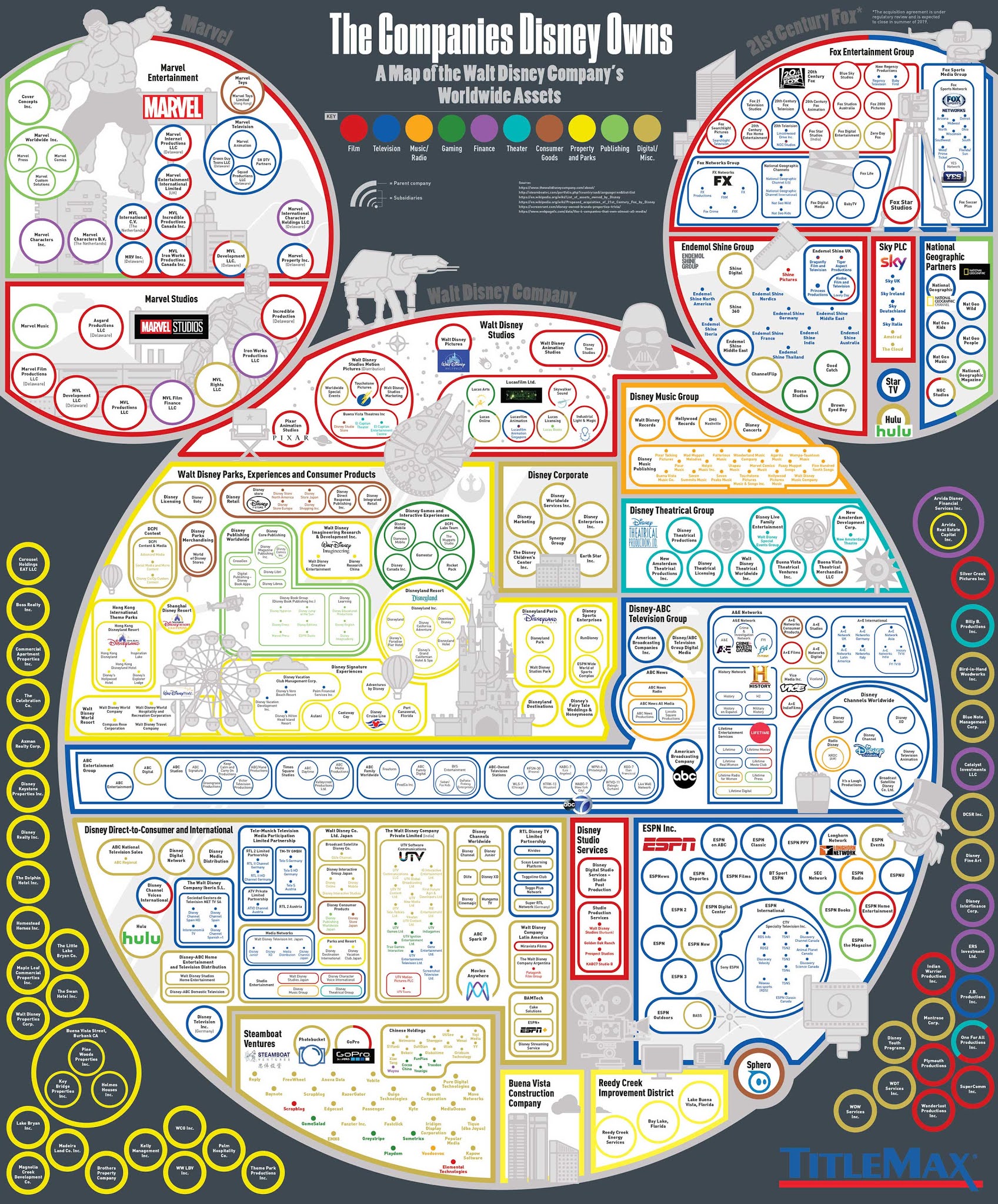
            It might be difficult to imagine, given that Disney today fluctuates between the first and third media conglomerate in the world, but in the early 1980’s the company was going bankrupt (Giroux and Pollack 2010). This staggering fact is only seconded by what it reveals: that Disney went from near bankruptcy to a major producer and owner of media content in only 36 years. As of this writing, Disney holds around 30% of all media, alongside 3 other companies (At&T, Viacom, and Comcast).  This huge turnaround into bureaucratic capitalism, exploitation, and the profit motive above all else was the work of two men. Michael Eisner, and later, Bob Iger. Under the supervision of Eisner and (later) Iger, Disney became more than just a household name, they became the producers of culture. A culture that normalized irrational bureaucratic policies that dehumanized and exploited both workers and consumers.

            When Eisner came on as President of the Walt Disney Corporation in 1984, he was the first to recognize that “pop culture was soft power” and that Disney should center itself as a major producer of US culture; thereby educating and entertaining children to become lifelong customers of the Disney brand (Giroux and Pollock 2010).  This is what is known as Brand Loyalty, a marketing term identifying the desired psychological state producers want in their consumers; a commitment to buy their products. This commitment is created by the status that is attached to the brand, the social belief in its superiority regardless of its contents, and for nothing more than the name recognition of the brand itself.

            Under the yoke of Eisner and (later) Iger, Disney became “ the new face of corporate power” shaping the companies identity as the “ paragon of virtue and childlike innocence”  with the social and historical context of each age, through cutthroat corporate policies and perspectives (Giroux and Pollock 2010: 27).  Since the 1990’s, Disney has been acquiring companies and folding in their content into their ever growing stable of intellectual property, media distribution and Property.  Currently, Disney is worth 130 Billion dollars encompassing Parks, content, and companies leading to one of the biggest Monopolies in the US. This happened, in part due to a political and economic shift in the 1980’s and the apathy of a consumer culture.

            The election of Ronald Regan in 1980 began the intense deregulation of corporate control.  The process of Market Globalism, by Regan and Thatcher allowed corporations (including Disney) to use other countries as their own personal labor farms.  This specifically led to the exploitation of the labor force in the development of sweatshops; factories with unsafe, unhealthy working conditions where the workers are worked to death for slave wages.  This is a common practice in several industries; many which Disney are involved in. Additionally, through their corporate pedagogy of complete control, Disney shapes the understanding of the countries and cultures their workforce represents, for the patrons of their parks (which are normalized to be white)[7]. 

            Through its theme parks, produced content, and products, Disney participates in a revisionist history. It continually presents racist aspects of the past as folksy and charming, while mining the history, values, and norms of a variety of non-white cultures, as well as whitewash and sanitize them, for the consumption of white middle class America.  Whether this is openly having racist caricatures in its films ( Song of the South, Lady and the Tramp, Dumbo, Aladdin etc.), lack of representation (many characters of color being played by white actors) and acquisition misfires (trying to trademark Dia de los Muertos);  to non-diverse themed areas in parks (Main Street USA, Adventureland, Frontierland and Tomorrowland) which “implicitly proclaims the triumph of white culture”, and sanitizes the experiences and history of people of color from their presentation, organization or operation (Giroux and Pollock:41). This is the successful recreation of the myth of the 1950’s (and its false imagining of the future), an oversimplification and commercialization of the past that couches everything in an American ideological spirit, that only reflects the experiences of middle-class white folk, Disney’s target audience.   

            According to Giroux and Pollack (2010), through these actions, Disney has contributed to the collapse of history in the public discourse, and replaced it with entertainment and commercialism to the point where we cannot tell the difference anymore. This is a part of the transformation of reality to “Hyper Reality” (Baudrillard 1994).  We generally think of Disney, regardless of what it is, and where it is located, to be its own continuous entity.  One can recognize that they are always in the presence of something that is Disney. There are particular sights, sounds, and even smells that become quintessentially associated with Disney; regardless of what these things were before being incorporated into the Disney brand (words like “magic”, “Mickey” and “wonderland” ).  According to Baudrillard (1994), these are representations of the simulacra and simulacrum. Nothing Disney has, or what is represented in its theme parks, is real. From the interactions “guests” have with “cast members”, to the street they walk on, the buildings they patron, or even the air they breathe, is fake; all while not recognizing that they are still in the state of either Florida or California…they are at Disney. Yet, the relationships customers forge with their family and the experiences they have are real. Therefore, the image of reality that Disney presents, is one that is more desired and embraced by the public rather than the seedier reality of a global corporate monolithic monstrosity. “Disneyland is more than fantasy because it now provides the images and narratives based on which America constructs itself (Giroux and Pollock 2010).  That is, unless you’ve worked for Disney.

            Historically, Disney not only underpays and creates unsafe working conditions abroad, but continues these practices domestically in its stores and specifically its theme parks.  Giroux and Pollock (2010) note that Disney disseminates an authoritarian ire to many of its employees, requiring standards of quality and behavioral control that encroach on personal freedoms, and borders on human rights abuses. “Every behavior and action, from how one dresses to how one responds to questions raised by guests, is scripted by someone of higher authority” (Giroux and Pollock 2010:49). Additionally, there have been several reports of Disney employees having to be on government assistance due to the Disney practices of union busting and lobbying to maintain a low minimum wage. On top of which, Disney furloughed over 32,000 (minimum wage) workers due to a “loss of revenue” during the COVID-19 Pandemic.


Disney and The Princess Culture

            Since their first animated film, Snow White, Disney has been a major purveyor of what Peggy Orenstein (2011) identifies as “The Princess Culture”. The Princess Culture can be defined as the patriarchal framing of gender roles that encourages girls to embrace a passively subservient role to men. To that end, girls are encouraged to focus on the care of their male partner , completing domestic chores, and only developing their identity in regards to achieving erotic capital within society. Orenstein (2011) chronicles her daughter’s descent into this abyss of glitter, pink and acquiescence that, because of the monoculture of Disney, and its far-reaching manipulation it has over gender socialization, seems unavoidable. This becomes so ubiquitous that the words “girl” and “female” begins to equate to subservience and superficiality that results in internalized forms of sexism. And, since the target age demographic for the princess culture is several years younger than the ages depicted, this internalization happens early.  The classic examples of the princess culture are from Disney (particularly the Renaissance period) and have completely consumed how girls feel about themselves, and how they should interact with the world around them.

            Ariel vs. Ponyo

            Since Disney’s The Little Mermaid and Ghibli’s Ponyo are stories that are adapting the same source material, it is beneficial in this sociological critique to look at the differences in the gendered messages presented in each film.  Yet to do that, we need some sociological and historical context.

 Gender socialization is the process by which individuals learn what it means to be male, female, masculine, feminine, and trans, within a particular society. The understanding and implementation of the existent gender spectrum is variable based upon the cultural, institutional, and political dynamics of a particular country. Indelibly, some cultures are more progressive than others, and as the case in the US, “progress” is mainly optical and always at a cost, for profit.

            As previously mentioned, since the “monoculture” corporate direction was charted by Eisner in the 1980’s, Disney has been interested in controlling the culture and development of children to create lifelong consumers, who will spend hundreds of thousands of dollars throughout their lives on a variety of Disney products. Therefore, Disney has purported to not just sell their image of childhood innocence, but provide models for social groups and identities, especially gender (Giroux and Pollock 2010). Yet, many of these retrograde gender messages outside of an academic critique, have either been ignored, explained away or rationalized rather than taken seriously in the public discourse.


             Disney’s Ariel, the titular “Little Mermaid”[8] is depicted in line with Orenstein’s (2011) critique of the princess culture. She is a young, white, cisgender heterosexual who is, at the beginning of the film, an adventurous scavenger with a wonderful singing voice. With this set up, Disney had the ability to craft a coming-of-age story where Ariel struggles with creating space for herself, while learning how to be part of a royal maritime family. Instead, under the patriarchal framing of the princess culture, in rapid succession, she sees a man[9], falls in love with him (without ever meeting him),[10] trades her voice for legs[11] and tries to win him over.  Now, even with this cringey sexist set up, the creators could still give this film more progressive messaging of how changing fundamental parts of yourself (especially your favorite parts) for someone else is wrong, that love does not exist before you interact with someone, and girls and women should not silence themselves in hopes that a partner might like them.  But the film does not do these things. They do not present Ariel’s actions as a cautionary tale[12], they present it as a guide.  

1989’s The Little Mermaid, and the Disney princess culture more broadly, has continued to recreate the typical gender messages that girls receive in our culture. These messages are usually coming from a limited binary understanding of the gendered spectrum framework.  Girls constantly get the message that their value is in their bodies; either as a sex object[13] for male pleasure[14] or as a vessel for the next generation (reproduction) in which, during said gestation, a woman’s body is forfeit.  While some of this gender messaging has changed, presenting girls and women with an alternative, more agency focused representation in recent years; that does not eliminate the princess culture itself. Additionally, a lot of that “more progressive” messaging happens much later than one’s introduction into the princess culture, so there is an amount of “deprogramming” that must go on. This is of course if those “progressive messages” aren’t tropes in and of themselves, which maintain the delineation between the various dichotomous cages girls and women find themselves in. Whether that be: the virgin/whore, wife/mother, “strength”/compassionate, to “have it all”/ sacrifice. Then, set women up to fail, by requiring them to do and be all of it.    

Ghibli’s and Miyazaki’s Ponyo avoids a lot of the sexist traps by skewing the ages of the characters in their “little mermaid” to be considerably younger[15].  The love that develops between Ponyo and Sosuke is never interpreted in a crassly sexual way; but in the way that a child’s innocence allows for full emotional investment and acceptance. However, regardless of the age difference, Miyazaki still gives Ponyo more agency, drive, and determination than Ariel ever had. Ponyo and Sosuke meet and share a whole day together, cementing their bond when Ponyo is still a goldfish. She actively expresses her affection for Sosuke (and ham). Her rebellion begins when her father takes her away from Sosuke; at which time she not only decides that she wants to be human, but she escapes to be with Sosuke.  At every turn Ponyo’s actions are her own, and Miyazaki shows her parents not trying to regress this rebellion but accept it, allowing Ponyo to make her choice as long as she knows the overall consequences.  This is a princess story, like the other “Ghibli Princess” stories, rewards the determination, anti-establishment rebelliousness of its heroine. It does not minimize her desires or encourages her to be less than herself for the attention and affection of someone else.  It is the antidote to Disney’s poison.


Half-Hearted, Transparent attempts at Reconciliation  

            Recently, Disney has made attempts to rectify some of their sexist and racist imagery in the name of inclusion and focus on diversity. This change is less about equality and more about the commodification of social justice for profit.  Philosopher Savlov Zisek (2009) discusses this tactic as “cultural capitalism” in which a person buys a product and included in it is the ability to not feel like a consumerist. Thus, through the process of purchasing a product you ultimately become a philanthropist, because through “ethical consumerism” your money can be used to support ideas, causes, and people you believe in.  Feminist and Cultural Critic Andi Zeisler (2016) takes this a bit further when she recognizes how social movements like Feminism, anti-racism and environmentalism becomes commodified in a series of identity displaying products; (think of BLM hats, Che Guevara shirts, environmentalist pins, etc.) reducing the overall discourse around activism to be nothing more than a shopping spree. This disrupts social change, that might be a danger to the monolithic corporate control, while still allowing corporations to profit off the individuals that are protesting them.  Disney has repeatedly done this with issues surrounding gay rights, representations of race, feminism, disability, and religious and cultural diversity.  These changes that are made, are not because they believe in the cause of these social groups, but because they find it lucrative. Therefore, they only make the change if they believe said change will be profitable, the minute it isn’t, the messaging again becomes regressive.


            Additionally, Disney has also attempted to deflect criticism from its Princess Culture by having newer characters point out their own sexism, while still reproducing it. The latest example of this is in the character of Vanelope Von Sweets of Wreck-It Ralph and its sequel Ralph Breaks the Internet. At the end of the first film, Vanelope is revealed to be a Princess, but rejects all the trappings of “the princess culture” that Disney has peddled for decades. This acts less like an indictment of the culture, and more like Disney trying to capture the attention and money from girls that have never identified with the princess culture itself.  Disney continued this faux deconstruction of its brand by having Vanelope meet all of the other Disney Princesses and comment on the sexist misogyny in their stories. This again plays more as a deflection through humor rather than actual contrition. In this short 10-minute sequence, Disney gives their princesses more agency and action than in any of their other solo films combined. This also does not change the fact that they are still profiting off of and reinforcing all of the sexist misogyny in the previous Princess films. They, like any corporation, are trying to have their cake, and eat it too.     


CONCLUSION

            Ponyo is a celebrated masterpiece of animation. It is Miyazaki confirming, yet again, the benefit of two-dimensional hand drawn animation in storytelling. The care, craft, and artistry of this film are unmatched. Additionally, this is the best adaptation of the “Little Mermaid” story I have seen, allowing for more positive gender messages than the regressive gender norms touted by Disney’s version (even at the time it was created). For this reason, the overall track record of Miyazaki, and the monolithic entity of bureaucratic corporatism that Disney has become over the last 35 years, if anyone needs to see a “Princess” film, I am more than happy to recommend a “Ghibli Princess” over the morally dubious Disney versions.       


REFERENCES

Baudrillard, Jean 1994. Simulacra and Simulation Michigan: University of Michigan Press.


Giroux, Henry A. and Grace Pollock 2010. The Mouse That Roared: Disney and the End of Innocence Updated and Expanded edition. New York: Roman and Littlefield.


Orenstein, Peggy 2011. Cinderella Ate My Daughter: Dispatches From the Front Lines of The New Girlie-Girl Culture. New York: Harper Publishing


Zeisler, Andi 2016. We Were Feminists Once: From Riot Grrl to Covergirl, the Buying and Selling of a Political Movement New York: BBS Public Affairs


Zizek, Slavoj 2009. First as Tragedy, Then as Farce. New York: Verso Publishing


[1] I would like to think it was a lot of the misogynistic and sexist tropes in Disney’s Version of The Little Mermaid that was what pushed Miyazaki over the line. A Sort of equivalent of: “We’ll what Disney did was a sexist piece of trash, and everyone thinks my son has surpassed me. “Hey Suzuki, hold my Tea, I am going to take all of these people to school

[2] Yes, Kathleen Kennedy which would later go on to help the Disney Branch of Star Wars.

[4] Shout out to David Sims of the Blank Check podcast who, in their Ponyo episode quips that Lisa (Sousuke’s mother) see Fugimoto and immediately assumes that he is a pedophile ushering Sosuke into the car as quick as she can. 

[5] Phrase often used on the Podcast How’d this Get Made?

[6] Nausicaä, Sheeta, San, and Poyo are Ghibli royalty  

[7] EPCOT World Showcase

[8] The use of the word” little” in the title is pejorative by itself; when you are talking about a teenage “girl” it also adds a level of creepiness to it. 

[9] Eric is like 26 right?

[10] Though we could all argue she is just horny

[11] Analogous to plastic surgery

[12] Yes I did have the urge to write “tail”. 

[13] Do not look at Ariel deviant fan art

[14] Female pleasure including masturbation is rarely part of the narrative

[15] For comparison Disney did the opposite of this for their animated feature on Pocahontas aging up the 12-year-old historical figure to someone in their twenties


Saturday, September 12, 2020

Comics Cultural Collateral Damage: The Tragedy of 'The Eastrail 177 Trilogy'


INTRODUCTION

                Filmmaking has always had to contend with capitalism. Not only did film become a rich contextualized way to tell stories, but it was also beset by the whims and fancies of corporate executives that steer the film industry toward any direction that results in profitability. This devotion to the dollar (or other forms of currency) has historically guided film culture to the creation of various genres. These genres are the result of the reactionary nature of the business of film.  When something “works” (is profitable) we see it repeated, renovated, and regurgitated; turned over and churned out until the rich nuance becomes bland. Spent. Empty. This has happened with musicals, westerns, film noir, crime dramas, and now, the superhero film.[1] We are currently witnessing the over tilling of the superhero aesthetic, much in the same way it has been done in the past. Yet, because history rhymes, rather than recited, it always develops a little differently than before.  What has allowed the superhero genre to have a (strangle) hold on film culture is the way in which the spectacle of the superhero film fuels the profit motive of the industry; to the point that every major studio tries to option the next IP that may even have a hint of a superhero flavor. This, coupled with the rise of social media, and its incorporation into subcultural fandoms, has lead the superhero genre to become its own monoculture; thereby voiding out any depiction or analysis of the medium that does not fit with its myopathy.   


THE SUPERHERO ADDICTION

 Origin
           
            In the beginning, before the bombast and the heavy CGI laden visuals that mask simplistic writing and wooden dialogue, film culture has been a predominant space for whiteness and the celebration of white stories. This is important because the origin of this addiction is in the rise of geek culture which has also presented itself mostly as ethnically white. There are more white characters in comics and geek culture, and characters that present as white, than there are characters of color. Even today, many characters of color are obscured in secondary roles in stories. If they are prominent, they primarily exist in the independent comic scene. The irony of this is that a lot of comic stories appropriate the culture and struggle of people of color and then give it to white people. The clearest example of this being the Civil Rights struggles of Dr. Martin Luther King Jr. and Malcom X were appropriated and given to two white leaders of super hero teams: Professor Xavier and Magneto who, in the beginning, lead all white teams against each other.
            The appropriation of diverse racial culture into the predominantly white geek space is correlated with the seeming alienation of non-traditional masculine men.  In film culture until the late 1970’s the image of masculinity was the white masculinity of John Wayne, Elvis Presley and Humphrey Bogart. This alienated a lot of other white men from feeling represented. This feeling may have given some white male filmmakers a false since of kinship with people of color and other marginalized groups during this time, resulting in not only the aforementioned appropriation, but the rise of the “playing the white ethnic card” practice. Typically, “the white ethnic card” is played when a white individual uses their ethnic heritage to minimize the struggle of people of color as a part of the “natural” process of assimilation. This is using symbolic ethnicity[2] to deflect accusations of racism and racial bias; while at the same time, co-opting the struggle as something that is “American”.     
Starting in the late 70’s, you started to see a shift in the type of (white) masculinity. It is this shift (particularly in the work of Lucas and Spielberg) that paved the way for a generation of white male geek masculinity to flourish on screen. Through the 1990’s this geek masculinity (a version of the equally terrible beta male sexism) was percolating just beneath the surface. Waiting in the fringes for the technology to improve just enough for the doors to the studios to open. Once it did, the reservoir of toxic sexist behavior that was left unregulated[3] was released.  This geek masculinity still sexualizes and objectifies women, still promoted violence as masculinity, and promoted anger as a chiefly valid emotion. Yet, the difference is that this is done with an air of intellectual superiority to both women and traditionally sexist men. It is this type of sexism that is at the core of the geek culture that has consumed all the mainstream film culture, leading to a modern superhero addiction.


Impact of social media

            Social media has allowed for individuals to break geographic boundaries to build cyber social networks. In Sociology, a social network are the social links that people create through relationships that intertwine with others.  There are direct connections (individuals that you have a personal connection with) and indirect connections (the individuals you are linked through an association with another person).  The more people you meet and make connections with, the broader your social network.  A cyber social network through social media is wide and vast. We can create connections with more people than we have personally met in our entire lives.
Social media followers are a perfect example. A person may have a million followers on a certain social media platform which is quite difficult to do in person. While the overall vastness of both this concept and practice of social media can overwhelm some people, Social media has a way of making these groups smaller through the creation of specific subgroups to join or things to follow. Thereby curating (and siloing) your social media experience through the tracking of a person’s online presence by corporate consumption of meta data[4]. Individuals can be in their own private echo chamber of thoughts opinions and ideas that shall be supported and never challenged.
It is the challenging of these ideas, especially in fan culture, that receives the most visceral of reactions.  These reactions are the result of an unchanged reference group. Sociologically, Reference Groups are the collection of individuals in our life that we use to evaluate our own behavior.  These people change throughout our lives. Members of our group can be different based upon our age, or what social task we must perform. Our reference groups change as we acquire new and different skills and tasks throughout our life and as we age. We also reject members from our groups if they fail to maintain the standard by which they were included in the group in the first place. For example, your boss might be in your reference group because you believe that he is honest; but then you catch them in a lie. Consequently, you remove him from your reference group and find someone else to fill that position. Thus, the fluid nature of our reference groups keeps us from forming a too strong of an attachment to these members (outside of direct family members).  However, in the case of fictional characters in media, they often can cling to a person’s reference group due to the continuity of character writing and development.  If a character is written consistently for generations, then a person can have that character in their reference group for potentially their entire life. This puts a lot of personal investment in a fictional character to the point where any criticism or break in (perceived) continuity for the character, will be taken as a personal attack on the individual fan themselves.  This is why the writers for the Hydra Agent Arc of Captain America got death threats as did Director Rian Johnson for his depiction of Luke Skywalker in The Last Jedi. While this has continued to happen repeated for as long as fan culture has existed, social media tends to compound the problem exponentially. As indicated when the comic fan culture took aim at Martin Scorsese.
In an op-ed for the New York Times published Nov 4th, 2019, modern movie master Martin Scorsese explained why in an interview he stated that Marvel Movies Aren’t Cinema, and that he did not care for them.  The crux of his argument is that Marvel films (he does not speak to the broader Superhero Genre) do not have any “revelation, mystery or genuine emotional danger. Nothing is at Risk.” He goes on to believe that all the sequels and connected universe building is just giving the audience more of the same. While this might be bad enough, Scorsese fears that because of the success of these films, it may cause studios to drift away from independent cinema because it is not as profitable. He is worried that to focus on ONLY Superhero films will lead to the death of cinema itself.  The article, as of this writing has over 1900 comments, many of them overly aggressive and criticizing Scorsese for his opinion, going so far to make ageist comments and unprovoked criticism at Scorsese’s body of work.  When the internet equalizes all opinions, it lowers the level of discourse in spaces like social media to the lowest common denominator.  


        Why Marty was Right

For Superhero film historians the (post) modern superhero film culture we are currently living through began in 1998 with New Line Cinema’s release of Blade. Before this, film had dipped its toe in the superhero waters with only culturally well-known characters like Batman and Superman, but never drifted cinematically outside of this very narrow box.  Yet, regardless of Blade’s success, it did not spark the fire that was needed to get “the superhero genre” off the ground until the release of X-Men in 2000 by the now defunct 20th Century Fox.
The proverbial pebble that starts a landslide, X-Men (and its film franchise) led to the Sam Raimi helmed Spiderman Trilogy, Ang Lee’s Hulk and Guillermo Del Toro’s Hellboy duology. Still, the trepidation and lack of guidance from producers and filmmakers kept the genre a float, but did not maximize its full capitalistic potential until it broke the “billion dollar gross” ceiling with  Nolan’s The Dark Knight Trilogy and the entire Marvel Cinematic Universe . This is when super heroes went from a sample on a tasting menu of unique films,           to the cinematic experience of k rations 

This analogy is pointing to the homogenization of content and products through the process routinized bureaucratic capitalism maintained by a colonial style globalization that leaves us with volumes of goods with little value.

As I mentioned in a previous essay:

 In 2004, [George] Ritzer came up with a term Grobalization- to define all of the macro level rationalized dehumanizing practices of the process of globalization. Ritzer and [Roland] Robertson (separately) came to the conclusion that Grobalization- produced “Nothing”. Nothing was defined as anything that was devoid of unique and distinct content, homogenized to appeal the broadest audience possible. “Nothing” is the chief product of mass production; the foremost architect of mass production are corporations. The profit motive that drives corporations leads to the inevitable production of nothing because Nothing is safe, it does not take a social or political stance. Additionally, because of its lack of focus, more advertising dollars are put in to the selling of ‘Nothing’ because advertisers have to “Manufacture desire” for that thing in the minds of consumers (hence the pitch towards a synergy of content). Therefore, instead of “something’ people want various forms of ‘Nothing’ A product that gives the illusion of both quality and content, (the illusion that it is in fact ‘something’ when it is not) while making it easier for producers to create something for the broadest and simplistic tastes.


 This is what the Superhero genre, guided by massive corporations like Disney and Time Warner, has produced; content that is so monetized and standardized that it is devoid of life (with only a few exceptions)[5]. The inevitable success of ‘Nothing’ causes its reproduction. If something is reproduced enough, it moves from a subcultural component to a part of the dominant culture. Thanks to Disney, people know who Captain Marvel, The Guardians of the Galaxy, Black Panther and Thanos are. Before the Disney films, these names were only whispered in hush tones in the basements of geeks.  Now, they are becoming as recognizable as Batman and Superman. 
Most major food manufactures are chasing “the bliss point”. This is the optimization of sugar salt and fat which maximizes deliciousness and results in mass consumption. One of the reasons this Grobalization of comic book content has led to the proverbial “Nothing” is because Disney has cracked “the bliss point” of cinema.  It is the combination of sensory stimuli, emotional engagement, and social distraction that keeps the audiences rolling in to see stories that are  similar to one another .  This is cinematic junk food; and in small portions, this junk food is tasty and relatively harmless. However, when you make junk food a major staple of your media diet, it results in our film culture becoming gluttonously sick. We are addicts in need of detox.


CASE STUDY: THE EASTRAIL 177 TRILOGY

            The Eastrail 177 trilogy is the uncommon moniker for the three films in M. Night Shyamalan’s Unbreakable universe. Those three films consist of Unbreakable (2000), Split (2016) and Glass (2019). This is an interesting case study for understanding the impact and oversaturation of geek culture in film because:
1.      The Production of the Trilogy spans the time before and after Geek culture invaded film.
2.      The Trilogy was one that was not planned out ahead of time with unflinching rigidity

Film Synopsis


Unbreakable

This film follows the story of security guard David Dunn (Bruce Willis) who survives a deadly train crash (Eastrail 177) without a scratch. He is later approached by an eccentric comic art collector Elijah Price (Samuel L. Jackson) with brittle bone disease who questions his mild-mannered demeanor.  Through their conversations, and uncompromising support from his son, Joseph, David begins to realize the true power that he has always had.


Split

Casey, a social outcast high schooler is given a ride home by a few classmates when the three girls are abducted by a man who seemingly suffers from DID (Dissociative Identity Disorder). As Casey looks to find a way out, Kevin, their captor (James McAvoy) begins to prepare for the birth of a new personality. As preparations commence, Karen Fletcher, Kevin’s psychologist concludes that he was misdiagnosed, Rather than DID, he is a supervillain with 10 of his 23 personalities adopting the moniker “The Horde”; and their leader proclaimed as “The Beast”. Upon hearing this, David Dunn (Bruce Willis) sets his sights to capture him.


Glass

Set three weeks after the ending of Split, David Dunn and his now adult son Joseph track “The Horde” just after they abducted a group of female cheerleaders. As “The Unbreakable Man” confronts “The Beast”, their conflict is cut short by Dr. Elie Staple who captures and incarcerates both men in Raven Hill Memorial Institute, believing their super heroics/villainy to be nothing more than a delusion. Once there, David finds out that one of the institutes longtime residents is none other than Elijah Price (Sam Jackson). With all his pieces now on the board, the self-aggrandized “Mr. Glass” puts his true plan into motion.


            There are 35 pages and 124 illustrations in the average comic book.
A single-issue range in price between $1.00 and $140,000.
172,000 comics are sold in the US Every day.  Over 62, 780,000 each year.
The average comics collector owns 3, 312 comics and will spend approximately one year of their life reading them                                                          
                                                                      The Opening Text of M. Night Shyamalan’s Unbreakable 


The opening text of Unbreakable is a good indicator of the state of comic books and the comic book/superhero medium in film twenty years ago.  The audience needed to be primed with the overall profitability and popularity of comic books and superheroes to be engaged with the story.  It is almost as if in this opening Shyamalan is saying “Trust me. The story I am about to tell is legitimate.” Today, this seems quaint, and baffling that such a film would need to be legitimated considering the monoculture of the superhero films now; and especially ironic that Shyamalan had to argue with Disney (The Parent company of Touchtone Pictures) to allow this film to be about superheroes and marketed as such. This is because, the film was in production in 1999 well before “the official” glass ceiling of Superhero films was broken with X-Men July of the next year.  Since Unbreakable was released in November, 2000, it is an interesting thought experiment to ask if marketing it as a Superhero film would have made a difference? When you compare Unbreakable to X-Men, the latter certainly looks more comic book than the former. Yet, the whole premise of Unbreakable is how comic books evolved out of myths and storytelling which exaggerated the abilities of superpowered people. So, from the beginning, Unbreakable was unconventional superhero story one that seemed to be more analytical than most, an academic analysis that gets both lost and unappreciated in the near two decades since.
In the time between Unbreakable and Split the comic culture enveloped most media, taking comics from a fringe interest to mainstream acceptance. In comparison to the data cited in the beginning of Unbreakable, as of 2019, the comics industry generates, in North America alone, around 1.21 billion dollars annually. This is a combination of single-issue comics, graphic novels, trade paperbacks, and digital comics. Yet, during the time of Unbreakable’ s release, Marvel was in the process of mortgaging their character’s licenses to avoid bankruptcy. The question is when and why did it change?
The beginning of the Monoculture of comics began with the corporatization of comic characters. When characters began to be acquired by major corporations (WB, Sony, Disney), and those characters started to become successful, those corporations began to give us more of the same. As I alluded to earlier, there is an inherit flaw in Capitalism that causes profit driven media corporations, and the people who run them (mainly white men), to squeeze every ounce of financial capital out of all intellectual property they have. For example, when you compare Marvel Phase one with Marvel Phase four, there is a gradual decline in the tier of characters along with spreading them thin over an interconnected universe that spans many types of media platforms (film, television, shorts etc.)

Geek Aside
Ok, I know many Marvel Zombies that may have read that statement and now have a huge geek beef. Sigh. I am aware that a lot of the characters in Marvel’s Phase 1 were not considered upper tier in the comics until the movies were successful (Iron Man being the prime example), and that their most successful character in the comic books at the time was off limits because that character (Spider-man), and all of the characters associated with him, were owned by another company. Yes, Marvel had to make do with what they had left and what toy manufacturer Avi Arad didn’t set up yet at other studios. But again, this comes back to capitalism. If you always need more profit, and you use up a character, (this is particularly pertinent when considering movies, how long they take to make and the natural aging of actors.) you are bound to find other “revenue streams” (characters) on which to exploit.

Before and After the Invasion (Continued)

 Yet, because Unbreakable was produced and released before comic book legitimation by the corporatization of superheroes, it is a time capsule of how comic books were treated before all of this. It harkens back to a time when going to a comic book show had the same amount of shame as an adult bookstore. The entrance to comic book shops were in weird alleyways and your “stash” would be wrapped in the all too familiar black plastic bag. Comic book fans up until the 2000’s (really the 2010’s) were the bullied. This did not change until the economy shifted, and we saw a rise in tech based white collar jobs (not to mention the Silicon Valley dot com boom of the 90’s). This is because there is a strong overlap between comic book enthusiasm and school academics, particularly computer technology. So, it stands to reason that when that the cultural interests of those individuals who now were in high status positions, the subcultures they were interesting and a part of would also be elevated. Unbreakable just came too early for the culture to truly appreciate it, and because it wasn’t linked to a preexisting IP, it did not stick around in the public consciousness[6] Thus, it was forgotten in the mainstream public for 19 years.


The Unplanned Trilogy: Insurgency, Archetypes, and subverting expectations

 In interviews, M Night Shyamalan always said that he had ideas for an Unbreakable trilogy. Shyamalan has stated that Unbreakable was the origin of a superhero who would have a peak then fall. Originally, Unbreakable 2” was going to center on David Dunn tracking and capturing “The Horde”  Then, because a series of cinematic setbacks, Shyamalan was hesitant to dip back in, at least directly. So, he conceived the next film to be stealth sequel and as a super villain origin story. Yet, only marketed Split as a psychological thriller, without mention of what universe the film lives in, allowing the film to stand on its own two feet. However, because Shyamalan is a master of hyping his own work, he used the inclusion of David Dunn at the ending of Split to test the audience interests for Glass. The reveal and subversion went better than Shyamalan expected, going so far as to increase the positive word of mouth for Split, thereby raising ticket sales and green lighting the final chapter in the “trilogy”.  Unfortunately, unbeknownst to both Shyamalan and the audience, their expectations have crystalized into a desire he was not willing to fulfil.
The reaction to the end of Split is partially a function of, and reaction to the ingrained mono comic culture that we live in.  When the camera pans and reveals David Dunn in that diner at the end of Split, audiences are expecting the next film (Glass) to be an exclusive clash between Dunn and Crumb, in the spirit of the comic book culture to which they have been conditioned. Instead, they got a dissertation, the thesis of which was far more contemplative than the audience expected. Through this (albeit shallow) academic analysis, (That was, to Shyamalan’s credit, consistent with the tone and world he set up in Unbreakable) Shyamalan deconstructs comic books and comic book storytelling that has, in the interim, tapped into our basic instincts and feeling of childlike wonder, to become a touchtone of modern cinema. In short, the problem with Glass is not in the film itself, it is in what people wanted from it. Most people wanted to see a fun action movie where the hero and the villain fight, with the spectacle and majesty that they have grown accustom to. They were not looking for a philosophical meditation on the notion of heroism. They came for a party, instead they walked into a lecture.  

Because Glass was tasked with merging two seemingly independent stories and was written at a time where culture is saturated with comics/superhero content, Shyamalan was purposeful in his design to subvert expectations of the audience. Glass twists the audience into a pretzel as it continually promises, fulfills and undermines audience expectations.  The first twenty minutes of Glass is everything a modern comic book fan would want. A straightforward structure of The Hero tracking The Villain, saving the hostages, and engaging in fisticuffs.  Then, at the beginning of Act II, the film grinds to a halt and starts to ask deeper questions, that given the film’s rotten tomatoes score many people were not interested in asking. As the third act begins to ramp up, Shyamalan teases a huge MARVEL-ous climax that involves fighting in a newly constructed building that may or may not explode[7]. He has the audience again, then has the “showdown” in the front grounds of the institute unceremoniously. This again, is consistent with the thesis from Unbreakable. The fight on the building with thousands of people in danger would be the comic book version about something, that in the film’s reality, took place in a parking lot.  Unfortunately, regardless of this consistency, we have reached a point in the permeation of comic culture, that modern audiences wanted the teased comic book come to life, rather than an introspective scholarly evaluation of the subject.  The result was disappointment. Not for what the film is, but because of the audience’s exaggerated expectations; primed by a culture run amuck, the film was set up to fail.     


Shyamalan Criticism

            The consensus on Shyamalan’s filmography is that he starts out strong in his first four films, but progressively got worse with each film after Unbreakable up until Split. Some of the speculation was that with the success of his first quartet of films, he garnered enough support and trust in the industry that those in production with him did not censure his work. Shyamalan is known for keeping the same people around on his production crews from film to film. This could have had the consequence of insulating him from the limits and criticism from which his best work develops. This all culminated in the atrocious duo of films in a three-year period, The Last Airbender[8] and After Earth. The former being a whitewashed concentrated adaptation of a progressive and much beloved animated show. The latter a stealth Scientology soliloquy.   
If you look at Shyamalan’s filmography a subjective argument can be made that he makes his best work when he has both limits and something to lose.  This is why, starting with The Visit, Shyamalan began to fully finance or co-finance all of his films with horror producer Jason Blum of Blumhouse productions. Shyamalan has mortgaged his house, and re wrote whole scripts while in the development stage and the results of these restrictions were rewarded in renewed acclaim for his films.
One of the criticisms of Shyamalan’s recent work that has merit, revolves around Split’s use of the real diagnosable condition DID (Dissociative Identity Disorder). Many groups in support of those with a DID diagnosis, believed depicting the disorder in this way would add to the already horrible track record Hollywood has for representing mental illness on screen. These groups also presented data on the frequency of DID patients acting violently. In an open letter to Shyamalan himself, the presented data that showed violence among DID patients to be a rarity.  In this regard, there was a missed opportunity in Split’s third act. Shyamalan had already set up the character of Karen Fletcher (played by Betty Buckley) to be on the fringes of the psychological community. Therefore, when Karen confronts “The Horde” at the end of Split, she could have said a simple line of dialogue: “I was wrong.”
Split falls into another trap in the way that it uses the trope of abuse and child sexual violence. In the film, it can be interpreted that the abuse experienced by Casey, “the final girl”, to use horror movie parlance, does “save her” in the end due to the ideology of “The Beast” valuing “the broken” as pure. While this is nothing new, horror movies for generations have played on these ideas. Yet, it is disappointing that in such a progressive age, this sexist tired and lazy plot device would still be used. However, if I am at my most magnanimous, “The Beast” defines her “pure” not because the knowledge of the sexual abuse is made aware to him; but because he sees the scars on Casey’s body from “cutting”, a common coping mechanism for trauma. The Beast is only aware that she has experienced trauma, as he has, but he does not know what kind; the nature of the abuse is only revealed to the audience, which is not necessary. 


CONCLUSION

            For the last decade, film culture has been besieged by comic books and Superheroes to the point that the films that make money at the theater. In 2019, Disney alone made up 33% of the market share for overall ticket sales. Their closest competitor only had 13% (WB).  Couple this with the bureaucratically homogenized way that Disney, and other corporations, consume IP and produce their content, is there any wonder why all (studio) films look the same? These studios also have the marketing budget to make sure their product gets in front of as many eyes as possible.  The result is a negative impact on film culture itself. It has caused the expiation of the best picture categories from 5 to 10, created the discussion of the “popular” Oscar category, and set such an unrealistic bar for success that it has killed mid-range budget filmmaking. I often wonder what “The Eastrail 177 Trilogy” would look like if Shyamalan would have got to create his trilogy closer together in time. What would the Unbreakable/Split/Glass story be, if it did not have to contend with a film culture that is so supported by the “comics off the page” aesthetic? Would it have been better received? I would like to think so; and that is the ultimate tragedy of the whole thing. Because, in the words of Martin Scorsese, “the [filmmaking] situation at this moment is brutal and inhospitable to art.” As it turns out, even inhospitable to other comic/superhero interpretations outside of those owned by giant corporations.    


[1] I wanted to regulate this mini argument to a endnote. There are some that would not define Superhero films as a genre. In this (usually passionate) defense of superhero films not being a genre many will point to several more recent examples of superhero films that are also a crime story (TDK) or an espionage thriller (Winter Soldier). Yet, the same can be said about various films categorized in Drama, Comedy, or Action.  There are certain beats that the Superhero film, regardless of the other genre’s it is intersecting with, that they have which make it a superhero film
[2] Symbolic ethnicity is a term by Mary Waters to describe the particular form of white privilege that allows white people to only be abstractly connected to their ethnic heritage in superficial ways
[3] Nope the comics code does not count
[4] This has become of increasing importance to the film industry because it is a direct line to the consumer. Many actors now may gain or lose roles based upon their social media presence and the number of followers they have  

[6] There was little merchandising and cross platform promotion for Unbreakable to make and keep public engagement in the project
[7] Shyamalan even trolls the audience in a magazine article for the Building by calling it a Marvel in the same letter font and style of the Company/Studio
[8] Personally, due to my love of Avatar and its sequel series Korra, Shyamalan’s film is the worst thing I have ever seen. In addition to the film being poorly paced with too much exposition and wooden acting The film sparked race representation controversies. According to a comprehensive report in 2016 from the University of California  "71.7% were white, 12.2% Black, 5.8% Hispanic/Latino, 5.1% Asian, 2.3% Middle Eastern and 3.1% other",