Showing posts with label Noam Chomsky. Show all posts

Friday, February 24, 2017

Trump, Propaganda and Linguistic Imperialism


INTRODUCTION

 To paraphrase the Sapir-Whorf Hypothesis[1], the structure of language has embedded within it, a particular way of looking at the world. In short, the language that we learn shapes our understanding of the world, our rituals, our culture and customs.  In essence, it is our language that helps to shape our reality. It is also the main mechanism by which that reality is socially constructed.  Furthermore, it is the labeling effect that makes the whole notion of the constructivist argument relevant, even possible. Yet, in order to have any of this construction and organization of society, of culture, through language, it is necessary to have a clear understanding and acceptance of what that language means.  This understanding is broadly labeled a collective consciousness, or collective conscience.  This collective interpretation of the world is often the foundation on which there can be academic discourse, civil discussion and cordial disagreements. We are allowed to have a debate over complex critical issues because we’ve agreed that there are certain concrete truths, which act as a foundation for every social interaction, a baseline we all can fruitfully build upon one conversation at a time.  However with the rise of the Trump Administration and the existence and use of fake news, sponsored content and “Alternative Facts”[2] we have lost the collective conscience.  It was murdered in front of us during the campaign in 2016, and now Dead horse beater President Trump has mastered the doublespeak with such precision that it’s positively Orwellian. To unpack how we got to this space, we need to look at the media as a propaganda tool, whom are those who run it, and some examples of the overall fallout of the media’s duplicity. A fact that President Trump has exploited allowing for the myriad of unprecedented executive orders. The least of which is the Government agency gag order the administration enacted within the first 7 days[3]  


THE PROPAGANDA MODEL

As a definition, the Propaganda Model is an analysis of the media by Linguists Noam Chomsky and Edward Herman whom states that The media’s power[4] is in its ability to persuade. It is that manipulation, often rebranded from the common political adjective of charismatic when applied to candidates, that allows for, according to Chomsky, the “ filter[ing] out the news that is fit to print, marginal[izing] dissent, and allow the government and dominant private interests to get their message across to the public (Chomsky 1988)[5]

Propaganda Model: Five filters
1.      Size, Ownership and Profit Orientation- There are only 6 companies[6] that make up over 93% of all media in the United States. The top companies are Disney (Bob Iger), Viacom (Robert Backish), Comcast (Brian Roberts), Time Warner (Jeff Bewkes), News Corp (Rupert Murdock) 20th century Fox ( Jim Gianopulos),  Honorable Mentions: CBS (Leslie Moonvest (male)) Netflix (Reed Hastings) and Amazon (Jeff Bezos). These companies are run by white men, only seeing the world though that prism
2.      Advertising: License to do business- It is through advertising that many companies “Manufacture Desire” for their product in the minds of the populace. It is through advertising that we are sold the aforementioned large quantities of “nothing” and many of the objects and trinkets we by that we don’t need. Advertisers maintain high consumer demand through Consumeristic Philanthropy which inevitably leads to Commodification and Commodity Fetishism[7]
3.      Sourcing Mass Media News- Major media conglomerates have special access to news and the government. Thus they can literally shape the way that people understand what is happening in the world.  This is heightened to an absurd level in the way that a close relationship with the Government can mean the difference between legitimacy or illegitimacy.

An example of this is when The Trump Administration deciding which news organizations are more reputable than others: Decrying others (that do not side with the administration) as Fake News[8]  This lead to the coining of the term Alternative Facts[9]This is a practice known as “Gaslighting”[10] which is very effective since it is coming from An Upper Class White Male (with all of the privilege that entails) who also happens to be The President. Another tactic is Dog Whistling[11] Which is a common tactic used against people of color.

4.      Flak and Enforces- This is the use of lawsuits and other bureaucratic means to silence unwanted or unpopular opinions in order to maintain social control of the populace. EX: Trump and the Muslim ban Supreme Court case, The gag order for scientific and other research based organizations, Sean Spicer limiting control of the media by sticking to talking points regardless of “facts”
5.      Anti-Communism/War on Terror This is a major social control mechanism. This is when ideological forces are deployed to support powerful investments based upon soci-cultural beliefs. This could be against Communism, Islam, and supporting Christianity (Chick-fila) and Capitalism (Fox News and Starbucks).
6.      *My Addition another filter that has cropped up in recent years is “sponsored content” otherwise known as Native Advertising[12]  This is stories or articles typically written on the internet that can masquerade as news content. Since a Majority of individuals get their news from online sources[13] or Social media, they are susceptible. Especially because recent reports show that millennials passively consume news through social media[14] not requiring any critical analysis. Ads and News become one in the same.

The result of the propaganda model is the manufacturing of consent[15] from the public. In the political context, this acquiescence manifests itself through voter choices. A clear technique of manufacturing consent is Fear Mongering.

Narrative Techniques of Fear Mongering[16]

1)      Repetition[17] “There is something going on.” “Eminent” “tremendous” “Systematic” and Handful[18]
2)      The Depictions of Isolated incidents as trends “They are bringing drugs, they are bringing crime.”[19]  Logical fallacy of a Hasty Generalization
3)      Misdirection[20] Trump used it when NOT condemning David Duke[21] Sean Spicer talking about the Immigration executive order[22]

Manufacturing Consent (Desire) is also a mechanism of the powerful, to control the non-powerful (This theme we will come back to) but this only happens after the people relinquish their power to those in higher status positions by voting or not voting.   

There are two ways that you get people to relinquish their power:
1)      Fear We are living in a tremendous culture of fear that puts us in a constant state of unrest that we will freely give up our civil liberties in order to feel safe again.
2)      Convenience If it means that we can have an easier time day to day. If our needs and desires are satiated faster than before, we are willing to give up our privacy, autonomy and agency. When people are lulled into a state of complacency by the shiny new things and forms of entertainment they have around them, this is a road to social and political apathy
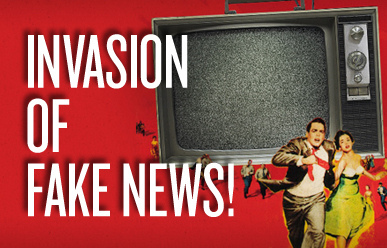


STORIES VS. FACTS

The consent that is achieved through fear mongering tactics polarize people and make the issues not about “facts but about Emotional feelings”. This is compounded by the blurring of the line between factual news stories and editorials thanks to Sponsored content, Donald Trump gained and maintains support regardless of what he says, and no Amount of “facts” will stand in the way of that belief. This is an example of what Sociologist call constructionism

Social Constructionism contends that individuals within society are defining, and therefore creating, the world around them through social interactions as a type of “communal exchange” (Cheung 1997:2).  Therefore, our understanding about the world cannot take place without other people. It is a social process that produces knowledge.

Knowledge, therefore “is developed, transmitted and maintained in social situations” creating a distinct reality (Berger and Luckmann 1966:3) for particular individuals. 
The mantra that is often used to illustrate this in sociology is twofold:
1)      “What is real is real in its consequences” W.I. Thomas
2)      Something has meaning because we (in society) give it meaning  Herbert Blumer    

Media Role in Social Construction

            One mechanism by which we give things meaning is through the media. The media embraces its role as the arbiter of knowledge (what Sociologist call an Agent of socialization) when they are advertising something, they whole heartedly seek to change behavior and self-identity if it means the consumer buys their products. They will clearly link product consumption with emotional fulfillment, gender identity while giving us normalized imagery of Race social class, satisfaction, drive and desire. However, due to the normalization of social media and the rise of hyper subjectivity online (which blurs the line between opinion and evidence) when it comes to politics, many media outlets will give opposing viewpoints, regardless of their scientific or other evidential validity,[23] Or be oddly non-committal in their political analysis thereby passing the buck on the their viewers

What is unfortunate is that a politician who understands this social process (of knowledge production) well, can tap into the emotions of the populace, stoke their flames of fear and ride the tide of tyranny right into office.  Such a politician understands that with a lack of an agreement of what is considered true, belief can TRUMP facts. Yet, the most problematic, and dare I say “deplorable” use of language, is in the obliteration of a group of people and their culture.


LANGUAGE AS IMPERIALISM

According to Michel Foucault, language is a way to organize and is a source of thought (Gutting 2005)[24].  Yet, the type and way we use language produces a different form of knowledge and understanding.  But the very way we use language to produce and organize thought, also limits us; hindering a deeper understanding of the world due to the rules language shackles us with. Thus, the way we construct the world, ultimately leads to our misunderstanding of it.

The existence of any form of inequality is solidified by the absence of language to try and fix it, for more egalitarian language. The American English language’s form of categorization is based on highlighting differences. Because the American value of individualism is embedded in the language that we use.  Therefore, the words that we use to describe our world is based on vagaries of distinction, creating a language that is motivated by separation.  That separation also motivates identity formation, forcing us to define ourselves by what makes us unique, what makes us stand out…the inevitable result of which is a form of toxic competition that fuels the politics of “otherness” (alienation, segregation, discrimination)[25]. Essentially, the language that we use predisposes us to create a structural social system that is unequal.[26] This is then continued on when many people of color teach their child English, rather than their native tongue. This might seem practical given the way that English is accepted and spoken in the world, however this idea can also be reframed as problem. One that sees the learning of English as oppressive and supportive of an unequal racial social structure pacifying people of color through the adoption of white cultural words, words that are given…to oppress people of color rather than uplift them; usually through complacent acquiescence. Thus Language is used as a mechanism of imperialism cultural annihilation and the pacification of the public. There are the all too clear examples of spread English by Christian Missionaries in Non-white countries[27]. The British occupation of India and Australia[28] A practice that is often echoed in the drive for a national language in the United States[29]
 
We are now living in the Upside-Down
CONCLUSION
           
            The Power of the media and language cannot be overlooked, both in its role in the election of Donald Trump or the way he has used it to cast doubt on what objective truth and facts are. For example I do not know if President Trump is personally a racist ( Though there is certainly evidence for it[30]) What is clear though, is that he has been able to tap into the zeitgeist of blue collar white fear, structural racism and xenophobia that has bubbled up to the surface after the election of Barrack Obama.  Since White privilege is invisible to most white people. They believe that their experience, opportunities and access to resources are in line with everyone else, regardless of the truth. This is what is known as the normalization of whiteness (or White Hegemony). Thus, when social movements, the passing of laws and the election of the first “black” president not only makes their whiteness visible, but begins to strip away the privilege they didn’t believe that they had; it creates a backlash that Donald Trump is capitalizing on; which makes him, at the very least, an opportunist. Regardless of his motivations, Trump embodies America in the way that we are only forward thinking not taking the time to look at our past history of genocide, racism, and sexism, while still being racist and sexist through the emulsification of hate into a new subtler aberration; he is the manufactured mirror of our culture that is now clearly visible to all.


[4] Using the Weberian definition of power being “The ability to realize your will even when others resist
[7] the perception of the social relationships involved in production, not as relationships among people, but as economic relationships among the money and commodities exchanged in market trade.
[10] The manipulation of someone by Psychologically causing them to question their Sanity
[11] This is when those in authority use coded language to hide the intention or meaning behind the words that they say. “ urban” meaning people of color “Law and Order” meaning over prosecuting people who attack police, or higher deportation rules “American” meaning white people.
[15] Manufacturing Consent Chomsky Herman
[23] Which can tip their hand to their political leanings
[24] Foucault: A Very Short Introduction
[25] This is different than say other countries that have a more inclusive and communal Cultural heritage that shows up in their language ( Kanji, Mandarin, Russian)
[26] This idea is, in part, an application of Baudrillard’s understanding of meaning based upon difference,  to explain the persistence of systemic structural inequality

Monday, February 16, 2015

Spider-Man, Deadpool, and The Legend of Korra: The Internet's Effect on Entertainment Content and Consumption


The invention and implementation of the internet, and the birth of social media has arguably had the greatest sociological impact since the Industrial Revolutions (1760-1850). For Sociology, and we humble Sociologists ( J), this is a pretty big deal. For it was the social change brought on, in part, by the Industrial Revolutions that lead to the coining of the term Sociology in 1838 by Sir Auguste Comte and the birth of Sociology as a discipline later in 1895 (Thank you Durkheim).  Therefore, I would argue that because the study of society was born from explaining Social change it is only fitting that we use Sociology to study the Social changes brought on by the Internet and Social media.  To that end, I will begin with a brief comparison between the changes brought on by the Industrial revolution and those we’ve experienced through the use of the internet. Yet, the main focus of this piece, given the theme and nature of this blog, will be on the shifting patterns of content creation and consumption we’ve experienced as a result of the changing media landscape using current pop cultural examples.
            The Industrial revolution(s) in a symbiotic and reciprocal relationship with the French Revolution of 1789 (Bastille Day, Reign of Terror) and (to a lesser extent) The American Revolution created a period of social change that transformed society from a pre-modern age into one of modernity.

  Components of Modernity:
-          -  Shift in the economic system. From a Barter Systems of trade, to Capitalism
-         -     New technologies emerged causing an increased focus on industry and production ( resulting in          hydro and steam power, textiles, steel, and increased transportation (sea trade))
-         -    Expansions in Medical Science leading to Population Growth (lower infant mortality)
-          -    Urbanization ( City boom; go where the jobs are)
-          -   Increase in Secularism

This shift was also important for those of us (Sociologists) that study Stratification (usually from a Power/Conflict or Critical Perspective) as it was this shift in social organization and institutionalization that was the beginning of so many forms of oppression and domination that we still see today. In fact, Some Classical Theorists believe, rightly so, that with the birth of Modernity we see the complex transformation of inequality to many forms of intersecting injustices.
Similarly, we see this type of Social change mirrored in the transitional changes from pre- internet age to a post internet age:

Paralleling effects of the Internet and Social media (Abbreviated):
-          Shift in the economic system: Online ordering, purchasing, distribution and banking. The existence and popularity of online currency ( Bit-coin)
-          New Technologies emerge: Social media changes the way we socially interact. 3-D printing, transportation by internet (video conferencing), online data storage, Physical space is less important
-          Increased access to medical records and communication with “providers” rapid test results and distribution of wellness care
-          Digitalization. We have online lives, personas, new notion of personal “branding”…every aspect of our lives is now marketable. Whatwould Marx say about this practice of commodifying ourselves?
-          Ironically, the online space has allowed for both the expansion of Secularism and the revitalization of belief at the same time. Even allowing fringe beliefs to gain support and prominence.

While there are obvious parallels between the change experienced by the industrial revolutions and those experienced with the implementation of the internet; what I am interested in, being both a Sociologist by trade, and a critic of popular culture by designJ, is the impact the “age of the internet” has on our creation and consumption of entertainment.    


            Let me first begin with consumption.  Since the implementation of the internet, the sheer volume of entertainment content has increased exponentially. Not only that, but now more content is available in many different forms (through many different platforms, devices and services). Before, where you may have received your entertainment content through a few different mechanisms ( TV, Radio, Concert/ event, Movies, Theater etc), now it is near limitless Thus, not only are we getting more (which can be attributed to and feed our fetishistic attitude) but we can consume this content in multiple ways (usually through hand held multi-media devices).
            One the most popular ways to consume nowadays is through entertainment streaming services. Pioneered by Netflix, these streaming services (that include Hulu and Amazon Prime as Netflix’s top competitors) allow (for a monthly fee) all access to enormous amounts of content. At first, this only included already produced/broadcasted material somewhere else (Usually in theaters, or on network or broadcast TV).  Now, these streaming services are producing their own original content exclusive for their subscribers becoming, in essence, the new “TV” networks.
 It is this new form of content distribution that greatly impacts media consumption behavior. Since these streaming services often release content all at once (including whole seasons, or in some cases the entire series run of a show), this has given rise to “binge watching” where consumers consume a large amount of content at one time.  This is not only a function of the immediate access through the internet but the desire to complete a particular story.

EX:  In comic book terms episodic consumption is the monthly single issue comic book, where as binge consumption is like having a graphic novel. An example of streaming services for comics would be The Marvel Unlimited App.

While there are many positives to this kind of consumption, (namely allowing for a diversification of content including the more esoteric variety to reach an audience and create a fan base) this also increases our desire for instant gratification to the point where we become content addicts.  Thus, when we have consumed all of the content a particular television program or movie has to offer we go through feelings of loss and withdrawal until more content is produced or distributed, or we latch on to another program (i.e. drug). Also, these states of entertainment distraction and gratification fuel both the Millsian idea of Private Orbits and the Weberian idea of “The Iron Cage”.
            However, what is really fascinating is the way that this new content consumption has actually effected the way content is created and distributed.  In many cases, online grassroots organizing has allowed programs to continue, flourish or be resurrected.

 An Aside: There is a whole other argument I may make in a future post about the lack of online social activism (sometimes referred to as “slacktivism” or “I-pod Liberalism”) for legitimate social causes while there is enormous outpouring of support and dejection anytime a television show may be canceled or new movie news is released.


Recently, there have been several examples where the release of content online, and the public response, has lead to a shift in industry focus.


Example 1: The Interview Controversy and positive and negative fallout of Sony Hack

The Film The Interview staring Seth Rogen and James Franco is a story about a talk show host that is recruited by the US government on a secret mission to kill Kim Jong-un. Because of its premise, The North Korean Government banned the film and sent death threats to its writers and stars.  Sony, fearing bad press and perhaps an international incident, initially pulled the film from theaters and released it online.  This had a two pronged effect. One, it over hyped a film that was (at least in the minds of critics) lackluster anyway and Two: it lead to the very explosive computer hack of Sony Pictures. While the North Korean government denies this, there have been many reports that implicate their involvement.
            Much of the inter-workings of Sony were released online including any potential deals that Sony was working on, namely a deal to share the character of Spider-man with Marvel and a lot of personnel information including bank accounts and social security information. Again what I find interesting is rather than focus on the tragedy of releasing personal information, much of the focus was on the Spider-Man deal.
            According to the leaked documents, the deal with Marvel/ Disney was talked about but then fell through. However, after the hack, what do we see, but Spider-man soon to be part of the MarvelCinematic Universe.  So the conclusion that one could draw is that the hack itself, leading to a Sony regime change, was the catalyst for the deal to actually get made. Which in part could give credence to Sony employees being involved in the hack. So the question is, what was the purpose of this hack? Was it punishment for the premise of The Interview and the Spider-man deal is making the best out of a bad situation? Or was it more deliberate? There is little data (outside of anecdotal evidence and wild speculation) that suggest the latter. However the next example is a little more direct.

Example 2: Deadpool Leaked Test footage


Since 2009’s disappointing portrayal of Wade Wilson/ Deadpool in X-Men Origins: Wolverine. There was always a solo Deadpool film in the works.  The buzz was big leading up to the film and after its initial release. However, news (and public interest) slowly died. Over the years, we would hear about the film in sound bites; That Ryan Reynolds was still attached, about how it had a script (written by the team behind Zombieland ), and how it had a director (Tim Miller).  But it looked like the studio was very non-committal about it being made. 

That is, until this test footage was “leaked” online


Now, The Deadpool film is in full production mode with a release date of Feb, 2016.  All involved accredit the green light to the leaked test footage and the enormously positive fan reaction that followed.  Not only could this be a direct example of how social media and the internet effect content creation, but this could be the function of the studio’s attempt to maintain social relevance in the public sphere.  This begs the question, if studios are desperate to have their finger on the pulse of popular and youth culture (which is nothing new) will we see a few more ideas getting green lit because of social media buzz that, most likely won’t pan out? (ala “League of Extraordinary Gentlemen” or “Watchmen”).  There are though examples of content that is punished for their distribution.

Example 3  The Legend of Korra books 3 and 4


The Legend of Korra is the popular spin off and continuation of the Nickelodeon animation series Avatar: The Last Airbender created by Michael Dimartino and Brian Konietzko.  Both shows have a rabid fan base (see my review of Book 1), so much so that episodes of The Legend of Korra were leaked before the airing of the show’s third season.  This lead to (a continuation of) the mismanagement of the show by Nickelodeon (putting all of the episodes on Nick.com and pulling it from thebroadcast schedule) and slashing the budget for the show’s fourth and final season. This was as if the producers of the show, and by extension, the fans were being punished for their enthusiasm and consuming content in the normalized form of the new digital landscape.


            Finally, it has to be acknowledged that even though the United States is still the producers of the majority of this content, due to globalized Capitalism, Americans are now not the majority of its audience.  Because of the majority of film box office receipts are now acquired overseas (US domestic box officenumbers have been on a steady decline), production companies have now change release dates that reflect that. Now, movies made by US production companies are released in Europe and around the world, sometimes weeks or months before they premiere in the US.
           For all of these reasons we see a shift in both consumption and production of content in popular culture. Some of it is positive, we get more content, and greater diversity, much more of it is problematic (elevating the importance of entertainment over social problems and activism).  As the internet becomes less like the new frontier and is slowly brought under more regulation and control, I wonder how powerful these behaviors will still be. But until then, enjoy the independent gems, while being horrified by the creation of (as C. Wright Mills says) TheMass Society. One where both desire and consent are manufactured.

Rant

I just wanted to take a paragraph or so to rant about the content I consume in general.  I am starting to really enjoy what I call complete content. Content that has a particular story to tell and a particular direction.  One major component of that direction is a satisfying conclusion, an ending. Because there is this thirst for more (mentioned above) this forces a lot of stories to go on longer than they have the content or premise to sustain. When a show or program reaches this point it is commonly referred to as “Jumping the Shark”.  To me something only has value because it ends, the infinite continuation of story or material loses its value, because it becomes a constant. I do not need 10 seasons of a show or 4-5 film franchises, that is way too much. How many TV shows or films in their later seasons/installments are just as good as the beginning?

So here is my proposal:

   1)      The Rule of Three ( 3 films in a franchise only or 3 seasons of 22 episodes each)
    If you can’t tell your story in that amount of time start “trimming the fat”
   2)      Shorten episodic television to 12-13 episodes per season (an example of trimming the fat aka filler episodes)   
   3)      Follow the source material without being married to it. Conversely, fandom has to allow for some “dramatic license when dealing with any adaptation.
   4)      Create something new. New stories, and ideas. Do go back to the same well, Complete something      and then do something different.
   5)      Allow for more diversity. I don’t want to keep seeing the same white able-bodied male               protagonist.  There are other perspectives, find them, create them, use them.

End of Rant